Showing posts with label Blue-tailed Damselfly. Show all posts

Monday, 16 July 2018

Damsels causing distress

I don't know about damsels in distress, but sorting out the little blue ones has caused me some distress over the years. I got the hang of them many years ago but middle age intervened and I forgot more than I had learnt. The long hot summer has brought out the curiosity in me again though so with field guide in one hand and site guide in the other I set off to see some of the scarcer species to be found within striking distance of home in Dorset...
Scarce Blue-tailed Damselfly is on the GB red list - a new species for me
Note the tiny black marks on s9 (near the tail tip) which help identify this species
Finding water on its parched Dorset heathland home was the key to finding this one
Compare the Scarce Blue-tailed above with the 'regular' Blue-tailed Damselfly here
Another new species for me was this Southern Damselfly in the New Forest
The smallest blue damselfly and one of the rarest, it was busting some serious moves
Southern Damselfly can be identified by the 'mercury' mark on s2 (just behind the thorax)...
...and the spear-shaped marks on the abdomen. Compare to:
Azure Damselfly, with a 'beer glass' shape on s2, and...
...White-legged Damselfly - more black on the abdomen and white sides to the legs
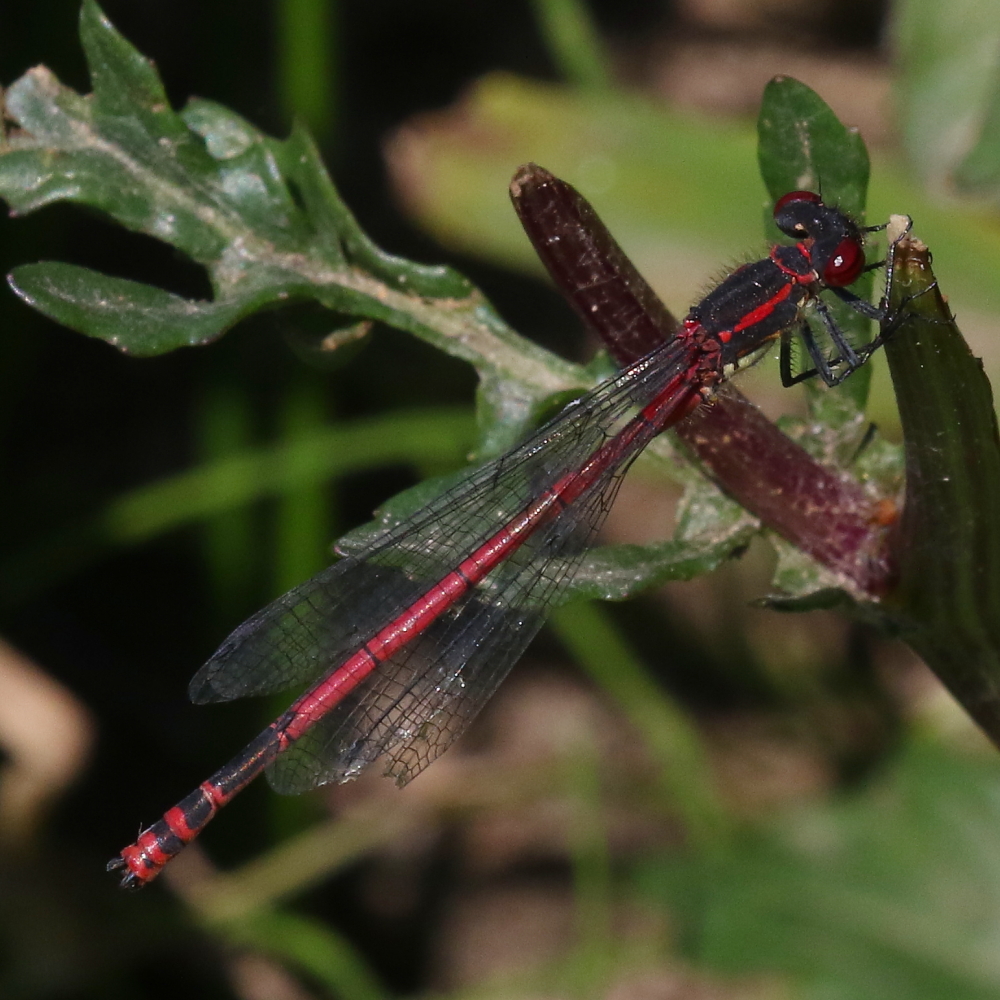
A bit easier was this Small Red Damselfly in the New Forest - an all red abdomen compared to...
...Large Red Damselfly (also New Forest)
Longham Lakes was full of Common Blue Damselfly (which has a 'mushroom' mark on s2)
And after all those little blue jobs, something nice and easy to close: an impressive Golden-ringed Dragonfly in the New Forest
 

Monday, 10 July 2017

Scarlet fever at Longham Lakes

On Saturday evening Dorset birder Martin Wood posted on Twitter a photograph, taken at Longham Lakes, of a startlingly bright red dragonfly, along with a request for help with the ID. Martin is a popular figure on the Dorset birding scene, not least due to his endearing habit of not checking what the auto-correct function has done to his posts before he sends them. Thus, a number of new species have been added to the Dorset list over the years thanks to these typos, including Montagu's Barrier, Woodstock, Wedge Warbler and the aptly-named Wood Sandpaper.
Scarlet Darter (confusingly also known as Scarlet Dragonfly or Broad Scarlet) is an incredibly vivid shade of red - here resting with wings swept characteristically forward 
The abdomen is flattened compared to other red Darters, and it has a small yellow patch at the base of the hindwing. Note also the blue underside to the eyes, a feature evidently shared with Red-veined Darter
A different angle to show the brilliant scarlet head and eyes. On one of the finer points of ID, 10 or 11 ante-nodal cross-veins on the leading edge of the forewing can be seen on the photos above (compared to 8 in other red darters)
Red-veined Darter had been reported at Longham in recent days and Martin posed the not unreasonable question of whether this might be one of that species. The internet 're-identified from photos' phenomena reared its head at this point with dragonfly buffs confidently proclaiming it to be a Scarlet Darter Crocothemis erythraea - only the 8th record for Britain and apparently the first for Dorset. I had trudged around Longham Lakes in the heat of Saturday afternoon trying to improve on my earlier photographs of Lesser Emperor - unsuccessfully I should add - and was unaware of the presence of the even rarer visitor which must have been present at the same time. So with a good forecast on Sunday morning I made the short journey back to Longham while the rest of the family were having a lie-in, arriving just after 0900.
Lesser Emperor at Longham Lakes - note the pale blue band at the base of the abdomen. An absolute swine to photograph - they seemed to patrol over a much larger area than Emperors, and they hovered only rarely
I never saw one perch in almost 6 hours at Longham - as a result I had to wait patiently in the baking sun and hope for one to pause long enough for the auto-focus to lock on
Fortunately this one did and although the light was unkind I was pleased to have improved on my earlier efforts
Checking the areas of the lakes allegedly favoured by the Lesser Emperors (again, unsuccessfully), after about an hour I headed down to the bottom end of the south lake where Martin had photographed the Scarlet Darter. There I met up with some other local dragonfly hunters who had come to search for the Darter. We spread out and covered the area near where Martin had photographed it, before moving on to pay close attention to a small pool at the base of the south lake.
On any other day this Red-veined Darter would have been the star of the show - but yesterday it played 3rd fiddle to the Scarlet Darter and Lesser Emperor
Brown Hawker - the only other dragonfly to be as restless as the Lesser Emperor, I had to settle for a flight shot
This Golden-ringed Dragonfly was more inclined to perch on tall vegetation - though it seemed to want to stay in the shade unfortunately
As I walked slowly along the edge of the pool, primarily looking for Small Red-eyed Damselflies close enough to photograph, I was stopped in my tracks by a tiny telephone box of a dragonfly which I surmised could only be the Scarlet Darter. Hailing the others, we all enjoyed close views as the Darter basked and made occasional hunting sallies before returning to perch on the same stalk of vegetation.
Emperor Dragonflies were sparring with the Lesser Emperors
A female Emperor
Emperor is more inclined to perch on vegetation than Lesser Emperor
After a bit of debate about the ID during which our disbelieving minds were almost in denial of the clear evidence before our eyes, we eventually ruled out Red-veined Darter and put the news out that the Scarlet Darter was still present. A number of locals and a few from further afield managed to get to Longham to see it before it went missing around lunchtime. Thanks to his discovery of the Scarlet Darter, we can now celebrate Martin for yet another addition to the Dorset list! A great find and a just reward for his diligent coverage of the Lakes.
Black-tailed Skimmer was by far the most numerous large dragonfly at Longham Lakes this weekend
Here a female Black-tailed Skimmer captured in flight
Three species of damselfly in this picture - Small Red-Eyed (top left), Blue-tailed (top right) and Common Blue (bottom left)
After success with the Scarlet Darter, everything else then fell into place - the Lesser Emperor(s), previously so elusive, were found faithfully patrolling the same stretch of the south lake shore, a Brown Hawker floated past, a Golden-ringed Dragonfly played hide-and-seek in some brambles with a pair of Banded Demoiselle, and a Red-veined Darter posed for photos. Some 16 species of Odonata were recorded at Longham Lakes this weekend - firmly establishing it as one of the country's leading sites for this fascinating family.
Common Blue Damselfly
The much rarer Small Red-eyed Damselfly
Banded Demoiselle

Wednesday, 28 June 2017

Dragons' dens

Dorset is a something of a dragonfly hotspot but I have visited a few others on recent travels, including on our holiday to the north west of Scotland at the start of the month, an area which hosts a number of species with restricted ranges in the UK. Site guides old and new suggested that Bridge Of Grudie on the southern shore of Loch Maree would be worth a look. Not an easy site to cover with wellingtons being essential to get out to some boggy pools which I had read host the White-faced Darter, though I had almost immediate success with one of my targets on leaving the car and flushing a Northern Emerald in a forest clearing just behind where we had parked.
Northern  Emerald - a female judging by shape of the abdomen - compare to....

...a male Northern Emerald, which has a more 'waisted' appearance. Note also the calliper-shaped anal appendages. Call me puerile, but it's great to have an excuse to use the phrase 'anal appendages' on this blog again. It's been a while.
Lateral yellow spots on the frons also identify this as Northern Emerald - one is just visible here
I eventually located the pools, which can't be seen from the roadside, but unfortunately there were no White-faced Darters on them and I had to make do with several Four-spotted Chasers and a variety of Damselflies. James Lowen's A Summer of British Wildlife also suggested checking out a site in Slattadale Forest (where a tantalising glimpse of what was probably a female Azure Hawker left me slightly frustrated) and the Woodland Trail at the Beinn Eighe NNR where a brief but conclusive view of a male Azure Hawker in flight was more satisfactory. Annoyingly, despite heavy rain starting as it floated around a clearing, it just would not land to pose for a photo. Still, two new dragonflies in two days was good going.
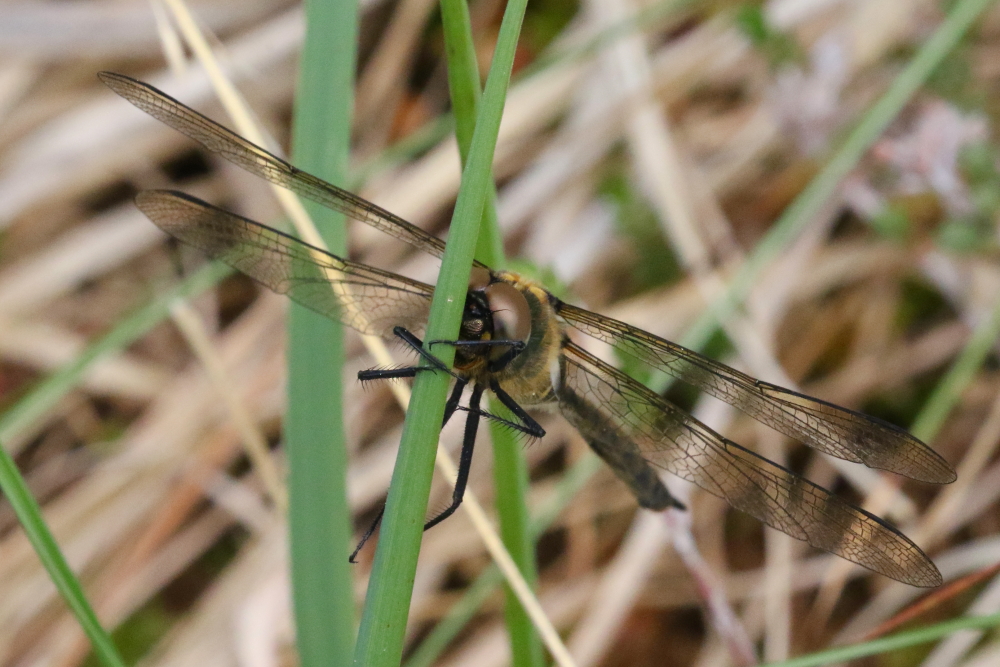
Four-spotted Chaser, Bridge of Grudie
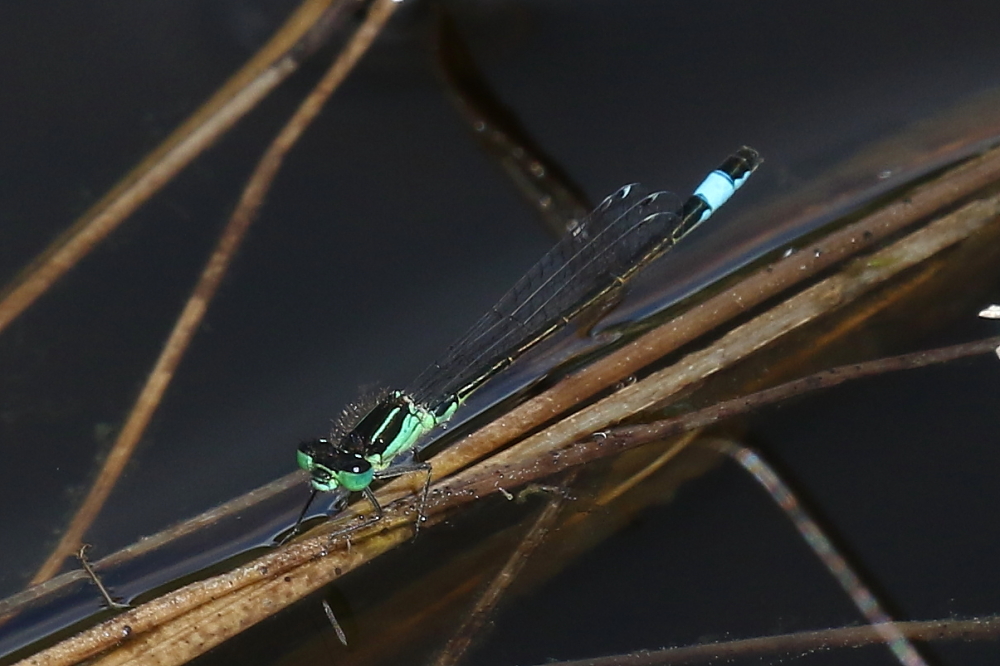
Blue-tailed Damselfly, Bridge of Grudie
Common Blue Damselfly, Bridge of Grudie
Within a week or so of returning home to Dorset from Scotland, the chance of seeing another new species arose when Olly Frampton discovered a couple of Lesser Emperor, a rare migrant to the UK, at nearby Longham Lakes. As it was during the recent heatwave, despite the lateness of the hour and some afternoon cloud cover, I felt it was worth a try after work to see if they were still on the wing.
Lesser Emperor, Longham Lakes - readily identified by the pale blue saddle behind the thorax.
This attractive Banded Demioselle was also on the wing at Longham
Female Emperor at Longham Lakes - during warm weather the normally green abdomen can turn blue
Sure enough, with the help of son George and the rest of the family who I had lured to Longham with the promise of pizza on the way home, we found one shortly before 8pm. It didn't settle, so I had to make do with a ropey flight shot as it sped past some lakeside reeds. This run of close encounters with rare dragonflies encouraged me to spend a bit more time photographing them on some recent walks in Wareham Forest - great habitat for odonata.
Female Black-tailed Skimmer, Wareham Forest
Emperor, Wareham Forest
Keeled Skimmer, Wareham Forest
On one tiny pool in the forest I came across three blue male dragonflies each of a different species - the impressive Broad-bodied Chaser, the slightly less chunky Black-tailed Skimmer and the sleek Keeled Skimmer - testament to how fortunate we are to have all this on our doorstep.
Broad-bodied Chaser, Wareham Forest
Black-tailed Skimmer, Wareham Forest
Keeled Skimmer, Wareham Forest

Wednesday, 11 June 2014

Hate camping, love the Levels

Something of a pattern emerging here in recent years: enforced camping trips made almost bearable by good birding nearby. First the New Forest, then North Norfolk and, last weekend, a gathering of the in-laws at High Ham. This is deep in the flat, wet bit of Somerset, and a short hop from the complex of nature reserves in the area now known as the Avalon Marshes. Poetic, perhaps; historically inaccurate, almost certainly.
Bittern: all photos taken from public hides and viewpoints at Ham Wall RSPB. Sit, wait, and enjoy the best airshow of the summer.
Still, churlish to complain about cheesy names when they've done such a good job of it - they being the RSPB, Natural England, the Somerset Wildlife Trust and the Environment Agency among others. A proper bit of landscape-scale conservation, this: no mucking about with a pokey little, fenced-off nature reserve: no, siree - this is restoration of a vast area of denuded peatlands to glorious wetland on a grand scale. More breeding Bitterns than you can shake a stick at - rising from a small proportion to around half the UK's booming males in less than a decade (see here for graphs and stuff) - and swarms of dragonflies which give some idea of what hyper-abundance must have looked like back in the day. For those who doubt people can ever do much good for birds, this is not a bad place to look for encouragement. I headed straight for the RSPB reserve at Ham Wall, with its well positioned hides and viewing platforms, from which a keen-eyed volunteer warden was pointing out passing Bitterns with surprising regularity.
Bittern: check out the photos on the recent sightings page of the Ham Wall blog of four in flight together last month
The camping itself was, of course, intolerable, and made only slightly less so by the presence of Uncle Andy, my brother-in-law, the only other member of the extended family who hates camping more than I. Taller than me with feet hanging even more over the end of his rapidly deflating airbed, he found it so traumatic he was having flashbacks to Kosovo where he served a difficult tour with the RAF.
Bittern at Ham Wall
The location was not a campsite as such, but a freshly mown hay meadow (not great for the hay-fever, it turned out) attached to a farmhouse owned by a friend of the family. While this meant we were spared the usual background noise of a proper campsite, it also meant sharing just the one chemical toilet, which had a festival feel to it by the end of the weekend. And not in a good way.
Great White Egret: the volunteer warden said they don't breed at Ham Wall but are regular visitors throughout the year.
One of the iron laws of camping was upheld: namely, no matter how many airbeds you take, precisely one less than you need will remain unpunctured. Fortunately I had a self-inflating mattress procured for twitching emergencies which saved one of the children from sleeping on a cold hard floor. Well I wasn't going to give up my airbed, was I?
Great White Egret: a flyover shortly after my arrival, in contrast to the elusive bird in Poole Harbour recently.
Over the course of about 36 hours, I estimate approximately 4 hours of decent sleep were snatched; another 4 involved pretending to sleep; perhaps 2 were spent actually relaxing in a deck chair; and the rest consumed by packing, unpacking, assembling, dismantling, packing and unpacking again. Surviving on a strict diet of barbecued food, the onset of scurvy threatened, so we drank as much alcohol as we could find, purely for its antiseptic properties, you understand...
Four-spotted Chaser was the most abundant dragonfly at Ham Wall - and what an abundance
Before being allowed home to indulge such outrageous luxuries as running water and walls, however, we were all gathered in a circle for tributes and a raffle (a regular feature of the camping trips which it would appear are a tradition in the extended family - a fact I certainly don't recall being disclosed before I took my wedding vows).
Banded Demoiselle - this one a striking male. Very few biting insects at Ham Wall: they were all in my tent up the road.
As we sat in the ring, we were welcomed among the other 'first timers'. I thought 'what do you mean first timers? How about last?', but what with the sleep deprivation and the heat, apparently I thought this aloud. I think I got away with it though as it was muffled by Uncle Andy's guffawing at having exactly the same thought at that moment. More guffawing when first prize in the raffle was drawn - you guessed it - a one week camping holiday. Thankfully, neither of us held the winning ticket.
Blue-tailed Damselflies. Get a room!
As his reward for turning up, this coming weekend Uncle Andy gets to go to Brazil and watch the World Cup. I get to go, er, camping again, back to the New Forest. Must have done something very wrong in a previous life...
Glastonbury Tor: the Avalon of Arthurian legend where the wounded King was taken to recover after the Battle of Camlann: an island sitting above the marshlands of what we now know as the Somerset Levels.
A wider angle view from the living hell of the campsite.