Showing posts with label Great White Egret. Show all posts

Saturday, 30 October 2021

Shetland day 8: fin - and an encore

Our last full day on Shetland started with us emptying the fridge for one final breakfast and cracking a few more slipway jokes before heading out into the field. First stop was a report of a possible Baikal Teal at Loch of Benston - plausible given the recent presence of one on Fair Isle - which had to be checked out. Satisfied it was 'just' a Garganey (still a Shetland tick for all of us) we moved quickly on to Kergord. A Bluethroat had been reported there in the 'Rustic Bunting ditch' and the team were keen to see it. We walked slowly down the hedge and it duly sat up on a post - too easy.

Bluethroat, Kergord
It was my second Bluethroat of the trip and to see the first I had crossed to Yell then Unst. At this point the rest of the team hadn't left Mainland the entire trip but were keen to put that right, and so a visit to Yell, for tea with the fittingly named Kettles, was proposed. Birders being birders, before we arrived at Adrian's house, we met him on the road scouting for the Ring-necked Duck which I had seen a few days before. We couldn't relocate it but a miserable looking Great White Egret near his house was our second of the trip.
'How did it come to this?' asks a sodden Great White Egret on Yell
After enjoying the Kettle's hospitality it was time to head back to Mainland and the ferry home. A couple of Bonxies in the sound between Yell and Mainland were our first of this Shetland visit. They were also our last 'trip tick' before we boarded MV Hjartland for another extremely smooth journey back to Aberdeen.
Great Skua off Yell
The end of a Shetland trip is always a bit of a downer, especially with a 600 mile journey ahead. But there was one more bit of potential excitement to be had about half-way home in West Yorkshire. On Thursday night, as we were preparing our penultimate meal in the Hoswick pad, a Temminck's Stint at Swillington Ings had been reidentified as a Least Sandpiper - a tick for Jono. Within the hour it was reidentified again as a Long-toed Stint - a tick for all of us given that the last twitchable bird had been in the 1980s when Bradders could barely drive a pedal car, let alone a Volvo! 
Long-toed Stint - a tiny bird a long way off!
Swilly Ings was just a 5 mile detour from our route south so it was barely an inconvenience to call in for a mega-tick and lunch courtesy of an extremely busy reception centre at RSPB St Aidans, to give it its proper name. We had opened a book on the way down about which birders on our ferry would beat us to it, and the odds on Cliff Smith being among them were pretty short. Sure enough, a tweet from Cliff confirmed he had seen the Stint just as we were parking up! Also there was Gary Thoburn whose lens I had returned on the ferry the night before, so this time Howard and Nick Oliver came to the rescue with the loan of cameras and lenses so I could grab a few record shots.
Amazing magnification on Howard's little superzoom
It was a satisfying end to a great week-and-a-bit, and meant that I maintained my record of a tick on each of my Shetland trips to date, even though this one wasn't actually on Shetland! The rest of the journey was painless, and I parted company with the team near Huntingdon, very much hoping it would not be our last Shetland adventure.
The long toes of the Long-toed Stint!

Wednesday, 13 September 2017

Sandpiper central

Mid-week rarities have been a theme of the Dorset birding year thus far in 2017 - from the Monday night Yellow Warbler, to the Tuesday night Spectacled Warbler, the Thursday night Elegant Tern and the Friday night Baird's Sandpiper. So it shouldn't have been too much of a surprise that this Monday produced another: a Stilt Sandpiper found by Dave Chown at Lodmoor near Weymouth. I missed a long staying individual of this species a few years ago which arrived the day I left for a family holiday, and left the day before I got back.
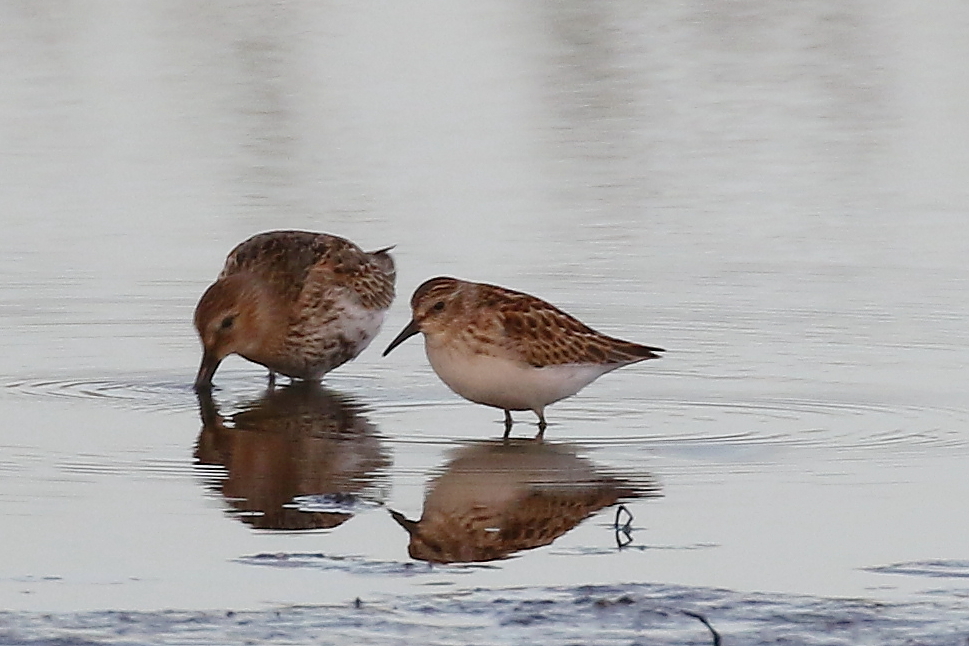
Least Sandpiper - despite the low light, against the mud the greenish legs can be seen
Smaller than the Dunlin on the left, Least Sandpiper has a slightly longer and more de-curved bill than Little Stint
I was on the train on the way home when the news broke, and when I sent a text to my neighbour and fellow Swineham-dodger Trevor to share the news, it emerged that he was on the same train. We therefore strode to our respective homes to collect our gear and I picked him up shortly after to head to Lodmoor. One of the iron laws of twitching Weymouth from Wareham as dusk approaches is that you will wait at least five minutes at the Wool level crossing for the train to pass. With that obstacle eventually cleared, we made good time to Lodmoor only to find that the Stilt Sand had flown off - five minutes before our arrival. It looked like the delay at Wool had cost us more than a nervous wait, and we pondered our next move - stick around and hope it comes back, or head to the next decent bit of mud at Ferrybridge in the direction the bird had reportedly flown?
Least Sandpiper shows more prominent dark lores compared to the similar (and even rarer) Long-toed Stint
A bright juvenile
Such are the dilemmas of twitching, and we prevaricated just long enough to make a trip to Ferrybridge a less attractive option, as dusk was fast approaching, and we concluded that our time would be better spent doing a circuit of Lodmoor which was still the most likely location for the bird to reappear. As we approached the western edge of the reserve, my phone rang and a surprisingly calm Brett Spencer broke the news that he had just re-identified a reported Little Stint as a Least Sandpiper - an even rarer American wader than the Stilt Sand and the first record for Dorset. We were just 100 metres away and covered this distance in a reserve record time. Dave, finder of the Stilt Sand, was with him, graciously accepting Brett's apologies for the outrageous act of up-staging!
Stilt Sandpiper at Lodmoor

Monday night's record shots of the Stilt Sandpiper taken at ISO1600 look like they were taken with a night vision camera..

The sun was by now about to dip below the horizon so there was just time to grab a few photographs and study the features which, despite the lateness of the hour, could be seen superbly thanks to the quality of modern optics. We stuck around enjoying the views and awaiting the arrival of Steve Smith who was still in transit. He got there breathless and in the near darkness, at which point another breathless Dorset birder, Nick Urch, emerged out of the gloom with news that the Stilt Sandpiper had been re-found another 100 metres to the north of where we were standing. This distance was covered in my second personal best of the evening and we found ourselves enjoying our second Dorset tick of the hour.
The Stilt Sandpiper was feeding actively

The long, greenish legs can be seen in this view
I returned after work the following day hoping to improve on the photographs from the night before. They are not great, but most of the key features of both can be seen at least. I do enjoy these post-work adventures at this time of year - with the evenings drawing in, you know you are not going to get far from home before dusk, or have too far to go to get home whether or not the target is present!
A very leggy bird
This Great White Egret at Lodmoor was seriously up-staged by the duo of American waders

Tuesday, 17 January 2017

Birthday treats

It was my birthday recently - a stuttering but undefeated innings of 48, in case you were wondering. To celebrate almost half-a-century of under-achievement I cleared my professional decks, booked the day off work and did some birding around Poole Harbour. The children were at school and Claire was at work, affording me the luxury of neglecting the entire family to go looking for birds without guilt.
Lesser Yellowlegs at Lytchett Bay
Green-winged Teal, just leaving Lytchett Bay
Redhead Smew distantly in Holes Bay
The once fierce competition between Lytchett Bay and Swineham as Poole Harbour birding locations, a fire stoked in these pages on more than one occasion in the past, has tailed off somewhat in recent years. Lytchett has gone from strength to strength under sympathetic management by the RSPB, being diligently scoured by Top 10 Patchwork Challengers (impressive, though I still think Patchwork Challenge sounds like a needlecraft contest). Swineham has gone downhill under a less wildlife-friendly regime, being wilfully neglected by feckless regulars like yours truly. So much so that I felt barely a flicker of shame in shunning the latter for the former to go looking for Lytchett's two long-staying winter rarities from the Americas: a Lesser Yellowlegs and drake Green-winged Teal.
Dark-bellied Brent Geese at Baiter Park
Coot, Poole Park
Drake Goldeneye and Red-breaster Merganser were out in the middle of Poole Park lake
The Yellowlegs was easy enough, sitting out nicely with a Redshank for comparison, the only two medium-sized waders on one of the pools. The Teal required a bit more luck: it flew off just after I arrived, but not before a kindly soul had let me have a quick squint at it through his scope, hence the dodgy record shot above, hurriedly snapped as it pelted away. Around the corner a returning redhead Smew was in Holes Bay for its third winter, while Poole Park held a few photogenic fowl as always. I caught up with a trio of Great White Egrets slightly further afield at Longham Lakes before heading over on the Sandbanks ferry to complete a circuit of the Harbour.
A lone Black-tailed Godwit was on the shore of Poole Park lake
Little Egret, Poole Park lake
Three Great White Egrets at Longham Lakes
The last hour of daylight was spent at Studland, where the raucous calls of a couple of Sandwich Terns were a cruel reminder of just how far away is spring, and the even more raucous calls of the local Ring-necked Parakeets were an equally cruel reminder of just how far away and warm is their native India.
Ring-necked Parakeet, Studland
Sandwich Tern, Studland
I would say watching the sun go down at Studland completed the day, but that wasn't really the end of it as on arriving home there was a birthday present to play with: the US Capitol building from the Lego Architecture range. Quite repetitive assembling the orderly lines of neoclassical columns and other fiddly bits, but ridiculously satisfying, a pure indulgence, and, I am reliably informed by the teenager of the house, substantially more socially acceptable than making an Airfix model. The perfect gift for the middle-aged man-boy in your life.
The US Capitol Building courtesy of the Lego Architecture range - George Washington laid the first brick. If you listen carefully this model makes a strange whirring noise: the sound of a miniature George turning in his grave.

Tuesday, 27 December 2016

September...

Good things seemed to come in twos in September, the latest month to be given the drive-by review treatment in my look back at 2016. Starting with two tickets to the Isles of Scilly for my youngest son and I to twitch a Cliff Swallow, with a point blank Lesser Yellowlegs making up a high quality American double for the day.
Cliff Swallow, St Mary's. Incredibly another was found in Suffolk later in the year but this was the smarter of the two ;-). Suffolk would have been cheaper of course - but not nearly as much fun! Bird of the month for September
Lesser Yellowlegs, St Mary's - my photo of the month for September
Seeing one Shrike always means it's a red-letter day, but two rarer members of the family in the same month was something to celebrate - especially when both the Woodchat (at Pirate's Cove near Weymouth) and the Lesser Grey Shrike (at Mountbatten near Plymouth) were so confiding.
Woodchat Shrike, Pirate's Cove
Lesser Grey Shrike, Jennycliff Beach
September produced some fine weather as well as some fine birds, and I made a few journeys to Portland during the month to look for migrants - the island can usually be relied on for seasonal scarcities like Rose-coloured Starling and Wryneck.
Rose-coloured Starling, Portland

Wryneck, Portland
Even Swineham had something to offer in September - an overdue patch tick in the form of a Great White Egret, and an approachable Kingfisher - common enough along the River Frome, but only rarely do they perch long enough for a photograph.

Great White Egret, Swineham

Kingfisher, Swineham
The final duo from September was extra special - my own sons, each seemingly taking an interest in wildlife photography. Rowan joined me on the trip to Scilly while they both tooled up with long lenses for a visit to Brownsea. I'm sad to report the passion for photography hasn't really lasted with either, but it was fun while it did, and may have sown the seeds of some future interest in this most absorbing of pastimes.

Friday, 16 September 2016

Autumn on the patch

I've been making a bit more of an effort to catch up with autumn migrants on my local patch at Swineham over the past few weeks. My visits in recent years have often been necessarily fleeting, involving a brisk canter around the gravel pits trying to cover as much of the area as possible. This autumn I have tried a different strategy, lingering in a few of the more promising looking spots for passerines, and not worrying about trying to cover all the ground. It's worked quite well, and I've started to appreciate the old place a bit more as a result. But a late evening walk tonight was bright, breezy and almost completely birdless, so I had reverted to type and was doing a circuit of the gravel pits when, heading west up the Piddle Valley, something made me look back: Great White Egret in a ditch - patch tick! It looked like it had clocked me before I clocked it, made a few short flights and settled to feed in amongst a herd of cows. A few pictures of the Egret and some other recent migrants below.
Great White Egret - difficult to miss
A huge bird, much larger than the familiar Little Egret
It or another has been seen recently at Lytchett  Bay, Middlebere and in the From Valley 
No point trying to be stealthy when you're that colour mate
Reed Warblers have been moving through though it's difficult to tell the migrants from the residents with this species which breeds in good numbers at Swineham
Reed Warbler
Whitethroat is surprisingly rare at Swineham - this one of two earlier in the month
Lesser Whitethroat is even rarer - three together a few weeks ago was quite a record
A juvenile Spotted Flycatcher was also a belated patch tick this autumn
Always a treat to see one of these
A steady stream of Willow Warblers over recent weeks seems to be tailing off
Always an attractive species at this time of year
Willow Warbler
Plenty of Sedge Warblers also around the gravel pits
Not a great year for them breeding at Swineham so presumed migrants
An acrobatic Sedge Warbler