Showing posts with label Grizzled Skipper. Show all posts

Tuesday, 23 May 2017

Far From the Madding Crowd

After a slightly fraught day on Friday involving, well, let's just say some caravans, a car park and the Dorset constabulary, the eminent Dr Sterling and I felt the need to seek out some tranquillity, so we left the bustling metropolis of Casterbridge and treated ourselves to a post-work field trip to Cerne Giant Hill. A bit of a flying visit before Phil caught his finger badly on some barbed wire and had to be virtually airlifted back home to Weymouth, but we caught up with two of the site's star attractions before his blood runneth over: the Duke of Burgundy and the Marsh Fritillary. The less celebrated and more modestly named Grizzled and Dingy Skipper were also on the wing. Despite being one of the best butterfly sites in Wessex, we had the place to ourselves for the time we were there. Lacerated digits aside, it was just what the Doctor ordered.
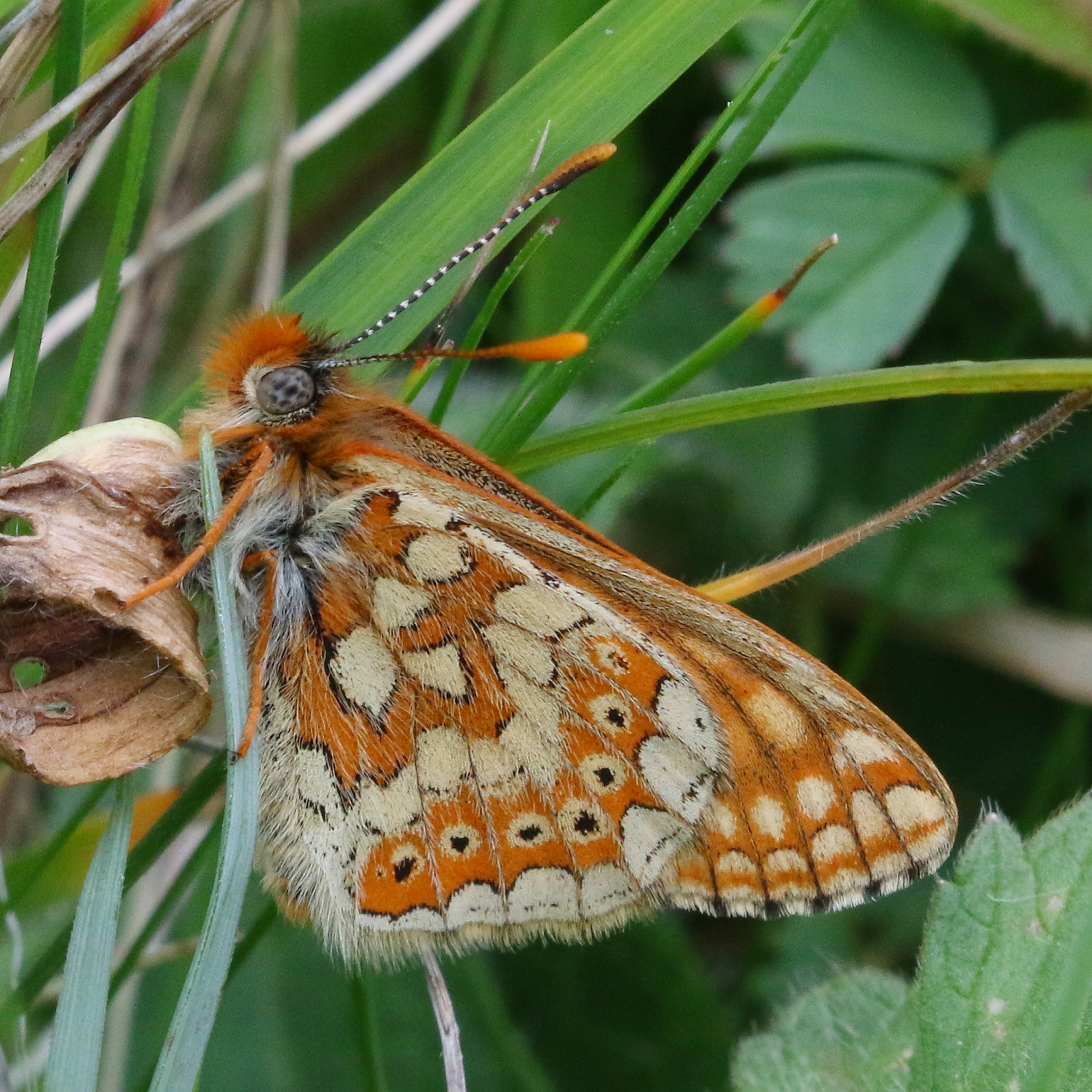
Marsh Fritillary
Marsh Fritillary
Duke of Burgundy
Duke of Burgundy
Duke of Burgundy
Duke of Burgundy
Duke of Burgundy
Dingy Skipper
Grizzled Skipper


Sunday, 15 May 2016

Something green, and a giant

Sunshine, warmth and opportunity combined on Saturday, encouraging me to make the trip to Cerne Abbas, one of the finest sites in Dorset for butterflies where a range of species flourish in the shadow of the celebrated giant. After a surprisingly chilly morning with patchy cloud, the afternoon warmed up enough to bring out a range of species, including a stunning Green Hairstreak.
Green Hairstreak - more often 'stumbled upon' than 'found', in my experience
This individual was rubbing its wings together in a rotating motion, revealing a glimpse of the brown upperwing
Perhaps the most sought after butterfly at Cerne Abbas is the Duke of Burgundy - a rare species for which conservation efforts are helping to halt a precipitous decline
This male perched up during an overcast period - the forelegs of the male are stunted giving it a four-legged look (compared to six visible legs on the female)
The Marsh Fritillary has been in long-term decline in its wetland habitats, but is bucking the trend on Dorset downland sites. A single individual was spotted during my visit - hopefully more will be emerging soon
Small Heath - another species which has seen a steep decline, although it remains widespread
Grizzled Skipper - a very dapper individual
Dingy Skipper outnumbered Grizzled by about 5 to 1 - the opposite ratio compared to a visit to Fontmell Down a few weeks ago
This Green-veined White served as the warm-up act on the way to the flower-rich downland at Cerne Abbas
And representing the day-flying moths, this attractive Green Carpet was disturbed from vegetation
A fine show of Orchids and Cowslips on Cerne Giant Hill
Green Hairstreak - our only green butterfly


Saturday, 7 May 2016

Grizzled and Dingy on the Downs

The words 'Grizzled' and 'Dingy' may not conjure up the most cheerful of images but the recent sunshine and warmth have seen an emergence of the Skippers which go by these names - enough, I would suggest, to lift any spirits. I was able to spend some time this week with both species, along with other butterflies and day-flying moths, on Fontmell and Melbury Downs, two of Dorset's finest.
Grizzled Skipper on Fontmell Down
A lot prettier than the name suggests
Dingy Skipper - a little more understated, I grant you, but 'Dingy' still seems a bit harsh
Who doesn't love an Orange Tip?

Commoner than the Skippers but no less welcome was this Green-veined White

The battered wing suggests that this Peacock has had a close shave with a would-be predator
Day-flying moths were also in evidence on the Downs, including some attractive micros. I wasn't carrying the scholarly works of Messrs Sterling, Parsons and Lewington to help with the ID, though I took the precaution of having the first one of them with me in person, which made the task a little easier!
Small Purple-barred - a day-flying macro-moth
Another Small Purple-barred - though much easier to see how it gets its name from this one
A very striking micro - Pyrausta purpuralis
The closely related Pyrausta nigrata
Ancylis unculana
There was too much to look at on the ground to look up much, but when I did this Red Kite was a handsome reward
A fine show of Bluebells in many Dorset woodlands at the moment
While I try to avoid being a camera gear-bore on these pages, a few people have asked me how I am getting on with my newish Canon 100-400mm Mk II zoom lens, so if you don't want to know, look away now. I bought it largely because I figured the closer focus (about 3 feet compared to about 10 for the 400mm f5.6) and zoom range would give me more versatility for a wider range of subjects, particularly smaller subjects, compared to my old 400mm. I like to travel reasonably light so having the flexibility to shoot distant and close subjects, of all sizes, without the need to carry around a second lens or a macro, was an important consideration.

I was already pleased with the results I was getting for bird photography with it over the autumn and winter, but this is its first spring, and after a bit of a poor summer last year which restricted the scope for insect photography, I have now been able to start putting it through its paces on a wider range of subjects than was possible with my old lens. Compared to that, I have to say it's quicker, just as sharp and the Image Stabiliser does seem to give the equivalent of a few extra stops of light, especially in darker conditions.

I have also been quite pleased with how it performs as an alternative to a macro lens, the closer focus compared to the 400mm being the key to this. Being a long zoom lens, good sized images of smaller subjects are possible without getting too close or disturbing them. Clearly, as you can see from some of these images, it was never going to be as good as a proper macro, and it's also a lot heavier (the Canon guarantee could have included neckache!). But if you like to photograph a variety of subjects, and only want to carry one lens around over your shoulder without a tripod, my conclusion is that you could do a lot worse than this. So if anyone is out there with their finger hovering over the 'Buy now' button of a consumer electronics website, I hope this helps!


Thursday, 13 June 2013

In the footsteps of giants

Now summer's over (last week, you blinked, you missed it) it's time to reminisce about sunshine and butterflies. Between blinks last week, I managed a trip to Cerne Abbas, whose Giant is famous for his butterflies among other things. The chalk figure is thought by some to be a fertility symbol, and it seems to be working for the Lepidoptera this year at least. Good job too - they had an appalling year in 2012 which was ranked by Butterfly Conservation as 'officially the worst since records began'. The wet weather contributed to declines in 52 of out 56 species with moths faring just as badly - not just a problem for them but all the other critters that rely on them for food. Hopefully, the range of species and good numbers of each on show last week is a sign that they can bounce back quickly.
This Marsh Fritillary was freshly emerged - blood was still being pumped into the wings

Marsh Fritillary underwing - one of the most attractive of all the butterflies
Another view of the underwing
Marsh Fritillary - numbers fell by 71% last year...
...but reasonable numbers seem to be getting reported so far this year
Common Blue - another species suffering a big decline in 2012 (60%)
Common Blue underside
Duke of Burgundy - already one of our rarest butterflies, this suffered a 47% decline last year
A surprisingly small butterfly if you've not seen one before
This was one of at least half a dozen seen in a short visit
Duke of Burgundy - a stunning underwing pattern
Another Duke of Burgundy underwing
Brown Argus was also on the wing...
...as were Dingy Skipper...
...Green-veined White...
...Grizzled Skipper...
...and Small Heath


The view from Giant's Hill