Showing posts with label House Sparrow. Show all posts

Saturday, 31 October 2015

Furrowed yellow brows

It's been a week of head-scratching and furrowed brows - yellow brows, specifically - looking for rare Phylloscopus warblers - ultimately successful in terms of seeing them, but a bit frustrating trying to photograph them! A report of a possible Hume's Yellow-browed Warbler in Weymouth yesterday, the rarer of a species pair with Yellow-browed Warbler, saw me heading there late morning. By the time I arrived the bird had already been identified as the commoner of the two by finder Joe Stockwell. A Hume's would have attracted considerable interest, but with so many Yellow-broweds around this autumn, no-one else seemed to have followed up the sighting. With no bird and no birders present, therefore, all I had to do was find it.
Yellow-browed Warbler (#233), Weymouth, 30th October - a washed out looking bird, you can see why Hume's was considered a possibility
Hume's Yellow-browed Warbler (#234), Durlston, 31st October - duller-grey green upperparts compared to Yellow-browed
I wandered up the Rodwell Trail, a wonderful green lung of Sycamores, sallows and brambles running through suburban Weymouth, and eventually heard the Yellow-browed calling about 100 yards from the original sighting. It had taken the best part of an hour to see it, and it took another couple to get some record shots for the photo yearlist.
The Weymouth Yellow-browed - note the double wing bar, pale feet and legs and pale base to the bill
The Durlston humei, note the single wing-bar... 
...and the dark bill, legs and feet - all indicative of Hume's
Today seemed like a case of Groundhog Day, with another late morning report of a Hume's at Durlston, scene of my mad dash for a Pallas's Warbler earlier in the week. The Hume's had been discovered by the finder of the Pallas's, Warren Clayton, clearly on a roll - or perhaps eating a roll as he was enjoying refreshments from Durlston Castle's restaurant balcony when he heard an unfamiliar call coming from the trees below.
The Weymouth Yellow-browed - very clean white underparts - interesting how the 2nd wingbar on the median coverts is much more subdued in this photo than the one above. Both species show a hint of a crown stripe
Another view of the Weymouth Yellow-browed
I arrived at Durlston around midday to join Warren and Steve Smith looking forlornly down into a large area of trees and scrub which offered plenty of hiding places for a tiny central Asian vagrant. With no sign or sound of the bird for over an hour we feared for the worst, but a faint call encouraged us to stick around. The calls became more frequent and strident - certainly more strident and lower pitched than the Yellow-browed I was hearing the previous day - and after the best part of 3 hours we got our first view of a small pale bird flitting distantly through the vegetation. A short while later a more extended view provided a brief window of opportunity to get some record shots, enough at least to confirm the key features.

A shame the Hume's didn't show as well as this Chiffchaff at Durlston
Another massive Purbeck twitch: from left, Joe and Jol, resurrecting the Mitchell curse (they left before the Hume's reappeared); Warren, Durlston's top rare Phyllosc-finder this autumn (sorry Hamish); and Steve 'Birding Poole Harbour and Beyond' Smith, taking a break from 'beyond' to grace us with his presence
So while my week off has hardly been rarity-packed, seeing Pallas's, Yellow-browed and Hume's Yellow-browed Warblers in consecutive days is certainly not to be sniffed at. Finding them would have been even better - so well done Warren and Joe.
A nice Short-eared Owl in the fading light at Portland Bill on 30th October
House Sparrow with the Old Lower Light at Portland Bill

Friday, 7 August 2015

Because I'm worth it

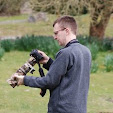
One of the benefits of working like a dog recently has been a few more pennies in the savings jar, enough at least for me to feel able to spoil myself with a new Canon 7D Mark II and 100-400mm f4.5-5.6 II zoom lens. First impressions of both are pretty good.

The most obvious improvements to the camera compared to the original 7D are the reduced grain at higher ISO ratings (and the increased upper limit at 16000 ISO), the ability to set the ISO range (thus giving a minimum as well as a maximum ISO), a faster high speed burst (10 frames per second compared to 8 for the old 7D), and the ability to shoot onto SD and CF cards (and both at the same time, if you want an instant back-up). Best of all, there is a release button on the main dial to stop you accidentally switching modes - the absence of this has cost me some good shots in the past.

This Willow Warbler was photographed out of the car window at an inconvenient angle in imperfect light - f5.6, ISO640 and a shutter speed of 1/500th of a second.
A distant Buzzard (f5.6, 1/500th, ISO500, handheld)
House Sparrow in the gloom at Llanuwchllyn station on the Bala Lake Railway - I was impressed with how little grain there was at ISO4000 (f5.6, 1/500th, handheld)
The only down sides so far are the loss of the AF area selection mode from the 'Quick' menu (though it's easy enough to do on the back of the camera) and the shorter battery life (though that's probably got more to do with the Image stabiliser on the new lens than the camera itself). Focusing is said to be a big improvement as well on the 7D Mk II and while I haven't tested that sufficiently yet to verify, there were certainly a few more 'keepers' in sequences of flyover Ravens and Peregrines than I would have expected from the 7D.
Peregrine over the garden of our temporary home in Snowdonia (f5.6, 1/4000th, ISO400, handheld)
Raven fly-past (f5.6, 1/1000th, ISO400, handheld)
Red Kite in horrible light, not far from our holiday home (f5.6, 1/1250th, ISO400, Exposure comp +2, handheld)
As for the lens, well it appears as sharp, if not sharper, and as quick, if not quicker, than my trusty 400mm f5.6. The Image Stabiliser provides the equivalent of a few extra stops of light, useful for my usual m.o. of hand holding the lens rather than relying on a tripod. Part of my thinking in getting this lens was that, as well as needing a second good lens if and when the 400mm keels over, as it has done a couple of times in its 5 year life, I wanted a bit more versatility for insects and landscapes without changing lenses, and the 100-400 range certainly gives that. The close focus - about 3ft compared to 10ft with the old 400mm f5.6 - promises to open up a new world of possibilities, making it virtually a macro without the hassle of an additional lens, and without having to scrabble around on my hands and knees to take pictures of small critters.
Annoyingly, with my new lens making more decent photographs of insects possible, I will now have to start identifying bees. But for now, here is a bee sp. Zoom down at 100mm, f4.5, 1/800th, ISO400, handheld.
Ditto, Hoverfly sp. x 2. f5.6, 1/640th, ISO640, handheld.
And a Meadow Brown in close-up. The combination of zoom and close-focus meant I was nowhere near flushing the butterfly but could still get a reasonable close-up. F5.6, 1/640th, ISO500, handheld.
Weight was my only real concern about the new lens - it is quite a bit heavier than the 400mm, but having invested in a new comfy sling strap at the same time, I can't say I am noticing much difference at the moment. Ask me how it feels after a birdless slog around Swineham, and I might view it differently, we'll see. But there is always the monopod option if it gets too much.

Given that it's just a lump of metal and glass, I feel strangely guilty about forsaking the old 400mm lens, though it will certainly not be retired just yet. It can just have a little rest. Like I am at the moment, in a dreamy cottage with under floor heating in Snowdonia, a holiday destination selected after I was inspired by the landscapes we passed en route to twitching the Cretzschmar's Bunting on Bardsey. And yes, I know one is not supposed to post whilst away from home as it lets burglars know you are not there. It's OK, though, we have guard guinea pigs. And, almost as fierce, my sister-in-law house sitting.

Saturday, 6 April 2013

Pastures new

My parents moved to North Devon last year, a place that must have potential for good birds but from where not much seems to get reported. Being where it is there is always a chance of something good, as the Trumpeter Finch which relocated from Lundy to this stretch of coast in 2011 suggests. Yesterday's was a family visit rather than a birding trip but we managed to get out to Baggy Point and see a few birds between tea shops, beaches and car parks.

This Rock Pipit on Croyde beach looks a bit littoralis - very grey above, pretty white below, prominent supercilium with a hint of pinky wash about the face (but not so much on the breast) - but the more I read the more confused I get. Any help?
Same bird from a wider angle.
Different bird, even greyer and a bit more pink on the underparts
A smart male Wheatear near the Baggy Point car park
House Sparrow
White Wagtail in the same field as the Wheatear

Saturday, 5 January 2013

This message will self-destruct in 10, 9, 8...

After disembarking a New Year bird boat on 1st Jan I had an hour to kill around my old haunts of Poole Quay and Baiter Park before a secret rendezvous with my team-mates in a forthcoming bird race. Only a few Dark-bellied Brents were on the waterlogged playing fields at Baiter though the burger van was still there, so hot sweet tea was readily available.

Dark-bellied Brent Geese. Compare with...

...Pale-bellied Brent Geese. Photographed in Portland Harbour in December.

There were no Black Redstarts on the Quay but plenty of chippes were open so a bag of their finest meant that my visit was not in vain. And while there was no wader roost to speak of on the walls of the marina, Tesco's were good enough to sell me a Mars bar. Fortunately I made no rash New Year resolutions about giving up fatty foods, sugary drinks or chocolate, but the one I did make (about getting out birding more often) remained in tact after spending most of 1st January in the field.
 
This Turnstone was eating just about anything it could find on Poole Quay. I know how it felt.

 
Male Starling singing at Baiter. Just happy to see the sun.

Then it was off to the pub for a confidential team talk and tactics meeting before the bird race. Maps were pored over, targets identified, transport options debated, provisions requisitioned and kit-bags theoretically packed. I'm not saying my team is taking it too seriously or anything, but if I revealed their names, I would then have to kill you. And, judging by my blog viewing stats, if you're reading this I really need you alive...

A small flock of House Sparrow hangs out around the lobster pots on Poole Quay

A confiding Shag fishing just off Poole Quay