Showing posts with label Meadow Brown. Show all posts

Sunday, 24 July 2016

Filthy imperialists

My friend Steve thinks that deferential hagiography written by butterfly enthusiasts about Purple Emperors on the internet just shows how Britain is a country still riven by a class divide. A visit to Hampshire for my nephew's 21st birthday recently put me within striking distance of the Alice Holt forest complex, a stronghold for the Purple Emperor. A few pictures below with some quotes attributed (wrongly, in some cases) to Karl Marx, just for Steve.
His Imperial Majesty, the Purple Emperor, may be master of all he surveys, but he's not above grovelling in the dirt with the lumpenproletariat to feast on dog mess. Except on this visit, when he stayed stubbornly in the treetops.
White Russians resisted the communists after the revolution in 1917. Fitting then that the White Admiral - running dog of the Emperor himself - is often found in the same habitat
This White Admiral was doing what I had hoped the Purple Emperor would do - taking salts from the path...
...as was his arch enemy, the altogether more revolutionary Red Admiral
Marx on debt-driven banking crises: 'Owners of capital will stimulate the working class to buy more and more of expensive goods, houses and technology, pushing them to take more and more expensive credits, until their debt becomes unbearable. The unpaid debt will lead to bankruptcy of banks which will have to be nationalized'. Oh Karl, you're so dramatic, like that's going to happen!
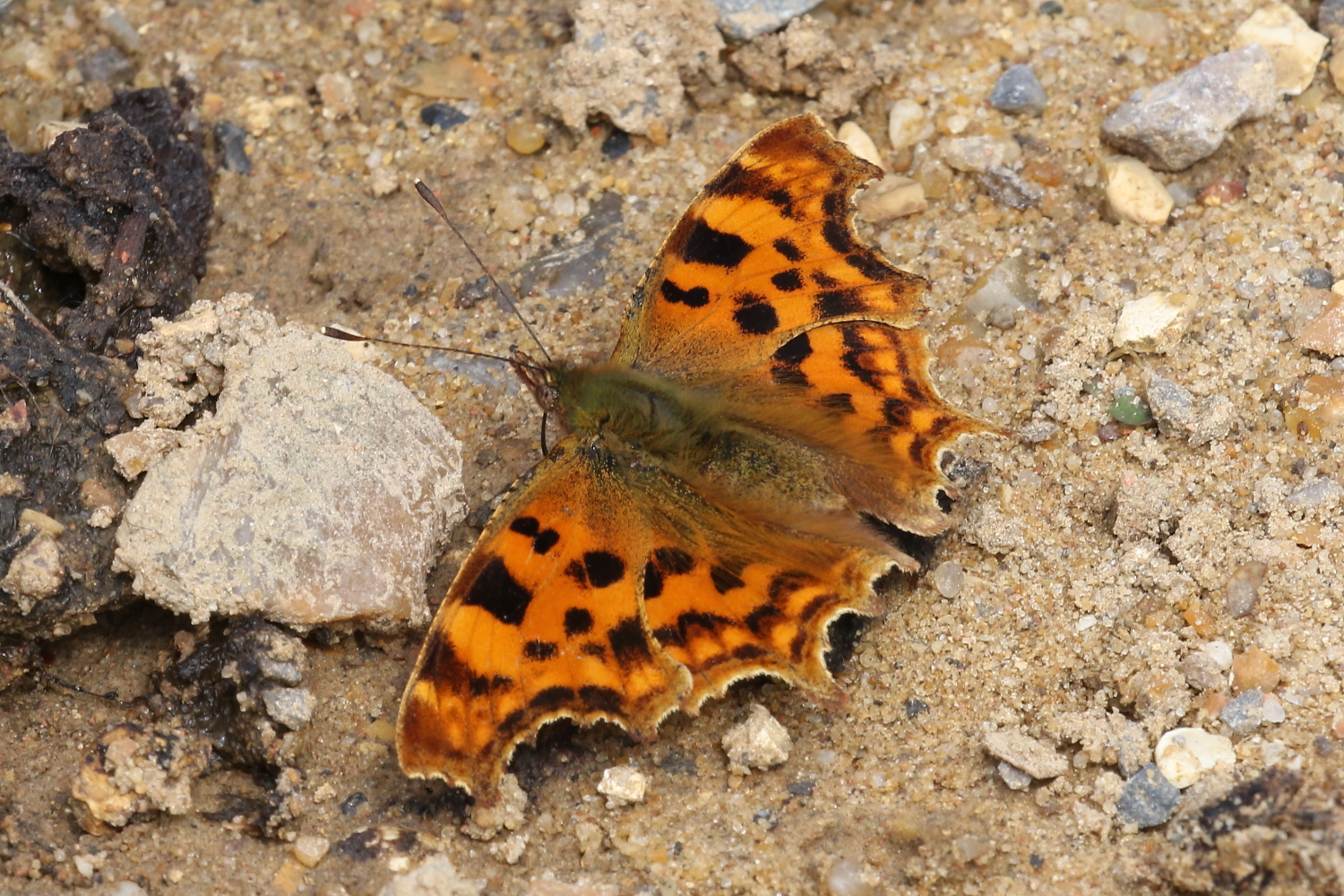
A more proletarian species, the Comma, feeding on the dog dirt arraigned for the Emperor - at least this commoner got the crumbs from the imperialists table
Another prole: the Meadow Brown
Ringlets of the world unite: you have nothing to lose but your chains

Small Skipper. Yet another oppressed victim of false consciousness.
Marx on X-boxes: 'The production of too many useful things results in too many useless people.' Mark those words, kids.
Female Silver-washed Fritillary: the gilded bourgeoisie of the butterfly world
Silver-washed Fritillary: female underside
Male Silver-washed Fritillary
'Let us not flatter ourselves overmuch on account of our human victories over nature. For each such victory nature takes its revenge on us. The people who, in Mesopotamia, Greece, Asia Minor, and elsewhere, destroyed the forests to obtain cultivable land, never dreamed that they were laying the basis for the present devastated condition of these countries, by removing along with the forests the collecting centres and reservoirs of moisture. When, on the southern slopes of the mountains, the Italians of the Alps used up the pine forests so carefully cherished on the northern slopes, they had no inkling that by doing so they were cutting at the roots of the dairy industry in their region; they had still less inkling that they were thereby depriving their mountain springs of water for the greater part of the year, with the effect that these would be able to pour still more furious flood torrents on the plains during the rainy seasons...At every step we are reminded that we by no means rule over nature like a conqueror over a foreign people, like someone standing outside nature – but that we, with flesh, blood and brain, belong to nature, and exist in its midst, and that all our mastery of it consists in the fact that we have the advantage over all other creatures of being able to learn its laws and apply them correctly'. This was written by Karl's mate Engels, in fact, not Marx. Apart from the final word, I'd say he wasn't far off being right.

Friday, 7 August 2015

Because I'm worth it

One of the benefits of working like a dog recently has been a few more pennies in the savings jar, enough at least for me to feel able to spoil myself with a new Canon 7D Mark II and 100-400mm f4.5-5.6 II zoom lens. First impressions of both are pretty good.

The most obvious improvements to the camera compared to the original 7D are the reduced grain at higher ISO ratings (and the increased upper limit at 16000 ISO), the ability to set the ISO range (thus giving a minimum as well as a maximum ISO), a faster high speed burst (10 frames per second compared to 8 for the old 7D), and the ability to shoot onto SD and CF cards (and both at the same time, if you want an instant back-up). Best of all, there is a release button on the main dial to stop you accidentally switching modes - the absence of this has cost me some good shots in the past.

This Willow Warbler was photographed out of the car window at an inconvenient angle in imperfect light - f5.6, ISO640 and a shutter speed of 1/500th of a second.
A distant Buzzard (f5.6, 1/500th, ISO500, handheld)
House Sparrow in the gloom at Llanuwchllyn station on the Bala Lake Railway - I was impressed with how little grain there was at ISO4000 (f5.6, 1/500th, handheld)
The only down sides so far are the loss of the AF area selection mode from the 'Quick' menu (though it's easy enough to do on the back of the camera) and the shorter battery life (though that's probably got more to do with the Image stabiliser on the new lens than the camera itself). Focusing is said to be a big improvement as well on the 7D Mk II and while I haven't tested that sufficiently yet to verify, there were certainly a few more 'keepers' in sequences of flyover Ravens and Peregrines than I would have expected from the 7D.
Peregrine over the garden of our temporary home in Snowdonia (f5.6, 1/4000th, ISO400, handheld)
Raven fly-past (f5.6, 1/1000th, ISO400, handheld)
Red Kite in horrible light, not far from our holiday home (f5.6, 1/1250th, ISO400, Exposure comp +2, handheld)
As for the lens, well it appears as sharp, if not sharper, and as quick, if not quicker, than my trusty 400mm f5.6. The Image Stabiliser provides the equivalent of a few extra stops of light, useful for my usual m.o. of hand holding the lens rather than relying on a tripod. Part of my thinking in getting this lens was that, as well as needing a second good lens if and when the 400mm keels over, as it has done a couple of times in its 5 year life, I wanted a bit more versatility for insects and landscapes without changing lenses, and the 100-400 range certainly gives that. The close focus - about 3ft compared to 10ft with the old 400mm f5.6 - promises to open up a new world of possibilities, making it virtually a macro without the hassle of an additional lens, and without having to scrabble around on my hands and knees to take pictures of small critters.
Annoyingly, with my new lens making more decent photographs of insects possible, I will now have to start identifying bees. But for now, here is a bee sp. Zoom down at 100mm, f4.5, 1/800th, ISO400, handheld.
Ditto, Hoverfly sp. x 2. f5.6, 1/640th, ISO640, handheld.
And a Meadow Brown in close-up. The combination of zoom and close-focus meant I was nowhere near flushing the butterfly but could still get a reasonable close-up. F5.6, 1/640th, ISO500, handheld.
Weight was my only real concern about the new lens - it is quite a bit heavier than the 400mm, but having invested in a new comfy sling strap at the same time, I can't say I am noticing much difference at the moment. Ask me how it feels after a birdless slog around Swineham, and I might view it differently, we'll see. But there is always the monopod option if it gets too much.

Given that it's just a lump of metal and glass, I feel strangely guilty about forsaking the old 400mm lens, though it will certainly not be retired just yet. It can just have a little rest. Like I am at the moment, in a dreamy cottage with under floor heating in Snowdonia, a holiday destination selected after I was inspired by the landscapes we passed en route to twitching the Cretzschmar's Bunting on Bardsey. And yes, I know one is not supposed to post whilst away from home as it lets burglars know you are not there. It's OK, though, we have guard guinea pigs. And, almost as fierce, my sister-in-law house sitting.

Thursday, 23 July 2015

A dull boy

If you're thinking 'it's been so long since he posted anything that he must be working like a dog between jet-setting off to glamorous holiday locations', well, you'd be half right. The first half, specifically. The photo year list, around which this blog has been themed in 2015, ground to a shuddering halt on 202 following a Father's Day Terek Sandpiper. After bursting through the 200 barrier in style, with 3 lifers among my last 4 additions, I have had neither the time nor the energy to add to it, with some eminently achievable target species remaining unsnapped.
Silver-washed Fritillary (male)
Gatekeeper - male
Meadow Brown
The closest I have come to escaping the thraldom of wage slavery was a trip last weekend to see my parents in North Devon. Mainly bumbling around busy beaches and arcades, so not a lot of time for wildlife watching, but a walk from Lynmouth up the river to Watersmeet produced a family of Grey Wagtail every 100 yards or so, a couple of Dipper and a hyper-active Shrew - I think a Common Shrew, but how does one tell for sure? Star of the walk though was a stunning male Silver-washed Fritillary.
Dipper on the River Lyn
One of many young Grey Wagtails on the same
And who doesn't love a newly fledged Robin?

Still, August is fast approaching and with some holidays booked, including a few pelagic trips out of the Isles of Scilly, I aspire to resuming a better balance of work and play very soon, making this Jack a slightly less dull boy, I hope. Stand by for an upsurge in average photos, tawdry narratives and cheesy puns in this space. I know they have been missed.
Shrewd move. And he's back!
My book says Pygmy Shrew's tail is hairy, and this looks pretty bald. However, it also says Pygmy's tail is 70% of head and body length, Common Shrew's just 50%. But this tail looks nearly 100% of body length. Perhaps they only measure them once they've been run over. Anyway, that confused me.
Common Shrew has 3 toned fur - brown on top, paler on sides, paler still underneath. Pygmy 2 toned - brown on top, paler under. While this looks 3 toned in the photo, it's a tough call to make on a tiny mammal which bombs around at 100mph in the dark.
Anyway, a charming beast, snuffling it's way along a woodland path.


Sunday, 21 July 2013

Summer meets autumn coming back

High summer means butterflies and there has been a wide selection on view at Butterfly Conservation's Alners Gorse reserve in North Dorset recently. The smartest of these was undoubtedly:
Silver-washed Fritillary - female of the rare form valezina
Valezina underside
About 15% of females are said to be of this form. Compare to...
...a regular female Silver-washed Fritillary...
..and a male of the same species...

...males being identified by the parallel black bars on the forewing 

Silver-washed Fritillary underwing

Silver-washed Fritillary with Meadow Brown for size comparison

Purple Hairstreak - these can be seen flying around the tops of oaks usually, but occasionally they will come down to a lower perch.

Another Purple Hairstreak - this one on the favoured oak

The rarer Hairstreak - White-letter - wouldn't play ball on a morning visit on Saturday - this shot of one high in the canopy was taken on a late evening visit earlier in the week.
White Admiral - there were a few around but this one was the only one to land, and then only briefly.

Ringlet - one of the most attractive of the 'brown' family.

Commoner species included: Comma...


...Gatekeeper - this one a female...
...Gatekeeper - a male...

...and Meadow Brown.
Also on the wing at Alners Gorse was the Beautiful Demoiselle

The same individual but with the light behind me this time.

High summer also means the start of return wader passage - the rarest so far in Dorset has been a White-rumped Sandpiper which spent a few days at Lodmoor in Weymouth last week and stayed until Saturday:
White-rumped Sandpiper (left) sadly not quite as in focus as the Dunlin

An adult bird


Another imperfect flight shot - this time into the light, but clearly showing the white rump
Another comparison with Dunlin