Showing posts with label Rock Pipit. Show all posts

Tuesday, 20 March 2018

Serpent-time

Between 'beasts' there were a couple of sunny days which encouraged me to head out with the camera in search of early spring reptiles. Not far from home, a south facing bank is favoured by basking Adders which, with a long lens, can be photographed from the road without risking disturbance. Half a dozen had braved the low temperatures to catch some rays. Amazing to see them flattening their bodies to get maximum warmth from the sun. 
The first Adder of the year is always a thrill
On closer inspection, my first Adder of 2018 turned out to be two Adders 
A recent visit to Portland in search of migrant birds also provided an opportunity to look for the Wall Lizard which has become established on the island. Finding this species was quite straightforward as they bask on the rocks and around the chalets of Church Ope Cove. Photographing them was another matter - the first and last sign of one was often a scuttling noise as it vanished under a beach hut! Unfortunately this non-native species appears to prosper at the expense of native lizards. They tend to return to the scene of past crimes so despite the frequent disappearing acts, a few photographs were possible with patience.
Wall Lizard, Portland
A Common Lizard later in the day was my third reptile of the year but unfortunately it too was vanishing - down the throat of a Kestrel. This bird was one of a number which gave remarkably close views during my meanderings around the quarries, cliffs and coves of Portland:
Kestrel: reptile-lovers look away now
Scanning for prey intently from a fencepost, the Kestrel was unperturbed by passing dog-walkers and joggers
Finishing off the Lizard
An attractive male Kestrel
This Raven was another approachable subject on Portland
A long robust, bill with extensive feathering - compare to...
Carrion Crow on the West Cliffs
Rock Pipit from the car window at Ferrybridge

Sunday, 17 September 2017

Autumn gathers pace

This week's weather appears as a statement of intent about the changing seasons, though for migrating birds 'autumn' has of course been underway for some weeks. Yesterday I met up with my parents on Portland to see what was about on a day which started out fine and bright, but which saw torrential rain by lunchtime, arriving just in time to give us soggy chips at the Bill's Lobster Pot cafĂ©.
Wryneck, Portland Bill
Probably the best view I have had of this species
Photographing it in dappled light on the ground was tricky...
...but the cryptic plumage can be seen well here
And here's a clue to how the Wryneck got it's name
Shortly before the downpour, we had jammed in on a long-staying Wryneck in the Obs quarry - not only was it on view as soon as we arrived, shortly after it was flushed by a rat and perched up to give unusually good and extended views of this often shy species. Apart from Wheatears, common migrants were thin on the ground on Portland, though there were plenty of hirundines in the air feeding up before the long journey south.
Northern Wheatear at the Bill
One of nine in the same paddock
Not just migrant birds on Portland - there were many Red Admiral around too
The resident Rock Pipits entertained us while we sat for lunch
Most of the Wheatears were sporting the tawny female-type plumage - but at least one male (left) was among them
In contrast to the shortage of common migrants on Portland, a visit to Greenlands Farm near Studland a couple of weekends ago saw the fields and woods alive with them. Yellow Wagtails were particularly entertaining and I spent a warm morning stalking them, hiding behind gorse bushes and acting like a horse in an effort to gain their trust. Suffice to say I got closer to the horses than the wagtails.
Yellow Wagtail, Greenlands Farm
The wagtail flock follows cattle and horses around the National Trust land at Greenlands...
 ...feeding right under the noses and feet of the livestock
This blue-grey headed individual didn't look like the regular British race - enquiries are underway to establish what flava it might be, but it's presumably of continental origin
Good to see these migrants on the ground rather than just flying overhead calling
While the Yellow Wagtails dominated the paddocks at Greenlands, Willow Warbler was the most numerous migrant around the forest edge - every tree seemed to contain two or three - with Common Redstart, Spotted Flycatcher and Whitethroat present in smaller numbers. 
Redstarts seem to like Greenlands - here a male...
...and here a female

Willow Warbler
Willow Warbler
Spotted Flycatcher
Spotted Flycatcher

I became enamoured with Greenlands Farm during a late summer bird race in 2015 - the concentration of migrants there at this time of year puts my own patch at Swineham to shame - a good excuse for my continued neglect of the latter! Purists would no doubt castigate me for forsaking my own patch to go farther afield where the grass is greener - I would merely point at that many hard core patch workers travel further to get to their 'local' patch than I do to get to Greenlands!
Common Whitethroat, Greenlands Farm
 
Wheatear, Greenlands Farm
House Martins were gathering around Manor Farm on Studland at the end of August
This rare visitor to Poole Harbour, a Hooded Crow, was also at Manor Farm

Monday, 17 April 2017

Operation Daymark

The Easter Bank Holiday weekend provides a unique opportunity for the lover of rare birds: an uninterrupted four day window at a promising time of year to stress out with the added attraction of heavy traffic. Whilst I had idly clocked news of a Rufous-tailed Rock Thrush on the Isles of Scilly, I hadn't really considered going to see it until, not for the first time this decade, a text message from David Bradnum gave me the kick in the rear I needed to start thinking about it.
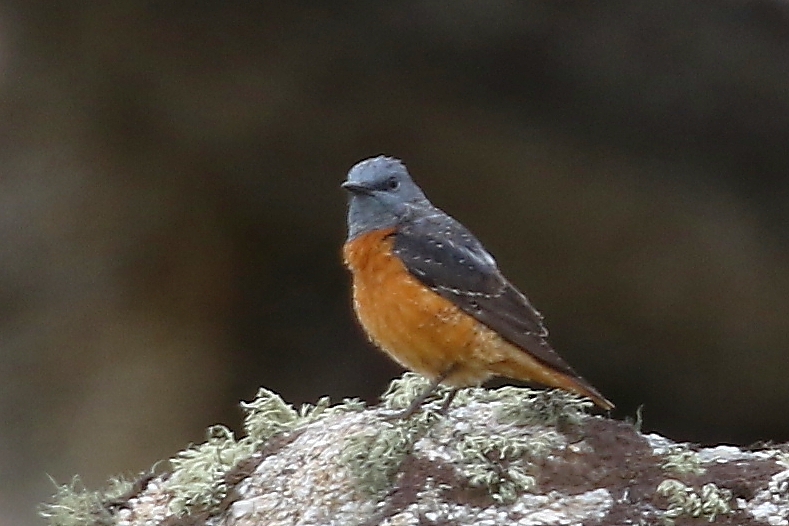
Rock Thrush, Bread and Cheese Cove, St Martin's
A red, white and blue riot of colour
Neither of us fancied day-tripping it, preferring an overnight stay to make the most of the islands and provide a second shot at seeing the bird if we were unsuccessful on the day of our arrival. Whilst not impossibly complicated, the logistics weren't straightforward: tickets for Scillonian III would be simple enough to procure, accommodation on Scilly during one of the busiest weekends of the year less so. But after just a few phone calls (Scilly's tourist industry has yet to get the hang of on-line booking), we managed to find a reasonably priced twin room.
The rufous tail seen clearly in flight
Note the white patch on the back of the Rock Thrush
That just left the small matter of getting from St Mary's to Daymark on St Martin's, where the Rock Thrush had spent the previous week. We were due to disembark the Scillonian at 1200 and an inter-island launch was due to leave for St Martin's at 1230, so that shouldn't be a problem either. All that remained was to secure permission to go from respective loved ones, and with that done, Operation Daymark was good to go.
Song Thrush: commoner than Rock Thrush on Scilly, and more confiding too
Daymark on St Martin's viewed from St Mary's
David arrived in Dorset from Essex for a few hours kip at our place and an 0400 start on Good Friday saw us arriving in Penzance in plenty of time to make the Scillonian. After possibly the smoothest crossing I have experienced, we made good time and shortly after midday were at the front of the queue on the quay for the boat to St Martin's. The latter island was hosting a music festival and we watched in dismay as suitcases, guitars and violin cases were unloaded carefully, and therefore excruciatingly slowly, from the Scillonian to a first, second, then third waiting boat - and all by hand. 1230 came and went, and when what appeared to be a drumkit appeared, it was too much for one enterprising birder who chartered a jetboat and offered us two seats on it. Once he had retrieved the hand we had bitten off, we were on our way.
Greenshank: the only wader present at Lower Moors on St Mary's
Wheatear: one of several on Peninnis
The advantage of the jetboat was not just the ability to jump the queue, but also to reduce the travel time and provide another half an hour on St Martin's before we needed to make the return journey. Unfortunately, the low tide meant that the disembarkation point was at the opposite end of the island to the cove where the bird was being seen.
White Wagtail on the quay at Hugh Town
Always a smart bird to see
The best part of half an hour later we arrived breathless and perspiring to catch up with more sprightly souls who had set a blistering pace across the island. Fortunately for all of us, islander Will Scott had the bird staked out in Bread and Cheese cove and shortly after arriving we were enjoying good views as the bird fed on the heather clad slopes and rocks around the cove.
Scilly Wren
This bird was singing on St Mary's
A few late-comers who had not joined us on the jetboat arrived even more breathless and sweaty, but they too enjoyed views of the bird before it headed to the other side of the cove. The walk back to the boat was altogether more relaxed and there was even time for a bit of birding back on St Mary's after the all the yomping around St Martin's.
Rock Pipit at Porthloo
Another songster

After the excitement of Good Friday, Saturday was uneventful but enjoyable on St Mary's. A few dozen Manx Shearwater and a single Common Dolphin provided interest on the way home. A fairly epic twitch then, with thanks to David for driving and providing the motivation to make the effort.
Manx Shearwater from Scillonian III

Rock Thrush - ordinarily at this time of year this bird would be breeding in southern European mountain range above the 1500m line - incredible to see it on a Scilly beach