And so 2018 has drawn to an end. A transition year for me professionally, and the focus of my energies on this perhaps inevitably led to less time out with the camera over the course of the last twelve months. Which is not to say I didn't get out - on the contrary, communing with nature and Canon continued to be an essential distraction from the trials of 'real' life. Blogging, by contrast, definitely took a back seat - just 28 posts in 2018 compared to 68 in 2017 and 165 in 2012, which was apparently the peak of my powers in terms of textual diarrhoea. A few highlights from the first 6 months of the year below.
January
My review of the year starts, with unswerving commitment to neat chronology, in January, when the
Hawfinch invasion of late 2017 continued to dominate the birding scene. Rural Dorset churchyards continued to receive many optic-bearing visitors not normally seen on hallowed ground as these chunky finches congregated wherever there were Yews. A couple of trips to Stanpit hoping to improve on my average pictures of the long-staying Stilt Sandpiper, which had relocated there from Lodmoor via Brownsea, proved unsuccessful towards the end of January though I did at least see it.
 |
| Bird of the month for January: Horned Lark, Staines Reservoir |
My first and only 'out of County' trip of the month was to the exotic environs of Staines, where an American Horned Lark spent several weeks around the causeway of the vast west London reservoir. Shore Lark is one of my favourite species and Staines is closer than any of their regular wintering sites so the chance of seeing this exceptionally rare form reasonably close to home was not to be missed. The undoubted wildlife watching highlight of the month was, however, a chance encounter with a
Humpback Whale in Chesil Cove in my adopted county of Dorset. A brief sighting of a distant individual allowed only for a poor record shot - but an incredible record nonetheless.
 |
| Wildlife highlight of the month: Humpback Whale in Chesil Cove |
February
February was a month for gull connoisseurs, with a dozen species available for viewing in the Dorset/Hampshire area. The rarest of the lot, a putative Thayer's, currently regarded as a sub-species of Iceland Gull, was enjoyed on a short-range twitch to Blashford Lakes with my good friend Steve Smith, taking a break from his punishing schedule of globe-trotting wildlife junkets to slum it on the south coast with the rest of us. A Ring-billed Gull kept company with the Thayer's Gull in the same late afternoon roost.
 |
Thayer's Gull, Blashford Lakes. What do you mean, underwhelmed?
|
With no disrespect to the Thayer's Gull (a rather drab juvenile), it was eclipsed for beauty if not rarity by one of the most sought after species from its family later in the month with the arrival of an exquisite adult
Ross's Gull in Weymouth. This bird first arrived at Lodmoor where it proved difficult to catch up with but by the weekend it had relocated to Radipole Lake where Jol Mitchell and I, plus our respective sons, were delighted to catch up with it.
 |
| Ross's Gull, Radipole: my first Dorset tick of 2018 and bird of the month for February |
March
March was a month of contrasts with icy 'beasts from the East' sandwiching the first signs of spring in the middle of the month. The cold snaps brought a Firecrest to my tiny urban garden, and a pair of hungry and unusually confiding
Hawfinches down to feed in the graveyard of my local church in Wareham for a sought after patch tick.
 |
| Hawfinch, Wareham |
A short Scottish trip at the end of the month saw me add the first new bird of 2018 to my British list in the form of an American White-winged Scoter off Musselburgh near Edinburgh. This striking seaduck was in good company bobbing along with Velvet Scoter, Surf Scoter, Red-throated Diver and Slovanian Grebe for company. Difficult to beat watching seaducks in winter on a wild Scottish estuary.
 |
| American White-winged Scoter (left-hand bird), Musselburgh: March's bird of the month |
April
Easter saw us hopping on to a ferry in Portsmouth for a week's family holiday in Brittany. The beach and marshes at Suscinio turned out to be the top birding spot of the trip with Fan-tailed Warbler, Bluethroat, Black-winged Stilt and Kentish Plover all within a short walk form the car park. Serin, Firecrest, Cirl Bunting, Short-toed Treecreeper and Crested Tit exemplified the theme of the week: apparently common species in Brittany which are all rare or range restricted birds at home.
 |
| Camberwell Beauty, Le Parc naturel regional de Briere |
A visit to the extensive wetlands of Le Parc naturel regional de Briere produced one of the highlights of the holiday - a close encounter with a couple of Camberwell Beauty butterflies basking in the spring sunshine. Marsh Harriers, Savi's Warblers, White Storks and Blue-headed Wagtails provided a colourful supporting cast.
 |
| Male Kentish Plover, Suscinio |
Back in Dorset a
Bonaparte's Gull returned to Longham Lakes continuing a good run of records of this American rarity. During the course of its stay I visited a few times to see the mottled feathers on the head moult into a fully dark hood within the space of a week.
 |
| Bonaparte's Gull, Longham Lakes: April's bird of month |
May
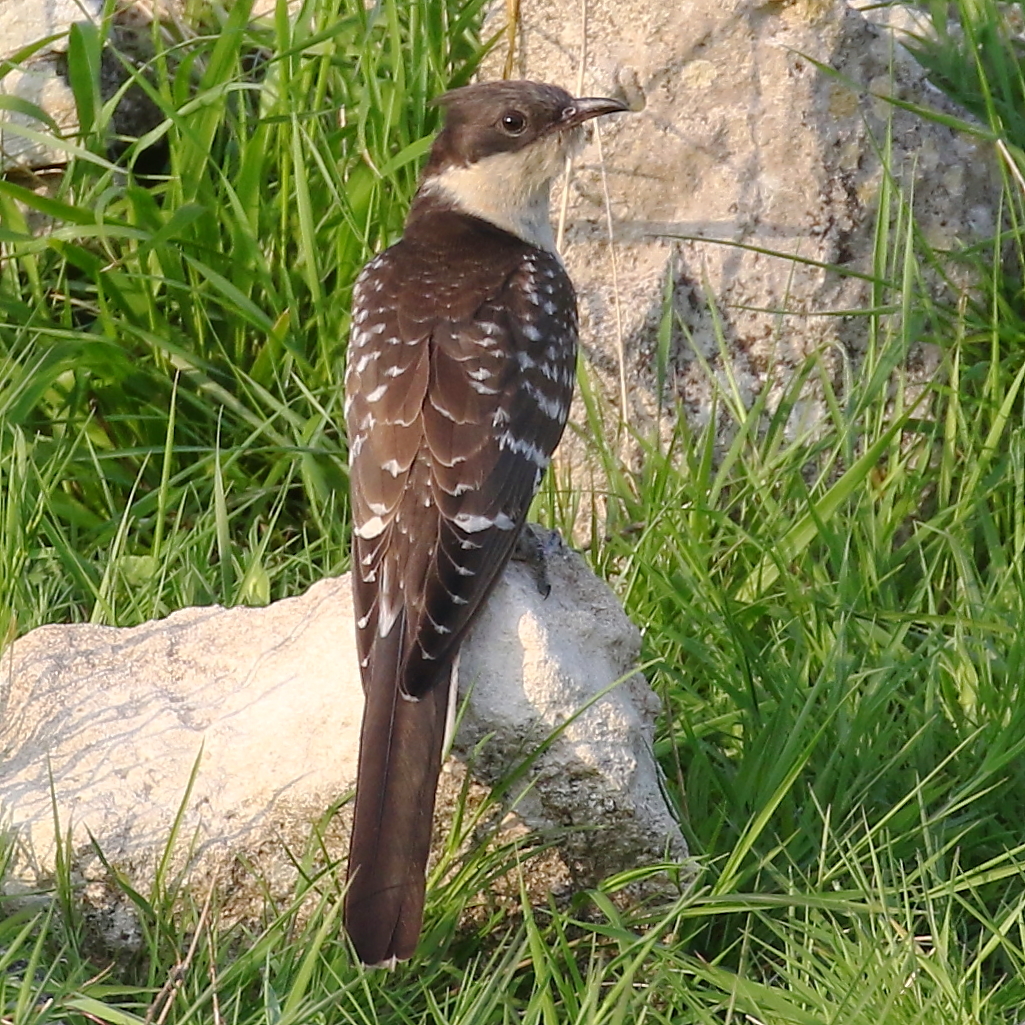
Cuckoos are easy enough to hear in the spring but seeing one really well is another matter as they can be very shy. So when other commitments took me past Thursley Common early in the month I took the opportunity to pay homage to an exception to this rule - an unusually bold returning male which has become a photographer's favourite in recent summers. Concerns have been expressed about whether the mealworm diet supplements laid on for it have been doing it any good - but it hasn't stopped it getting to and from Africa over the last couple of years so I guess it can't be causing too much harm!
 |
| Cuckoo, Thursley Common |
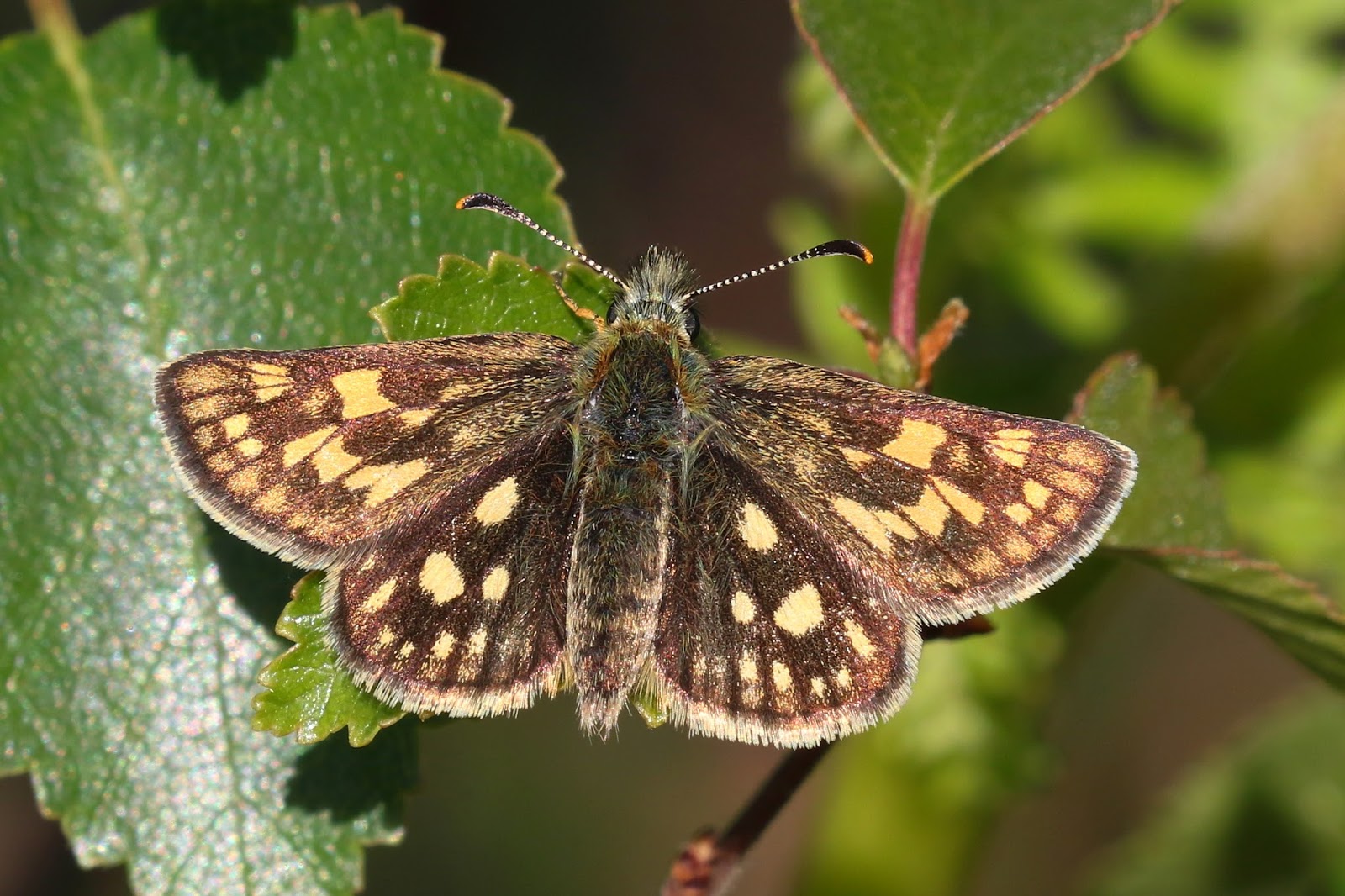
May also saw me returning to Cerne Abbas, one of Dorset's best butterfly sites, where the Duke of Burgundy can be seen on the wing. This species is recovering well nationally thanks in large part to the efforts of staff and volunteers working on behalf of my new employer, Butterfly Conservation. A special mention to one of them, Patrick Cook, who I bumped into that warm spring day at Cerne Abbas, for over-taking me on his bike so often when I started cycling the 7 miles to work this summer. The daily humiliation spurred me on to stick with it and I'm a lot fitter as a result - cheers Patrick!
 |
| Duke of Burgundy with Dingy Skipper, Cerne Abbas |
Due to my fondness for sanitation, when the family went camping toward the end of the month I was banished from their company and treated myself to a few days on the east coast. There, among other delights, I enjoyed the sight of
lekking Ruffs at Frampton Marsh and breeding
Swallowtails in the Norfolk Broads.
 |
| Swallowtail, Strumpshaw Fen |
Back home in Dorset, a smart Rose-coloured Starling at Portland Bill was part of a remarkable invasion of this species across the country. This pink poser looked quite at home among the cliff-top thrift of the same colour and gave some close views when Rowan and I paid it a visit.
 |
| Rose-coloured Starling, Portland Bill: bird of the month for May |
June
June began with some lepidopteran highlights: an Eyed Hawkmoth was a first for the garden moth trap, and a professional visit to Northern Ireland provided an opportunity to see my last UK butterfly species - the Cryptic Wood White - at Craigavon Lakes.
 |
| Cryptic Wood White, Craigavon Lakes: my wildlife watching highlight for June |
Continuing the insect theme, I made the effort this summer to see some of the
Odonata species which I had yet to see in Britain. Most spectacular among these was the Clubtail Dragonlfy. I spent a blissful morning photographing these on a slow-flowing Sussex river, then foolishly allowed myself to be talked into twitching a Moltoni's Subalpine Warbler at Blakeney Point in the afternoon with Steve Smith and Paul Welling. While I saw the Warbler's undertail coverts vanish into deep cover it was an untickable view, and the trudge back along several miles of shingle in the dark, with a limping James Lowen in tow, was, well, let's just say memorable! I should be grateful though that this was my only significant dip of 2018.
 |
| American Royal Tern, Church Norton: my second new British bird of 2018 and bird of the month for June |
As is traditional, mid-June produced an inconveniently timed mega-rare bird in the form of an American Royal Tern at Church Norton. Train, bike and car were all involved in a late evening dash from Dorchester to see it just as the sun went down!