Mid-week rarities have been a theme of the Dorset birding year thus far in 2017 - from the Monday night
Yellow Warbler, to the Tuesday night
Spectacled Warbler, the Thursday night
Elegant Tern and the Friday night
Baird's Sandpiper. So it shouldn't have been too much of a surprise that this Monday produced another: a Stilt Sandpiper found by Dave Chown at Lodmoor near Weymouth. I missed a long staying individual of this species a few years ago which arrived the day I left for a family holiday, and left the day before I got back.
 |
| Least Sandpiper - despite the low light, against the mud the greenish legs can be seen |
 |
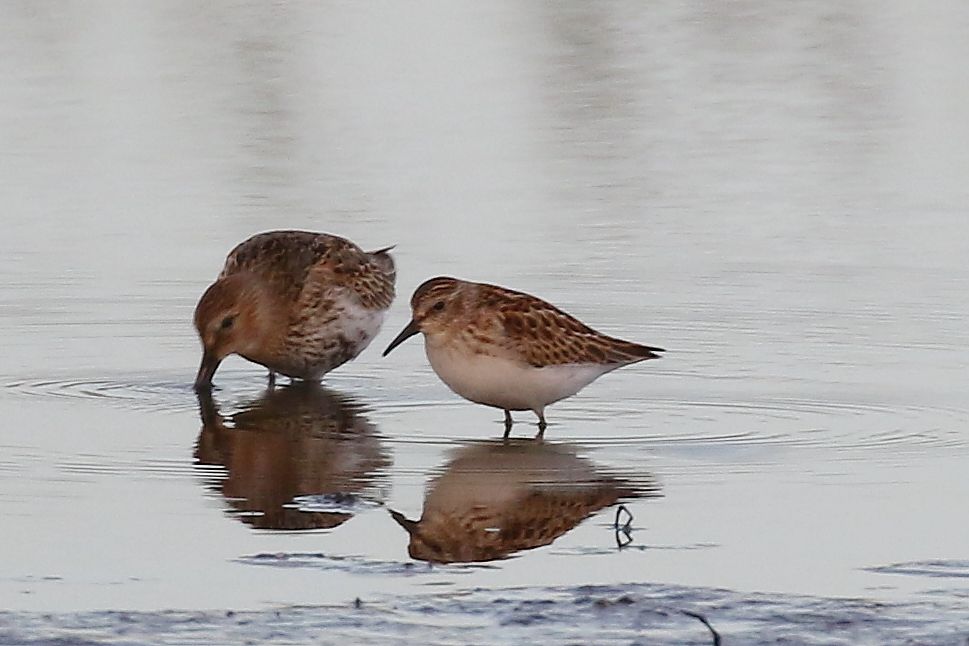
| Smaller than the Dunlin on the left, Least Sandpiper has a slightly longer and more de-curved bill than Little Stint |
I was on the train on the way home when the news broke, and when I sent a text to my neighbour and fellow Swineham-dodger Trevor to share the news, it emerged that he was on the same train. We therefore strode to our respective homes to collect our gear and I picked him up shortly after to head to Lodmoor. One of the iron laws of twitching Weymouth from Wareham as dusk approaches is that you will wait at least five minutes at the Wool level crossing for the train to pass. With that obstacle eventually cleared, we made good time to Lodmoor only to find that the Stilt Sand had flown off - five minutes before our arrival. It looked like the delay at Wool had cost us more than a nervous wait, and we pondered our next move - stick around and hope it comes back, or head to the next decent bit of mud at Ferrybridge in the direction the bird had reportedly flown?
 |
| Least Sandpiper shows more prominent dark lores compared to the similar (and even rarer) Long-toed Stint |
 |
| A bright juvenile |
Such are the dilemmas of twitching, and we prevaricated just long enough to make a trip to Ferrybridge a less attractive option, as dusk was fast approaching, and we concluded that our time would be better spent doing a circuit of Lodmoor which was still the most likely location for the bird to reappear. As we approached the western edge of the reserve, my phone rang and a surprisingly calm Brett Spencer broke the news that he had just re-identified a reported Little Stint as a Least Sandpiper - an even rarer American wader than the Stilt Sand and the first record for Dorset. We were just 100 metres away and covered this distance in a reserve record time. Dave, finder of the Stilt Sand, was with him, graciously accepting Brett's apologies for the outrageous act of up-staging!
 |
| Stilt Sandpiper at Lodmoor |
 |
Monday night's record shots of the Stilt Sandpiper taken at ISO1600 look like they were taken with a night vision camera..
|
The sun was by now about to dip below the horizon so there was just time to grab a few photographs and study the features which, despite the lateness of the hour, could be seen superbly thanks to the quality of modern optics. We stuck around enjoying the views and awaiting the arrival of Steve Smith who was still in transit. He got there breathless and in the near darkness, at which point another breathless Dorset birder, Nick Urch, emerged out of the gloom with news that the Stilt Sandpiper had been re-found another 100 metres to the north of where we were standing. This distance was covered in my second personal best of the evening and we found ourselves enjoying our second Dorset tick of the hour.
 |
| The Stilt Sandpiper was feeding actively |
 |
| The long, greenish legs can be seen in this view |
I returned after work the following day hoping to improve on the photographs from the night before. They are not great, but most of the key features of both can be seen at least. I do enjoy these post-work adventures at this time of year - with the evenings drawing in, you know you are not going to get far from home before dusk, or have too far to go to get home whether or not the target is present!
 |
| A very leggy bird |
 |
| This Great White Egret at Lodmoor was seriously up-staged by the duo of American waders |