Showing posts with label Black Guillemot. Show all posts

Friday, 22 October 2021

Shetland day 4: D-I-V-O-R-C-E

Day 4, like day 3, dawned bright and not very breezy - a rare treat in these parts two days running - so we started with a thrash around our temporary home patch at Hoswick. A nice selection of common migrants were seen, and Jono took one for the team by putting up a Jack Snipe at the price of falling balls-deep into rancid mud. As he returned to the house to clean up, I managed to locate another Jack Snipe bobbing in the sunshine in the incongruous setting of a field full of Aylesbury type white ducks. As we watched it we chatted with Claire and Nick Oliver, who had just arrived on Shetland and were staying nearby, before re-grouping at the house and heading off in the car.
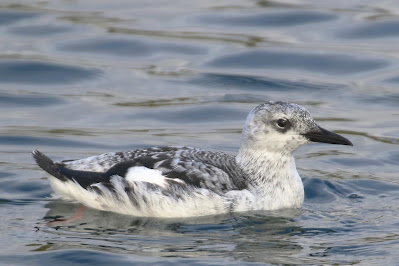
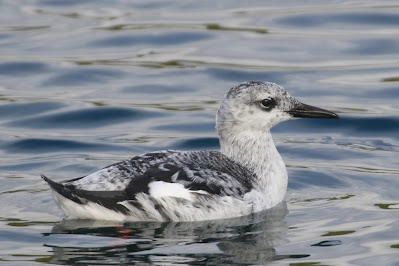
Black Guillemot, Toft

Black Guillemot, Toft
Before we got far reports started to come through of a Lanceolated Warbler on Unst. This was my nightmare scenario: a species notorious for being misidentified on Shetland, on an island two ferry rides away, which the other three in the team had already seen and would thus be less inclined to take a punt on. Any potential tension over this predicament soon dissipated however, when Claire and Nick offered a lift to Unst to anyone wanting to go for the Lancy. 
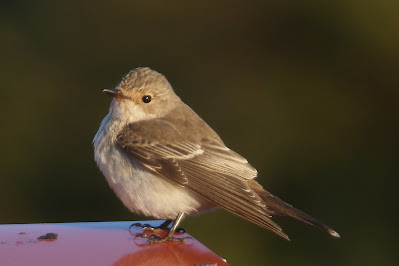
Spotted Flycatcher, Hoswick
Jack Snipe, Hoswick
I really didn't want to leave the team, but Lancy was high on my 'most wanted' list, and after two previous Shetland trips without success, I felt I had to go for it. So we arranged to meet the Olivers in a lay-by and initiated divorce proceedings. There was no bitterness or acrimony as the paperwork went through, in fact it was all very civilised. But I'm sure I saw a tear in one of the team's eyes as I popped my satchel into the leather back-seats of my adopted folks' Range Rover. Perhaps in hindsight it was just jealousy at the fancier ride I was hitching, but I like to think not.
A poor year for Yellow-browed Warblers on Shetland - and this shocker at Gutcher was the only photo I managed!
And speaking of shocking photos, this one of the Ring-necked Duck on Yell made the other members of the BBT team extremely jealous 
The report of the Lancy sounded pretty definitive, but I had learnt from previous bitter experience that such reports could quickly evaporate as a result of misidentification. Memories resurfaced of one particularly grim scenario in a rain-swept Quendale with birders chasing a 'Lancy' around which turned out to be a very wet Chiffchaff. As we boarded the first ferry from Mainland to Yell, news came through that the bird hadn't been seen since the original report - not great, but not terrible either as this ground-dwelling species could easily go missing for such a time. We were then approached by another birder, Phil, who couldn't get a space on the ferry from Yell to Unst, so joined our make-shift crew in the hope that the Lancy would reappear.
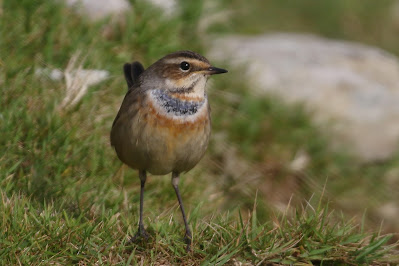
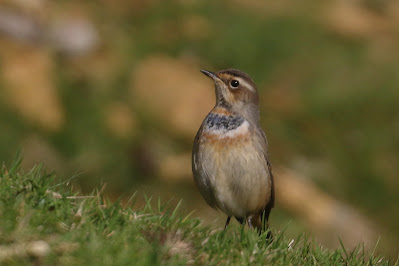
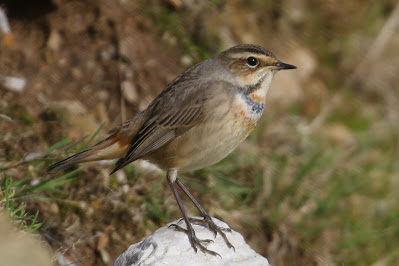
Bluethroat, Quoys
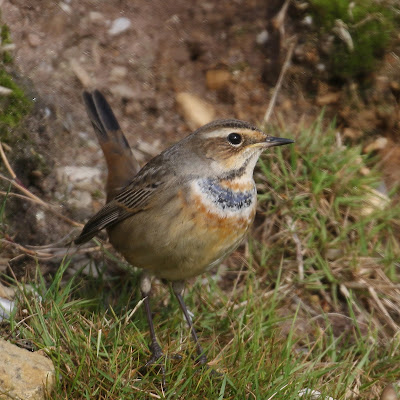
Bluethroat, Quoys
We had a few minutes to spare before catching the Yell-Unst ferry, enough to stop by a loch on the main drag to tick a distant Ring-necked Duck. But just as we were about to board the ferry, the worst case scenario unfolded: news reached us that the 'Lancy' had been reidentified as the much commoner Grasshopper Warbler. 
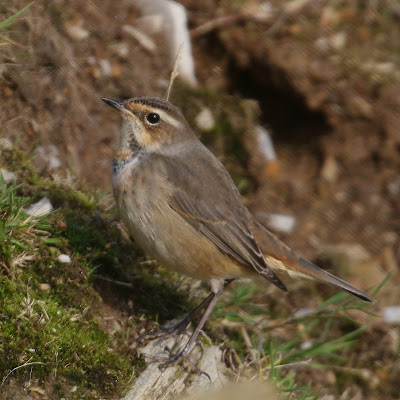
Bluethroat, Quoys
Bluethroat, Quoys

My eye started to twitch like Herbert Lom in the Pink Panther films at this point, but we quickly concluded that we had passed the point of no return and pressed on to Unst. We didn't even bother to seek out the Gropper site and headed straight for a quarry at Quoys where a Bluethroat had been reported. An hour's kicking around produced nothing and then Phil managed to deduce that the dropped pin we had made for based on the Birdguides app had been dropped in the wrong place, and we were looking in the wrong quarry!
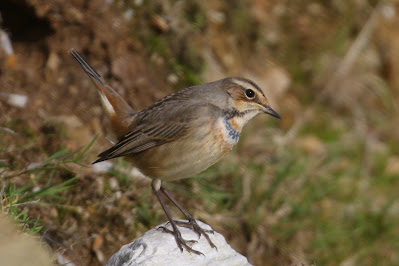
Bluethroat, Quoys
Bluethroat, Quoys
Heading a mile back down the road we quickly found the correct spot and within minutes had located the Bluethroat. This normally shy species first appeared at the back of the quarry hopping around a rusty manger, but then to our surprise and delight it started to head in our direction, and kept coming until it was barely a few metres away. A characterful bird, it completely saved the day with such a performance, and significantly lifted our spirits for the rest of the trip to Unst. 
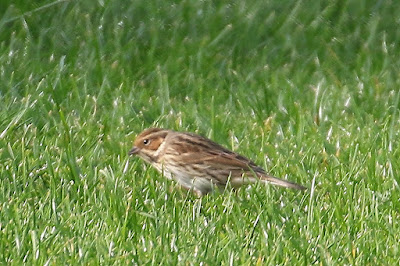
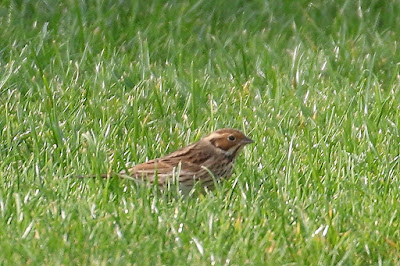
Little Bunting, Gutcher
On the way over whilst waiting for the Yell-Unst ferry we had seen a Yellow-browed Warbler in the last garden before the slipway, but were unable to locate a Little Bunting being looked for by Yell resident Adrian Kettle. On the way back Adrian was still staking out the same garden and got us onto the Little Bunting with plenty of time to get the final ferry of the day back from Yell to Mainland. 

In the meantime I had, of course, missed a belter of a day with BBT. Bradders had found a Radde's Warbler at Kergord, and Jono had picked up an adult White-billed Diver at South Nesting, plugging the gap on his trip list as he was absent when we saw one on the Northumberland coast on the way north. The Olivers were keen to catch up with at least one of these before dusk so we headed for the Radde's and managed fleeting views as it skulked in the long grass.

We returned to Hoswick and I was reunited with the rest of the team just before the decree nisi was pronounced. We patched things up over dinner and agreed never to speak of my unfaithfulness again. As for the Lancy, well that goes into the 'good reasons to keep going back to Shetland in Autumn' category for another year... 


Sunday, 25 July 2021

Black Monday

Monday night is probably the point in the week when I am at my least energetic, especially after a day's work, but when a Black Guillemot was reported at Barton-on-Sea last Monday, I realised I was going to have to summon up something if I was to add it to my non-motorised year list. Barton is just over the border into Hampshire and although I had cycled further a couple of times this year than the 57 miles which would be required to get there and back, I hadn't previously cycled to Hampshire, or done that sort of distance on a 'school night' in the middle of a heatwave.

Home to Barton-on-sea is about the same distance as home to Portland Bill, to which I had cycled just 2 days previously, and I was still feeling the effects from that in my legs, so I confess to some doubts about the wisdom of going. But if this year has taught me anything it's that challenging myself can bring considerable rewards, and I rationalised that, even though it was a long way, the journey eastwards along the coast would be pretty flat. Plus, although cycle route provision isn't great anywhere in Dorset, it's at its best in the Poole bit of Bournemouth conurbation, thanks to a period of progressive thinking by the Council there which would make at least that part of the journey a bit easier and safer. 

A quick getaway after work was necessary to maximise my chances and having achieved this I hit the seafront at Sandbanks just after the prohibition on cycling was lifted at 1800. I had forgotten about the 10 mph speed limit on the beachfront but, it being a hot day, it turned out that breaching it would have been a nice problem to have as beachgoers were still milling around in reasonable numbers. I was therefore reduced to picking my way carefully through the crowds until they started to thin out around 5 miles later at Boscome. A few miles more and the climb up the cliff at Southbourne was as close as the journey got to 'hilly' and I was soon working my way over the River Stour and around the Christchurch by-pass.

Several roundabouts later and I was crossing the border into Hampshire and dropping down to the beach at Barton-on-sea. News on the Black Guillemot, a pretty rare bird in these parts, had been a bit scarce since lunchtime so I had made contact with a local birder, Olly Frampton, who I suspected might have been to see it. Indeed he had, at about 1530, and he kindly sent me precise directions and the useful advice that I should look close in to the shore as the bird had been just a couple of metres out. This gave me hope that I could see the bird quickly and begin the long journey home before it got too dark. 

However, there was no sign of the bird for some time after my arrival. A lady on the rocks said she thought she had seen something which fitted the description I gave about 15 minutes earlier but it had flown out to sea. I was pretty sure I was in the right area but not certain so dropped Ollie a line to check. He called me back with the bitter sweet news that birders on the clifftop above me had been watching the bird but had lost it to view. He surmised that it might have slipped around the headland into the bay to the east of where I was standing. I had scanned the same bay several times without success but tried again - without success. 

Things were getting desperate now and the sun was dropping below the horizon. I decided to have one more thorough scan of the sea before leaving but again this produced nothing. At least, having dipped, I would be able to get the train home. I packed away the camera and changed into a fresh T-shirt for the journey home but before packing the bins I glanced forlornly for the last time into the bay where Olly thought the bird may have gone. And there it was, at the far end.

I was keen to get a photo, but the long beach between me and the Black Guillemot consisted of deep shingle - not ideal for pushing the bike, even through the narrow strip of sand being lapped by the surf. I carried it for a bit but it was too much - it was still a warm evening - so ditched it at the base of the cliff, yomped the last few hundred yards and spent a happy few minutes papping the auk in fading light as it came within a few metres of the shore. In truth it looked a bit poorly, the flight feathers being badly worn, and at the time of writing it had indeed been taken into care.

Black Guillemot is one of my favourite species, so I was delighted to have seen one travelling under my own steam - though the down side of seeing it was that I was now going to have to cycle all the way back to add it to the non-motorised year list! I had been pretty exhausted on arrival, and the bird had taken much longer to find than I had hoped, so the last couple of hours would have to be completed in the dark. Fortunately, the journey was pretty straightforward, and the 10 mile beachfront stretch which had been so busy on the way over was delightfully empty but for a few late night revelers. I got back just before midnight, shattered but happy to have chalked up my 196th species for the year seen by bike or on foot.


Sunday, 18 November 2018

Shetland: part the third, and last

As well as the rarities (see parts one and two), our week on Shetland back in October provided some opportunities to study northern species which we see only infrequently on the south coast of England. Top of the shopping list for me were the winter plumaged Tysties which frequented Lerwick Harbour. These charming birds look good in just about any plumage but I had not had much luck previously photographing them in their winter whites.
Close behind were the Twite, a bathing flock of which provided some compensation for two unsuccessful yomps through the infinite iris beds of Quendale in search of a reported Lanceolated Warbler. On both occasions we arrived to find no sign of the bird or the finders, reducing the chances of re-finding this mouse-like mega to a shade less than zero.
Otters were seen daily for the first few days, while other Shetland staples included Hooded Crow, Whooper Swan, Mealy Redpoll, Kittiwake, Fulmar and the ubiquitous Shetland Wren. The hoped for Killer Whales did not show for us but, unlike last year when the seas were whipped up by constant strong winds, we enjoyed a few calm days this year which gave us at least a chance to look for them.
Well that just about wraps it up for Shetland 2018. There were a few disappointments - principally the wild goose chases for the Lanceolated Warbler and a Pechora Pipit on Unst - but these were quickly forgotten when, as my wife said when I recounted the lowlights to her, 'there's always next year'. That's as good as a signed contract allowing me to go again in 2019!
And besides, the few disappointments were eclipsed by the many highlights of the trip: White-winged Scoter, Woodchat Shrike, Rosy Starling, River Warbler, Pied-billed Grebe, Eastern Yellow Wagtail, Citrine Wagtail, Rosefinch, American Golden Plover plus Barred, Marsh and Melodious Warbler were not bad for a week's birding.
It just remains for me to say many thanks to Bradders Birding Tours for providing another excellent driver for the trip, and the clans Vaughan for releasing Bob and Howard for another northern adventure. Good times in excellent company.
Rarest thing I saw on Shetland: a near vertical windsock

Sunday, 15 October 2017

Shetland day 4: the tipping point?

During our first 3 days on Shetland we had worked hard in challenging conditions for relatively little reward: there had been plenty of birds, and a couple of good ones, but nothing to justify breaking out the cigars. After another morning grilling the gardens of Hoswick and finding yet more Yellow-browed Warblers, we felt we had earned the right to go and look at other people's birds for the rest of the day. Specifically, a Rustic Bunting at Melby, back on the western mainland, in an area which, frustratingly, we had checked thoroughly a couple of days previously.
Rustic Bunting, Melby
The Rustic Bunting showed soon after our arrival, feeding on the verge but before I could get a decent record shot a car approached and flushed the bird. Fortunately, it landed much closer, enabling a couple of half-decent pictures to be obtained. A few minutes later, and we were bundling back into the car to head north for the first 'mega-alert' of the trip: a Pallas's Grasshopper Warbler had been found at Barnafield, a good 40 miles drive away in north Mainland.
This Black Guillemot moulting to winter plumage was just offshore at Melby
One of my favourite birds, known in these parts as the Tystie
Having been quick off the mark, and not seeing too many birders on our travels over the previous few days, we thought we might be among the first on site - a bit of a miscalculation as the major rarity had brought all the birders on Shetland out of the woodwork. We joined an expectant group of about 50 in an orderly assemblage around a small iris bed with a stream at its base. Within a few minutes we had seen the 'PG Tips' - named for the white tail tips - fly from an iris bed to some nettles, revealing a long, dark tail with the eponymous tips in the process. It was partially obscured and characteristically skulking when on the ground, but was on view just long enough to grab some record shots and piece together the key features.
Pallas's Grasshopper Warbler, Barnafield
A new species for my British list, it crept stealthily down through the nettles, revealing yellow underparts
One of this species had been seen a few weeks previously in Norfolk, but reports of bad behaviour at the twitch meant I had no desire to go searching for that particular individual, so it was great to see one with a small and orderly crowd. Some of them, including fellow Dorset birder Roger Howell, had waited several decades to catch up with this species so it was a special experience for all of us. Well done to the finders for checking out the iris bed, of which there must be thousands on Shetland which look equally if not more promising.
On the ground the PG Tips showed a dark, streaky crown, dark tail and hint of a rusty brown rump...
... and a prominent supercilium compared to other locustella warblers
We left the PG Tips just as the weather turned foul again, and the route home provided an opportunity to cruise the Aith-Vementry road where a Short-toed Lark had been seen earlier in the day. It was bucketing down and we didn't hold out much hope, especially as no-one fancied getting out of the car when we arrived at the site.
Earlier in the day we caught up with a putative Siberian Oystercatcher of the sub-species longipes at Sandwick - picked out from the regular Oycs by its browner upperparts - as Howard pointed out, if it is one, it was probably the rarest bird on Shetland that day.
Our home for the week (bottom left) near the beach in Hoswick
Miraculously though, the Lark was still there, grovelling in the gutter and looking about as water-logged as a passerine can look - another reminder of the trials which migrant birds are subjected to. Heart-warmingly, it survived the night and was still present the following morning, though we became quite concerned for its welfare a second time as the weather closed in again that afternoon.
The barely recognisable Short-toed Lark near Aith looking pretty sorry for itself in horizontal rain
Birders looking for the PG Tips - the largest crowd we saw in our nine days on Shetland