Showing posts with label Stone Curlew. Show all posts

Sunday, 7 August 2016

A day not at the beach

It's that time of year when our part of the world in Purbeck fills up with visitors heading for the sandy beaches of Studland. Sometimes there's only one thing for it to get away from all the people trying to get away from it all: head in the opposite direction in the middle of the night. Suffolk seemed like as good a place as any to do so this week, especially as a Western Purple Swamphen had rocked up Sunday and had been parading in front of workshy twitchers for the following three days.

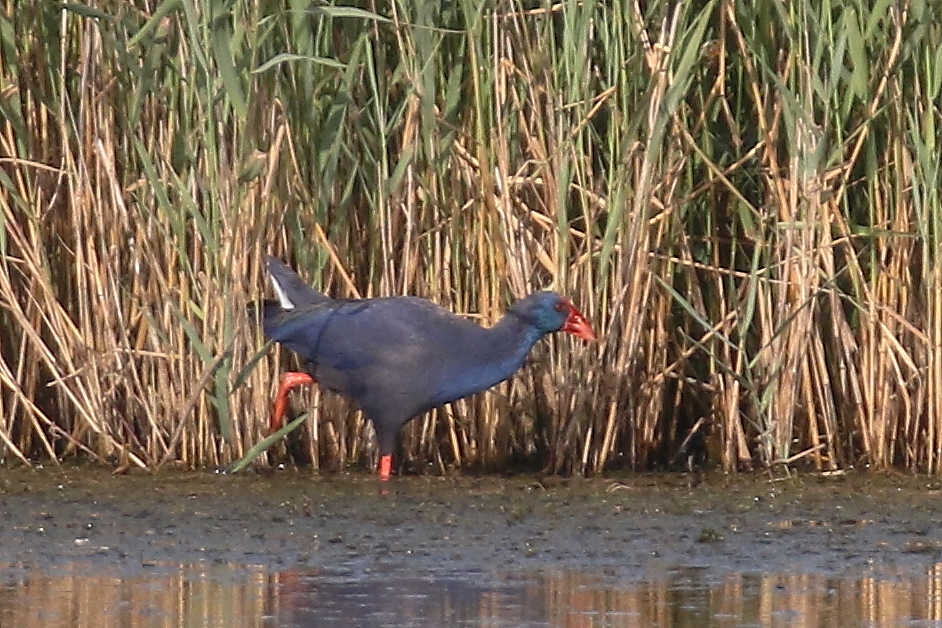
Initial views were obscured - but unmistakable
The Swamphen showed a large red shield on the forehead
Huge in size comparison with a nearby Moorhen
I hate to be left out so I took Thursday off, by which time I had established that Jol Mitchell and Marcus Lawson were interested in coming along for the ride. Jol and Marcus are Secretary and General Manager of the Dorset Bird Club respectively, and, like the US President and Vice-President, are not normally allowed to travel in the same vehicle for security reasons. Should both be taken out by, say, one of the birding militias from Portland or Christchurch, the consequences for social order in Dorset wouldn't bear thinking about. We might never see another Bird Report. But with both DBC limos up on blocks, they had no choice but to slum it with me.
A short flight revealed the elongated toes
We enjoyed extended views as the Swamphen fed around the edge of the pool
Another size comparison with Little Egret
Jol was so keen he arrived on Wednesday evening with a sleeping bag, more excited about our forthcoming twitch than a teenage girl at a Justin Bieber-themed slumber party. But this did at least make getting away promptly on Thursday morning a bit easier, and we picked Marcus up in Poole as planned in the wee-ist and smallest of the wee small hours. The journey towards London went smoothly but Jol's neurotic tracking of the travel news presented us with one of the great dilemmas of trans-national twitching: to boldly go clockwise or anti-clockwise around the M25? Jol favoured the northerly option, Marcus the opposite. Good job there are more than two members on the DBC Committee, I thought. Suspecting that reported closures on the M3 and the northern stretch of the M25 would divert us into booby traps set by CHOG guerrillas to assassinate my illustrious passengers, I broke the deadlock by eventually plumping for the southerly route. We avoided paying the Dartford Crossing tolls, which kick in at 0600, by several hours and from then on it was plain sailing up the A12.
White undertail coverts can be seen here
While often hidden in the reeds it did occasionally stand out in the open
An impressive beast
Like my last long-distance twitch, this one was equally remarkable in that it involved three dads getting some synchronised time off from tending to paternal duties. And like the Outer Hebrides trip, bawdy and irreverant humour helped the time fly by. Marcus can recite by heart every episode of 'The Young Ones', most of the sketches from 'Not the Nine O'clock News' and the complete works of the Viz Profanisaurus, so we spent much of the journey educating Jol, who has led a more sheltered life, in the joys of the latter's double entendres and puerile euphemisms.
Bittern beyond the South Girder pool
A family party of Stone Curlew
Juvenile Water Rail on South Girder pool
'Huzzahs' rang around our chariot when a tweet confirmed that the Swamphen was still present as we pulled into the Minsmere car park - and a 10 minute walk from there saw us looking hopefully into the reeds of the South Girder pool where it had spend the previous four days. The silence of what seemed like a long-wait, but was only in fact about 30 minutes, was broken by Marcus alerting us that the Swamphen was about to emerge from the reedbed to our left. Initial views were obscured but the giant purple rail with the massive bright red conk could hardly be mistaken for anything else.
Several Grayling were at Minsmere - my first of the year
Unusual to see them nectaring on buddleia
Several Painted Lady were also around the visitor centre
After another short wait when the bird was out of view, it emerged to creep around the perimeter of the pool, affording great telescope views as it preened and fed by breaking off reed stems, holding them in its elongated toes and stripping them with its outsized bill. Satisfied with the extended views, Jol headed off to hook up with an old friend at the sluice while Marcus secreted himself in a hide to root out some waders.
Bee Wolf
Digging out a nest hole
Grayling on the café wall - like us, attracted by the smell of bacon rolls
I stayed put, convinced that the Swamphen would complete the circular route around the pool and walk right in front of me allowing for better photos to be taken. It did about 330 degrees of this 360 degree circuit in the following hour, and just as it was about to strut out of the reeds into the open to be serenaded by the melodic whirr of my motordrive, it thought better of it and turned back. A flyover Bittern was ample compensation though, and, satisfied with our views, we headed back towards the car. With a potential first for Britain under our belts, the long journey home was a breeze. The Swamphen didn't stick around for the weekend, so the sacrifice of a precious day's leave was well worth it. With thanks to my travelling companions for a jolly dads' day out.

Saturday, 30 May 2015

Rare breeders

For some reason I can't think about Monty's Harrier without being reminded of a famously sweary line from Withnail and I. This doesn't happen very often, as they have become a very rare breeding bird in Britain, having started off being not very plentiful in the first place. After an early start from Dorset en route to a Gannet-fest at Bempton cliffs for a couple of days, I was able to call in at another RSPB reserve, Blacktoft Sands, where a pair have set up shop this year.
Male Montagu's Harrier, Blacktoft Sands
A very slim and elegant raptor
Here the male and female together
Records of breeding Monty's are usually kept pretty quiet but once in a while a pair will turn up somewhere like this where they can be kept an eye on and birders can be encouraged to see them there where the risk of disturbance is low rather than go looking for them elsewhere. Keep up to date with the progress of the breeding pair here. Always distant, though the female got up for a stretch and did a circuit which brought her a fair bit closer than the male.
Female Montagu's Harrier
Showing the white tail band here
The female Monty's looked very rufous in the field
Marsh Harrier and Avocet used to be rare breeders in Britain not so long ago but both have seen an upturn in their fortunes - and both were plentiful at Blacktoft. They weren't getting along too well though as several passing Marsh Harriers experienced the wrath of nervous Avocet parents intent on protecting their newly fledged chicks.
Marsh Harrier mobbed by Avocet
A Grey Heron gets similar treatment
Marsh Harrier
On the way back south I detoured via the Brecks for a day to see another rare breeder which I haven't seen for a few years - Stone Curlew at the Norfolk Wildlife Trust reserve on Weeting Heath. Four adults were present and I glimpsed a couple of fluffy chicks tottering around in the long grass too.
Stone Curlew, Weeting Heath (#188)
The birds were very vocal in the early morning
The hides at Weeting Heath are a reliable place to see Stone Curlew without the risk of disturbing the birds
Just around the corner from Weeting Heath is Lakenheath Fen, the third major RSPB reserve on my itinerary. A Little Bittern had been barking there for a week, but chose the day of my arrival to go elsewhere. Frustratingly, it was back again today after a two day absence which coincided with my visit.
Common Cranes, Lakenheath Fen (#189)
Cuckoo among the Poplars which used to ring with the sound of Golden Oriole song
Interpretation board at Lakenheath
Lakenheath used to be a reliable breeding site for Golden Oriole but although a male sang briefly there earlier in the month, they appear to have given up the ghost in recent years. Very sad, but a distant view of a pair of Common Cranes, which returned to the Fen to breed in 2007, made up for the disappointment of not seeing the Little Bittern.
Jay with what looked like a Great Tit chick.
Whitethroat, Lakenheath - more showy than...
...Lesser Whitethroat, taken back in Wareham last week (#190)

Tuesday, 9 April 2013

A rush of blood

I was out of county on Saturday on family business when two parties of Stone Curlews turned up on the West Dorset coast, and while I expected them to move on overnight, Sunday morning provided a slim chance to get this species on my Dorset list. I went for the pair at West Bexington which had shown well the previous evening, and eventually saw them in a stubble field with the help of the finder Alan Barrett and his fellow patch watcher Mike Morse. The birds were quite distant, but Mike had managed to check a colour ring combination which later revealed that at least one of them bred in neighbouring Wiltshire.

Skylark, Aust Warth
The plan for the rest of the day was to catch up with some other locally rare and scarce birds: Garganey at Radipole, Spoonbill at Lodmoor and Great Grey Shrike at Morden Bog. But then the pager reported a Killdeer in Lancashire. It is one of the iron laws of nature that a good bird will turn up just after my holiday comes to an end, but I thought I might have the jump on this one: it was just before 1100, and I reckoned I could be at the Killdeer site by 1530. Maps and crisp packets, along with reason and judgement, were swept off the dashboard and replaced with a satnav, which I set for Longridge and headed north.

Distant Stone Curlews at West Bexington, Dorset

A while later the pager reported that the bird had flown, but I ploughed on, and half an hour later it was back. I found myself uttering an involuntary 'Come on!'. Another half an hour and it was gone again, so it was clearly not a settled individual. At times like this, decisive action is required, so I pulled into the services on the M5 to procrastinate.

Short-eared Owl, Aust Warth
This second negative report saw my adrenaline levels plummet, the rush slowed and after a reflective cup of coffee I concluded that I might as well dip on Twite at nearby Aust Warth and save a tank of fuel as dip on Killdeer in Lancashire. So dip on Twite I did, and for a couple of hours. It was still a good decision as the Killdeer was not seen again all day, and at least there were Short-eared Owls to enjoy at Aust.
Shoveler, Ham Wall RSPB, Somerset
So with two sets of plans for the day not quite coming off, it was time for plan C: return home via the Somerset levels and try to photograph the long-staying Pied-billed Grebe. This was a bit more successful - the bird came quite close, albeit in poor light.

Pied-billed Grebe, Ham Wall RSPB, Somerset
More impressively, it repeatedly gave its distinctive call, a resonant yodel, puffing out a throat sac which seemed to double the thickness of its neck in the process.

The Pied-billed Grebe puffing its throat out and giving a haunting call
If the Little Bitterns return to breed on neighbouring Loxton Marsh this spring, you might be able to hear their distant dog-like booming at the same time as a Pied-billed Grebe calling - a collectors item for the sound recordists out there.

When wary, the Grebe would lie low in the water and not dive but submerge like a submarine with the body held horizontal - an interesting bit of behaviour
The penalty for all this tarting around was to miss a Red-throated Diver, one of my favourite birds, at home on Swineham Gravel Pits. While still present yesterday afternoon, it had gone by the time I got there at dusk, though a Barn Owl, a Marsh Harrier and a ringtail Hen Harrier were some consolation.

Me and the 'Peat Moor' centre on the Somerset Levels: made for each other
And so it was back to work today, secure in the knowledge that a full diary and an even fuller in-tray will prevent any further rushes of blood to the head, at least until the weekend.

Saturday, 30 March 2013

Get thee to a Nunnery

So said Hamlet to Ophelia, and if Ophelia wants to see a Black-bellied Dipper, it's still good advice. The Nunnery in question is in Thetford, home of the British Trust for Ornithology, and the bird has spent the winter nearby, next to Three Nuns' Bridges, off Nuns' Bridges Road, in case you hadn't got the nun-based influences on the area. I was guessing that one of the BTO staffers stumbled across the bird in their lunch hour and so it seems.

Black-bellied Dipper, Thetford
I was itching to road test my new Canon 7D, and what better way to put a camera through its paces than taking photos of a small dark bird in a small dark place? Taking photos of a small dark bird with a white breast in a small dark place full of shimmering water, that's how - a scenario guaranteed to test the exposure skills of even the best camera and photographer. The forecast was cloudy with sunny spells, which also boded well for trying out the new gear in a variety of light conditions.

For those who give a toot about such things, this shot taken in slightly better light at 1/200th sec, f5.6, ISO 400, tripod and shutter release cable. Same settings for the shot above except 1/125th sec.
After an early start from Dorset I was on site just after 0800.The Dipper took a little while to locate but the telltale sign of a man in camouflage gear lying in mud on the river bank gave it away.

1/160th sec, f5.6, ISO 400

Another dozen or so photographers then appeared from downstream - good to see a friendly face in the form of James Lowen among them - I thought they might be following the second Black-bellied Dipper which turned up at the same site recently, but it soon became clear they were in pursuit of the local Otters.

Otter. Shame about the twig. Life's too short for Photoshop. 1/640th sec, f5.6, ISO 1600
 
I joined them as a very compliant Otter swam around at close range and climbed out of the water amongst slightly less compliant vegetation. The light was still pretty poor so James and I returned to the Dipper to comfort it with the now familiar sound of whirring motordrives. It gave a few bursts of song in return, so clearly a male. After a couple more hours I had managed a variety of shots in degrees of light and shade, and used up all my memory cards, so decided to call it a day.
 
Otter. Aperture Priority (f5.6) 1/400th, ISO 3200)
So the wildlife performed, but what about the camera? This is not the place, and I'm not the man, for a full technical review, so let's just say I was very pleased with the results - sharp, good colour rendition in the circumstances, and capable of a very fast burst of 8 frames per second. It's also reasonably idiot proof, a bonus for the idiots among us.

The Dipper used this large stump mid-stream as a songpost.
I took a few test shots with the 40D just to convince myself I hadn't wasted my money on the upgrade, and they were reassuringly trashy. I shan't be pensioning it off yet though - as well as a treasured item, it'll make a pretty good spare body when I get the shutter button fixed.

Catching a rare bit of sunshine, allowing a dizzyingly fast shutter speed of 1/250th sec.
 The 7D was a bit grainier at higher ISO ratings than I was hoping for, but these were pretty extreme conditions, and I think my expectations were probably unrealistically high. I suspect I'll still be grateful at some point for the maximum ISO rating of 6400 compared to 1600 on my 40D. Any more criticisms? At this stage, I have to say Nun. See what I did there?

Just time to tick and run Stone Curlew in the Brecks on the way home, an early spring migrant overlapping with the not yet departed wintering Fieldfare (out of focus top right).