Showing posts with label Whitethroat. Show all posts

Thursday, 22 September 2022

July-lights

The post-before-last recounted my longest bike ride of the year to date which saw me cross the Hampshire border for the first time in 2022. A successful venture which made me feel like I had got my cycling mojo back after the frustrations of June. A few days after the Hampshire marathon my legs were still feeling it but a gentle stroll down to the patch was enough to add Yellow-legged Gull to the yearlist. Four adults were present on one of the scrapes which have been a reliable site for this species in recent late summers, and the number rose to 10 later in the week. 

Painted Lady, Tarrant Rushton 17 July

Painted Lady, Tarratn Rushton, 17th July

By the 24th of the month the legs had recovered enough to repeat another summer pilgrimage from last year: a ride to Portland to look for Balearic Shearwater - one of the rarest species in global terms to grace our shores. The journey down cycling into the wind starting at 0530 was challenging, but ultimately successful - a couple of distant 'probables' were followed by a few Balearics close enough to photograph, plus two Arctic Skua and half-a-dozen Manxies.

Corn Bunting, Tarrant Rushton, 17th July

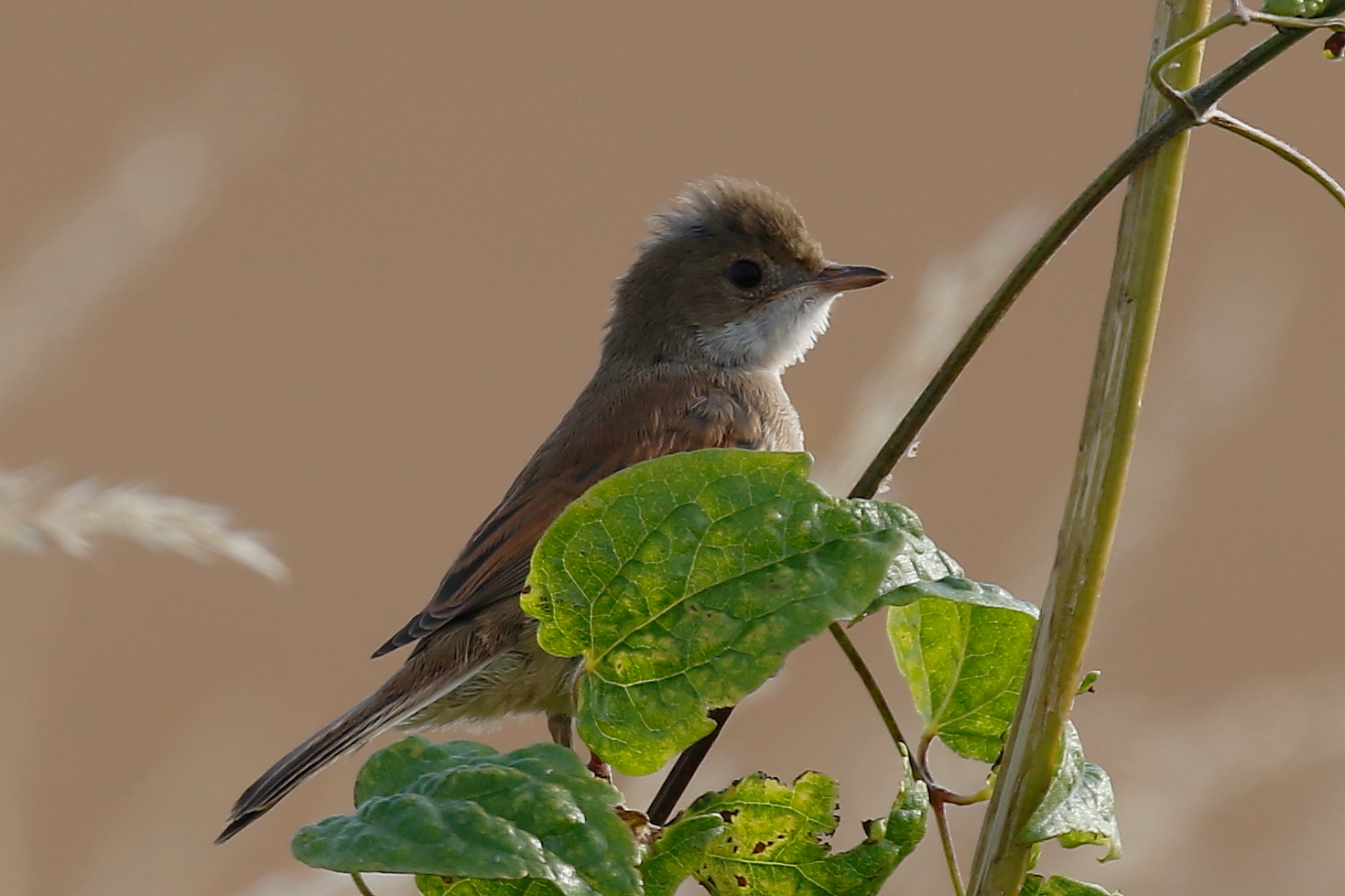
Whitethroat, Tarrant Rushton, 17th July

When I started the 2021 non-motorised yearlist I decided to include 'heard only' species but in the end managed to see everything, including the normally elusive Quail. This year I adopted the same rule which made a visit to Tarrant Rushton airfield, a reliable site for hearing if not seeing Quail, a good option. After dipping on 17th I managed to hear at least 3 calling males at the second attempt on the evening of the 29th. The month saw 6 new species added to bring the yearlist to 192 (compared to 198 at the same point in 2021). 318 miles had been cycled, my second highest total for a month in 2022 after May.
Balearic Shearwater, Portland Bill, 24th July

Balearic Shearwater, Portland Bill, 24th July

Sunday, 17 September 2017

Autumn gathers pace

This week's weather appears as a statement of intent about the changing seasons, though for migrating birds 'autumn' has of course been underway for some weeks. Yesterday I met up with my parents on Portland to see what was about on a day which started out fine and bright, but which saw torrential rain by lunchtime, arriving just in time to give us soggy chips at the Bill's Lobster Pot café.
Wryneck, Portland Bill
Probably the best view I have had of this species
Photographing it in dappled light on the ground was tricky...
...but the cryptic plumage can be seen well here
And here's a clue to how the Wryneck got it's name
Shortly before the downpour, we had jammed in on a long-staying Wryneck in the Obs quarry - not only was it on view as soon as we arrived, shortly after it was flushed by a rat and perched up to give unusually good and extended views of this often shy species. Apart from Wheatears, common migrants were thin on the ground on Portland, though there were plenty of hirundines in the air feeding up before the long journey south.
Northern Wheatear at the Bill
One of nine in the same paddock
Not just migrant birds on Portland - there were many Red Admiral around too
The resident Rock Pipits entertained us while we sat for lunch
Most of the Wheatears were sporting the tawny female-type plumage - but at least one male (left) was among them
In contrast to the shortage of common migrants on Portland, a visit to Greenlands Farm near Studland a couple of weekends ago saw the fields and woods alive with them. Yellow Wagtails were particularly entertaining and I spent a warm morning stalking them, hiding behind gorse bushes and acting like a horse in an effort to gain their trust. Suffice to say I got closer to the horses than the wagtails.
Yellow Wagtail, Greenlands Farm
The wagtail flock follows cattle and horses around the National Trust land at Greenlands...
 ...feeding right under the noses and feet of the livestock
This blue-grey headed individual didn't look like the regular British race - enquiries are underway to establish what flava it might be, but it's presumably of continental origin
Good to see these migrants on the ground rather than just flying overhead calling
While the Yellow Wagtails dominated the paddocks at Greenlands, Willow Warbler was the most numerous migrant around the forest edge - every tree seemed to contain two or three - with Common Redstart, Spotted Flycatcher and Whitethroat present in smaller numbers. 
Redstarts seem to like Greenlands - here a male...
...and here a female

Willow Warbler
Willow Warbler
Spotted Flycatcher
Spotted Flycatcher

I became enamoured with Greenlands Farm during a late summer bird race in 2015 - the concentration of migrants there at this time of year puts my own patch at Swineham to shame - a good excuse for my continued neglect of the latter! Purists would no doubt castigate me for forsaking my own patch to go farther afield where the grass is greener - I would merely point at that many hard core patch workers travel further to get to their 'local' patch than I do to get to Greenlands!
Common Whitethroat, Greenlands Farm
 
Wheatear, Greenlands Farm
House Martins were gathering around Manor Farm on Studland at the end of August
This rare visitor to Poole Harbour, a Hooded Crow, was also at Manor Farm

Wednesday, 30 August 2017

Better late than never

Blogging appears a bit passé these days, what with Twitter and the like offering more instant gratification and immediate feedback for and from today's time-poor social media user. So passé, in fact, that I needn't feel remotely guilty about posting almost pre-historic news from a family holiday in Yorkshire earlier this month. Today the wonderful Bempton Cliffs RSPB reserve is playing host to two Greenish Warblers - one of a small number of species I have seen in Britain but not yet photographed. A couple of weeks ago there were no Greenish Warblers - but there were signs of early migration with a juvenile Cuckoo providing me with my best opportunity this lifetime to photograph a normally skittish species. Wheatears, Whitethroats and Wagtails were also in evidence in the fields behind the clifftops.
Cuckoo at Bempton Cliffs
Feeding on caterpillars in the long grass
Wheatear
Whitethroat
Yellow Wagtail
Bempton is world renowned for its Gannet colony - thousands were still on the cliffs, providing, in my humble opinion, about the best natural spectacle one can see in mainland Britain today. I now know I am not alone in holding this opinion - to quote another visitor overheard behind me at one of the many well-positioned viewpoints: 'That's, like, the most amazing nature I have ever seen. You know, with my actual eyes'. Quite.
Gannet
An imposing bird in an imposing setting
Note the pin-striped feet
Still much displaying taking place
A family party at Staple Newk
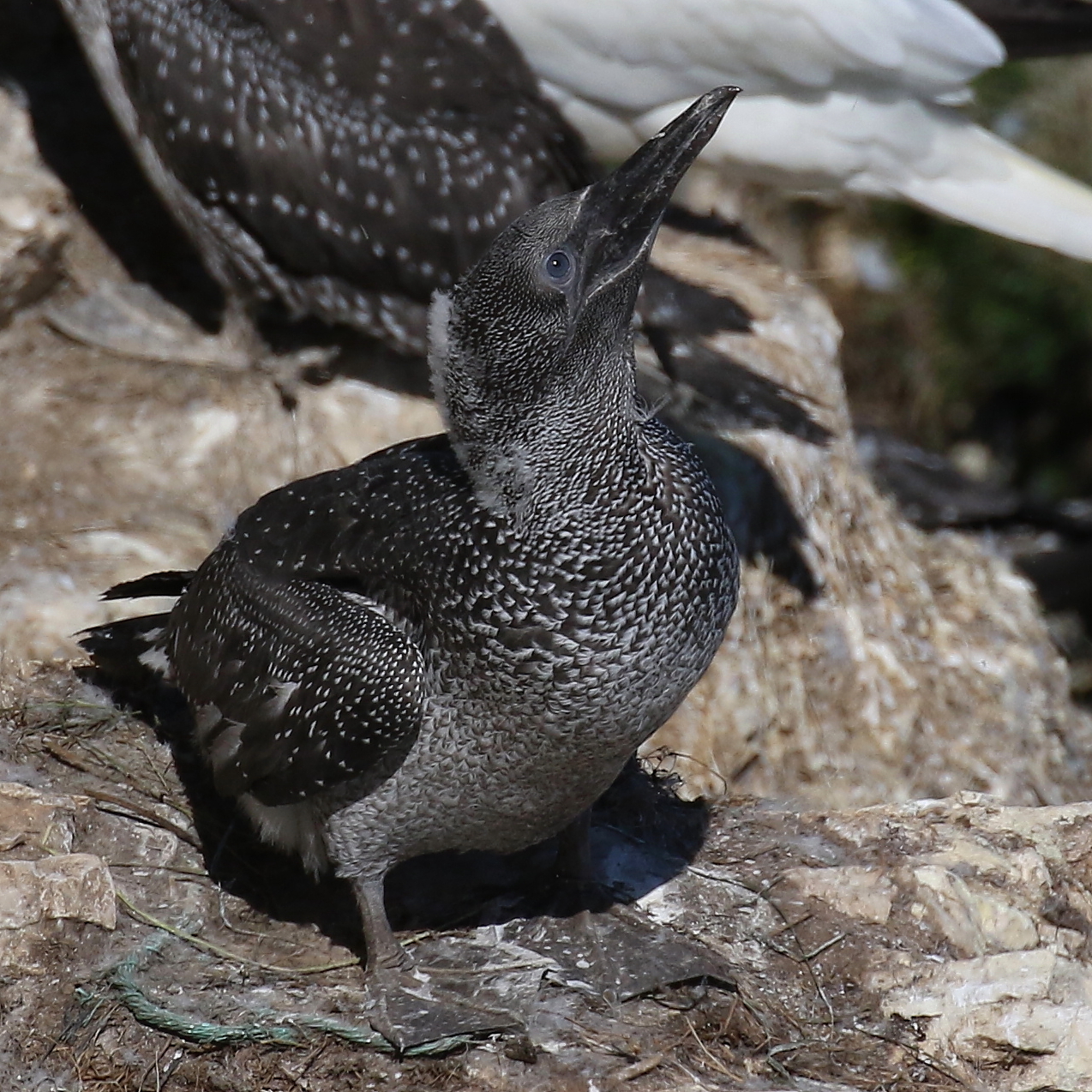
I had not been to Bempton at this time of year previously, so it was an opportunity to study Gannet chicks and fledglings at close quarters and in a variety of stages of advancement towards making their first flight. Some still looked like the plush toys in the RSPB shop, others were similar in proportion to the adults but their flecked grey-brown plumage was in complete contrast to the black, white and cream colours of the parent birds.
Gannet nestlings are prehistoric looking creatures
They breed so closely together that constant squabbling is the order of the day
Young birds can be viciously pecked by neighbouring adults if they cross an invisible line
Very young birds look like polar bears with dinosaur faces grafted on
They can get very large before the white down is replaced by feathers
Over 11,000 pairs of Gannet breed at Bempton, and at such a high density disputes between neighbours are inevitable - we winced as we watched young birds take quite a battering if they strayed into the wrong territory.
The rocky outcrop at Staple Newk is prime real estate for Gannets
A tiny fraction of the extensive Gannet colony
Gannet preparing to lunge off the sheer cliff
Gannet
It was quite difficult to isolate a single bird in the frame
The auks - Puffins, Guillemots and Razorbills - which are also a feature of Bempton in the summer had left their breeding ledges before our arrival in Yorkshire. But it wasn't just Gannets to admire - Kittiwakes were also still present in good numbers, and the Tree Sparrow flock around the visitor centre also appeared to be in good health.
Juvenile Kittiwake
Kittiwake on the rudimentary nest
Tree Sparrow
Tree Sparrow
Tree Sparrow
Tree Sparrow