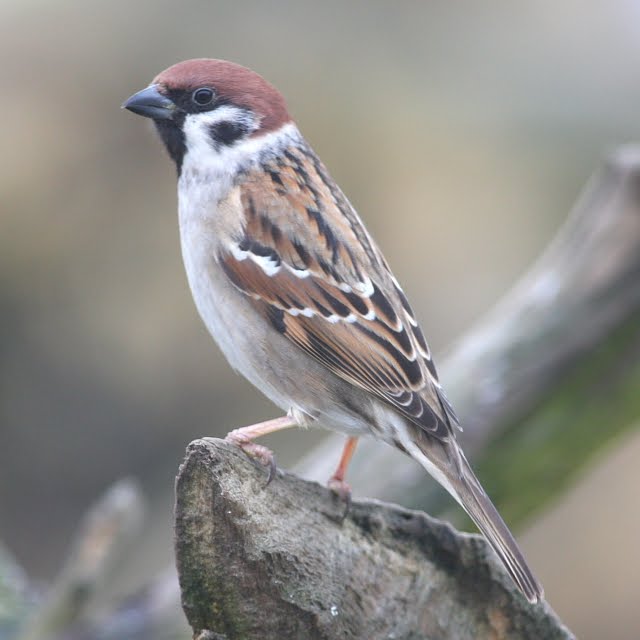
I only came across these birds much higher up the mountain at around the same altitude as the Ptarmigan (see previous post). Three birds were feeding in the small areas of exposed grass near the lochan at the base of the Coire. They allowed a close approa
 ch, and on the way back down I realised that the pictures would have been better had I had the presence of mind to wipe increasing amounts of rain from the lens. Always nice birds to see, but particularly in the snow!
 En route from Stirling to Speyside, a detour to Loch Laggan produced a female Black Grouse perched in a birch tree this morning. My main target for today was, however, another grouse - Ptarmigan, still in winter plumage at
 this time of year. I approached Cairngorm near midday to find the upper car park full - after the indignity of sharing a shuttle bus with a colourful army of skiiers, I began the arduous 90 m
 inute climb to Coire an Lochan where the birds are usually present. The weather was breezy but clear on setting off, and despite stepping through rapidly melting snow into streams beneath on one or two occasions, it remained so for the rest of the climb. When I heard the croaking call of male Ptarmigan nearby I knew that only mist and rain could get in the way now. Unfortunately, both turned up, driven by increasingly strong gusts of wind, just as I caught sight of two male birds and a female on the coire walls. The next couple of hours were spent happily, but dam
 ply, getting close enough to huddle under rocks for shelter and hope the birds would come closer. Eventually a pair did - close enough even to hear the female's soft clucking calls. Had the light been better I might have got some excellent photos but given the deteriorating conditions, I was happy enough with these. My third grouse species of the day was seen on the return journey when three male Red Grouse and a female flushed from beside the path.
 low Tit as this is reportedly the best site in Scotland for the species. Not this afternoon though - Great, Blue, Coal and Long-tailed Tit all came to feeders, but t
 he closest I came to Willow was reading about its regular appearance at the same feeders in the hide log. Still, Brambling, Nutchatch, Great Spotted Woodpecker and Red Kite around the reserve made for a worthwhile visit.
 Shooting at ISO1600 in dark and damp conditions stretched the camera to its limits, but it seemed to cope reasonably well.
 centre.

 A week off provided the opportunity to head to Scotland for a birding trip and a chance to catch up with my brother in Stirling. My own family were staying with friends in Kent so after dropping them off on Sunday I started the long journey north on Monday morning. North of the Thames that is, to Rainham Marshes in the hope of seeing the Slaty-backed Gu
 ll which had been present for several weeks and for much of the previous day. It's a miracle it's lasted that long considering the stuff the gulls eat from the local landfill site - very stinky birding. Many Herring, Lesser and Greater Black-backed Gulls were present but no Slaty-backed. A female Hen Harrier and half a dozen Corn Bunting brightened up an otherwise dull day, and though picking through the gulls was educational, staring at a landfill site all day doesn't do much for the spirits.
 ome proper birding. A dozen Waxwing on the hard shoulder of the M11 as I sat in a traffic jam heading north last night cheered me up, and Mersehead RSPB this morning provided further tonic. Barnacle Geese from the Svalbard population were fewer in number than nearby Caerlaverock, but whereas at the latter they are often quite distant, here the small flocks gave close views from the various tracks around the reserve. A Kingfisher and good numbers of Pintail were present along with more common waterbirds.
 he Saturday morning. Heavy rain did a good job of dampening the spirits of 250 would be dove twitchers, but the bird flew into a tree which could be seen from the road allowing most people to get a satisfactory view. At this point the crowd collectively exhaled, some enterprising brownies set up a cake stall, and all seemed well with the wet and windy world. The bird relocated to some nearby trees where telescope views were reasonable. Photography was almost a non-starter - this picture was the best I could manage - the rufous tones of the upperparts can just about be made out. I stuck around for a few more hours but could not improve on the earlier views. An American Wigeon on the way home was not far from the cemetery where my in-laws are buried so having twitched that, I stopped by to put some flowers on the grave in the hope of improving my standing with them - and their very tolerant daughter.