Saturday, 25 February 2017

Humpback Whale in Devon

A rare experience today seeing a Humpback Whale just 100 yards or so off an English shoreline - so lost for words I couldn't even summon up a bad whale pun for the title of this post. Thank to Steve Smith for the lift and the rugby referee style loud blast of the whistle when first relocating it off Blackpool Sands.
The Humpback Whale off Slapton Sands
Note the abrasions on the body
This was taken a few minutes earlier looking down from the coast road near Blackpool Sands
A passing Gannet gives some idea of scale
A fairly constant escort of gulls followed the Whale
The Whale's blowholes are on the right of this picture, the wind carrying spray to the left
The books say Humpback give a 'mushroom shaped' blow - a bit mis-shapen in today's stiff breeze
Humpbacks raise their tail flukes before a deep dive
Wonderful to see the huge tail out of the water
It was raining hard when these were taken so not great photos
A few whale watchers were at Slapton - boats have been asked to avoid the whale, and happily we saw none anywhere near it today - mind you, it wasn't really sailing weather
My driver and companion for the day, Steve Smith
A Black-necked Grebe at Slapton was slightly overshadowed by the Humpback

Tuesday, 21 February 2017

A tale of two estuaries

A short break with the family over half-term in Cornwall gave me the chance to catch up with two species of American duck, both relatively rare on these shores. First on the Hayle, a Green-winged Teal, the American cousin of our Eurasian Teal. We were staying in Hayle, so I nipped out before breakfast to look for it. There are usually plenty of Teal to sift through out in the channel viewable from the causeway over the head of the estuary but on arrival I could see just half a dozen. To my surprise, the Green-winged was one of them and it fed quite close in the shallows on a rising tide.
Drake Green-winged Teal on the Hayle Estuary
This was the entire Teal flock - what chance that one of the six would be the Green-winged?
Green-winged Teal
 A bit of aggression between drakes of the two species
When the Green-winged Teal stood on the mud a metal ring was apparent
Do any ringers out there think this look like a bird band from a North American scheme?
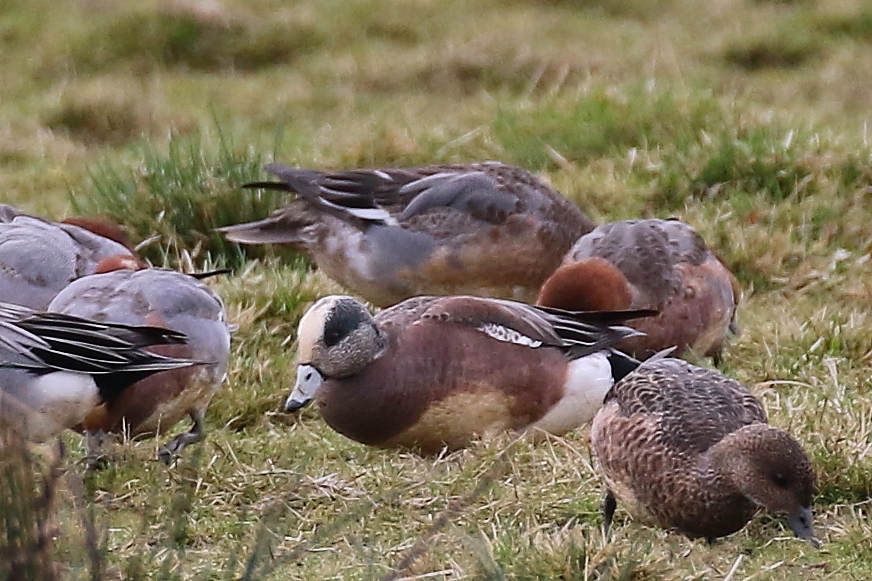
My second American duck of the trip was seen on the way home - an American Wigeon at Exminster Marshes, at the top of the Exe Estuary and just a few miles detour from our route home up the M5. Several large Wigeon flocks were evident on arrival - a slightly daunting prospect to search through them all - but a tip-off from a local birder who was just leaving suggested the bird I was looking for might be in one of the closer flocks. And so it was, picked up with just about my first scan of the bins.
A Spoonbill was also at Hayle
A young bird with horn-coloured bill and some black in the wing tips
First winter drake American Wigeon at Exminster Marshes
The Wigeon flocks were much larger than the Teal flock on the Hayle...
...but the American Wigeon was quite easy to pick out being near the front of the nearest flock
The American Wigeon spent most of the time feeding intently - a rare view with the head raised here

Monday, 20 February 2017

Bunker birding

I made the trip to Thurlestone Bay in Devon last November with my friend Trevor to see my first male Desert Wheatear in Britain. The bird was a bit bedraggled that day, so as I was heading to Cornwall with the family for a few days over February half-term, we took the southerly route along the A38 putting me within striking distance of this attractive rarity again.
On arrival at Leasefoot Beach, the Desert Wheatear was not present - a bit of a worry as it had been consistently there for several months, even returning after a short absence when it seemed to take a dislike to being trapped and ringed. I stuck around admiring the folded geology at each end of the sandy beach, and on returning to the base of the dunes was pleased to find the Wheatear catching the last rays of sun. When flushed by a dog it vanished over the dunes and I refound it perched on the roof of a small shed belonging to the local golf course. Away from the crashing surf I could hear its quiet sub-song - a scratchy warble mingled with a bit of melody - a real treat to hear this in the UK.
 
The Wheatear then perched up on some scrub at the edge of the golf course and continued to sing - I got some decent pictures of it with one of the greens as a backdrop, a pleasing contrast and a change from the classic views of it on the sandy beach which have littered the internet in recent months! It won't be long before the Desert Wheatear's northern cousins are arriving on spring migration - there must be a good chance of seeing both species together on Leasefoot Beach before the Desert Wheatear moves on.  
 

Tuesday, 14 February 2017

Wader wonderland

Almost forgot about these, languishing in a dusty corner of the hard drive labelled 'January'. Some cracking waders from around Poole Harbour last month.
This summer plumaged Bar-tailed Godwit was at Shore Road - the same bird I photographed this time last year
It has spent many winters now returning to this site, standing out among its more conventionally plumaged brethren
Bar-tailed Godwits, Shore Road
Compare to the more plain-backed Black-tailed Godwit 
This bird was feeding alone and at close range in Poole Park
Black-tailed Godwit
Oystercatcher, Shore Road
A blizzard of Avocets at Middlebere (click to enlarge)

Sunday, 12 February 2017

A distinct lack of wax

A small flock of Waxwings graced Poole on Thursday and Friday - so desirable they even persuaded Ian Ballam to part company with Lytchett Bay for a while. I headed around the harbour at the first opportunity on Saturday morning to look for them but despite checking out every supermarket car park within five square miles, they could not be found. After several hours I conceded defeat and cruised around some more familiar hotspots in Poole Park and Holes Bay.
A Kingfisher on the railings of the model boat pond at the partially drained Poole Park Lake relieved an otherwise grey day
Note the chipped bill tip - if it was a Blue Rock Thrush, people would say it was an escape :-)
Drake Goldeneye displaying
Female Goldeneye
Little Egret fishing in the shallows of Holes Bay - lovely plumes
The redhead Smew was a bit closer than on my last visit...
 
 
...but not as close as this Spotted Redshank
The outflow from the PC World drain into Holes Bay is a reliable site for them in winter
One was loosely associating with a large flock of Blackwits
Spotted Redshank

Monday, 6 February 2017

The best laid plans

'Fail to plan, plan to fail' say the text books, an aphorism I sometimes find myself using when being unnecessarily pompous at work. Then when my own plans come crashing to the ground, I am reminded of the alternative philosophy posited by the well known management guru, Mike Tyson: 'Everyone has a plan - until they get punched in the face'.
Distant Pacific Diver at East Chevington: incapable of sticking to a perfectly good plan
Pacific Diver shows a vent strap, part of which is visible here
These conflicting truisms rather sum up my weekend before last. The plan was as follows: drive through the night to see the sun rise at Druridge Bay Country Park in Northumberland, where a Pacific Diver had been giving the definition of crippling views on Ladyburn Lake. I have seen the returning Cornish bird several times so while it would not have been a new bird for me, the opportunity to photograph a confiding major rarity is what makes me tick these days, so it seemed worth the effort. If the Diver was present, I would fill my photographic boots and be on the road south by 1000 at the latest, get down to North Yorkshire for noon, tick my first British Pine Bunting, and then take a birder's detour on the way home via another long-staying, photogenic diver, the Lincolnshire White-billed, to complete a remarkable rare double-diver day. And with luck, I would still be home in time to tuck the children in to bed.
Pacific Diver lacks the white flank patch of the commoner Black-throated Diver, and is generally a dinkier bird - as comparison with a Coot shows
Pacific Diver has a paler grey hindneck compared to Black-throated Diver
The perfect plan, then: all I needed to do was execute it. Originally I was going to go on Saturday, but a poorly wife, and a glance at the weather forecast, persuaded me to leave it until Sunday. I drove part way up on Saturday evening and stayed at a motel to make Sunday's driving less tiring, and pulled into an icy car park at Druridge Bay as the sun was rising. Julian Thomas from Somerset, a familiar face from the Portland scene, pulled up next to me and with no-one else around, we strolled to the lake in anticipation of a close encounter with the Pacific Diver. It soon became apparent that the Diver had gone - the first day in nine that it had not graced Ladyburn Lake with its presence. I resolved to check the pool at East Chevington, where the diver had been seen before it relocated to Ladyburn, and concluded it wasn't there either after a cursory scan of the pool - too cursory as it turned out, as a call from Julian relayed that it had been found at the far end of the pool by a more diligent observer.
A mixed flock of White-fronted and Pink-footed Geese flying over Druridge Bay
Another skein of Pink-footed Geese over East Chevington
A breathy canter to the far end of the pool enabled a few record shots to be taken, and excellent telescope views to be had, and while it was bitterly disappointing that the Diver had chosen today to not perform at close range, at least I had seen it. By the time I left, I was half-an-hour behind my original plan - an imperfect, but recoverable situation, or so it seemed at the time. A relatively smooth journey to Dunnington near York saw me arrive just after 1230, and as I made the short walk from the car to the paddock near where the Pine Bunting was showing, birders leaving told me that it had been seen just minutes earlier.

I spent the next couple of hours grilling a large feeding flock with which the Pine Bunting had hooked up, as birds flew from a weedy field to the surrounding trees. Yellowhammers, Corn Buntings, Reed Buntings, Tree Sparrows, Bramblings, Chaffinches, Greenfinches and Bullfinches came and went but no Pine Bunting. It had been seen on and off in previous days either here or in a nearby sheepfield, so with enough daylight left to still go for the White-billed Diver, I tried the sheep field, where a seeded area was attracting plenty of Yellowhammers. While there, the Pine Bunting showed briefly back at the paddock - too briefly for me to get back in time to see it unfortunately. It didn't show again before I left at 4. So no Pine Bunting, and no time for the White-billed Diver either.
Tree Sparrows are much easier to see in the north of England - they were present at Druridge Bay and the Pine Bunting site
Close, but no cigar: Yellowhammer is a near relative of the Pine Bunting, another bird which hadn't read the script
Unbroken rain accompanied the long journey home. By the time I reached Dorset I had rationalised it quite well with the usual guff about how it would be no fun if rare birds always did what they were supposed to etc etc, and consoled myself with the thought that I had the best views of Pacific Diver I have enjoyed to date. Pine Bunting becomes officially my bogey bird, having now dipped a few, though with several being found this winter, perhaps I will get another opportunity to see one before long. A Plan B, if you will.