Showing posts with label Whooper Swan. Show all posts

Monday, 10 January 2022

We go again

Several friends have asked me 'what now?' after I put quite a lot of time and effort into a non-motorised year list in 2021. I doubt I will be able to repeat seeing 224 species in 2022 - only the combination of working mostly from home, neglecting domestic obligations, and benefitting from a belting spring for migrant birds in Dorset made that possible. But I certainly don't intend to stop birding locally by bike, and for several reasons. 

First, although I've never really had to watch my weight too much, as I edge closer to the next age range up on the census form (55-65), the exercise is proving necessary to keep it at a level I am comfortable with without having to make unwelcome changes to my diet (regular readers will be aware of my fondness for chips). Second, it's become an essential part of maintaining good mental as well as physical health - the endorphins really do kick in quickly when I get going these days, and the buzz of seeing a target species at the end of a long ride is surprisingly more satisfying compared to if I'd driven. Third, it's just become my preferred mode of birding locally: with some superb areas accessible by bike nearby but not by car, it takes me to places I might not otherwise get, giving a real sense of freedom. And I can't get the bike over the now locked gate at my Swineham patch any more, so cycling gives me a good excuse to neglect that as well ;-).

There are also the obvious environmental advantages compared to driving. I try not to bang on about them (I'll save that for the day job), but even if you aren't concerned about that low carbon/end-of-life-on-earth-as-we-know-it stuff there are other more direct impacts to worry about. To give just one example, on my travels at lower speeds last year I became visibly aware of the toll taken by vehicles in the form of roadkill. There were of course copious numbers of 'invasives' splattered on the roads - Grey Squirrels and, in these parts, Sika Deer, whose loss won't be mourned too much. But I also saw my first eared bat (of any kind, alive or dead) on the roadside, numerous thrushes, warblers and tits, a native Roe Deer and, most recently a dead Otter. So any reduction in that risk, however marginal, has got to be good too.

Anyway, as I say, I can't see myself reaching the dizzy heights of the 220s again this year in terms of the list - but with a few good wintering species lingering into the New Year in Dorset I thought I'd better sweep them up just in case. I'm nowhere near last January's total in terms of species, but while I clocked up about 120 miles in the first month of 2021, so far in 2022 I've done about 145 - so above par on that score at least. A few highlights of the year to date below.

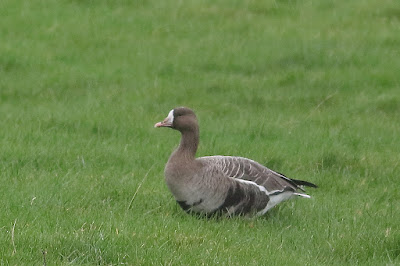
New Year's Day saw me heading west to Charminster, a very wet 40 mile round trip, to see a flock of 11 Russian White-fronted Geese

The Charminster White-fronts were a lot closer than the flock I saw at Hampreston in December - and accessible via one of the best bits of cycle path in Dorset!
A short detour to Silverlake on the way home enabled distant scope views of a redhead Goosander - a species I didn't see until August last year. It was a long way off!
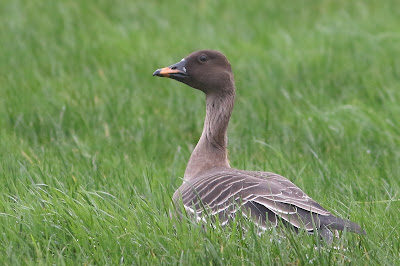
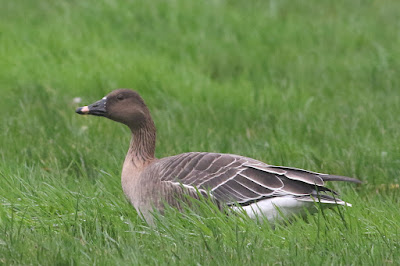
When I got back to Wareham from Silverlake, I knew the Tundra Beans were still at Upton - but for how much longer? I pressed on, adding another 15 miles to the journey, and saw them in fading light.
A good job I did - they were gone the next day
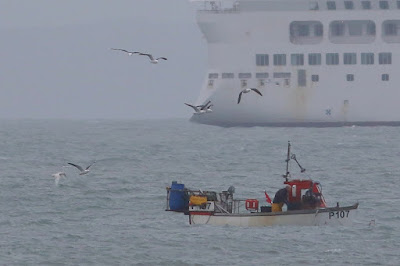
Iceland Gull as it should be seen: following a fishing boat miles out in a windswept bay (far left-hand bird). I really should have visited the Preston chippy on the way down and thrown some out to tempt it closer! Not the greatest of views, and not the nicest of journeys to Weymouth either, but a good bird to have under the belt in 2022. 

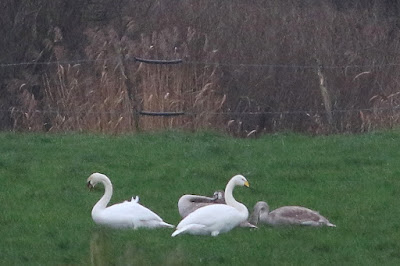
This Saturday took me back to Hampreston (another 30 miles in yet more foul weather) where the wintering Whooper Swan was still present
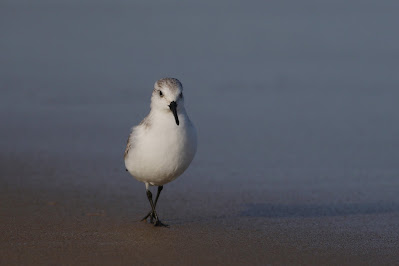
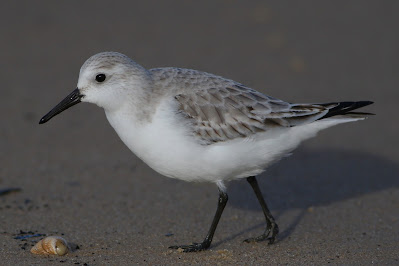
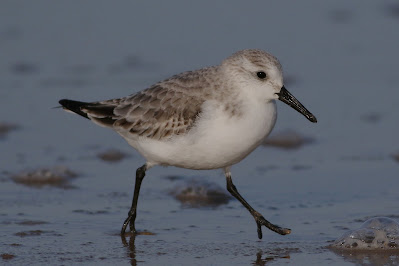
Sunday brought what felt like the first sunshine of 2022, and the lure of Studland proved irresistable despite heavy legs from the day before. Sanderling on the beach was my first of the year.
I like the shell adding a dash of colour to this picture
Studland also produced my first Scaup, Slavonian Grebe, Black-necked Grebe and Goldeneye of 2022

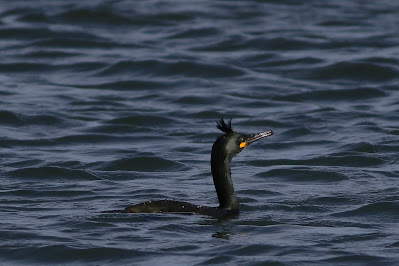
A bottle-green Shag looking glorious in the sunlight at Studland

Monday, 6 December 2021

Second chances

Back in January there were various species wintering in Portland Harbour or on the Fleet which I would have dearly liked to have added to my non-motorised year list, but which at the time seemed too far away to track down by bike. They included such scarce waterfowl, in a Dorset context at least, as Red-necked Grebe, Velvet Scoter and Whooper Swan.

Whooper Swan (right), Hampreston
With my horizons broadened in the intervening months, today I wouldn't hesitate to 'pop down' to Ferrybridge or Abbotsbury. And one of the good things about year listing is that if you miss a species at the start of the year, there might be a chance to make amends when winter comes around again at the end. As November drew to a close, I had already caught up with a Red-necked Grebe at Studland, and the next 'second chance' species appeared in the same area, in the form of not one but four Velvet Scoter off Middle Beach.
Can I get a 'Whoop'? Apparently, yes.
It was late in the day when I first set off to look for them but, not for the first time this year, Garry Hayman was on site and kindly lingered until my arrival to point me in the right direction. The birds were extremely distant and the light was fading, so much so that I went back on the bike a second time later that weekend to see if I could improve on my views. They were a bit closer enabling some very poor record shots to be taken for posterity. In the middle of last week I had to give my son an early morning lift to work which is literally 200 yards from Middle Beach so I went for another quick look before starting work myself. It was a case of third time not much luckier but I did manage to photograph one Velvet flapping to reveal the diagnostic white wing panels.
    A record shot if ever there was one - but the double face-spots help identify this as a female Velvet Scoter
So two of the three wintering targets had been clawed back and sporadic reports of the third - a Whooper Swan at Longham Lakes - offered the prospect of completing the hat-trick. The problem was, with the dark evenings, I would be unable to get there mid-week, and last weekend was earmarked for a Uni friends re-union in Lyme Regis. In the end, after a lovely weekend and more ale than I can handle these days, I returned from Lyme a bit earlier on Sunday than expected, leaving the afternoon free for a bike ride. 
Another record shot showing the white secondaries of a Velvet Scoter
There had been no news on the swan all day, but after a couple of nights of over-indulgence, I was in the mood for some serious exercise so made the 14 mile trip to Longham in the hope of finding it. Conditions were a bit grim but not enough to stop me making progress, and I arrived at Longham about 1330. One other birder was present but neither she nor I could locate the swan on the lakes or surrounding Hampreston fields, and she left me to it. A second birder walked past and on enquiring if he had seen the swan he seemed reluctant to say and basically suggested I would have to find it myself - a most unusual response in the normally friendly world of birding.
A very distant Common Scoter (bottom left) also at Studland
This brought out my stubborn streak and I resolved that I damn well would find it myself, despite the hostile environment! I could see a few swans distantly but they were just white blobs through a hedge so couldn't be identified to species level. They looked nearer to Hampreston village, a mile or two away if I returned to the main road east of Longham, and a helpful couple explained that if I headed for the Church I should be able to view more fields from the footpath leading from there towards Longham. 
As I drove to Lyme Regis in foul weather on Friday night I was reminded that I had cycled the same 80+ mile return journey back in the summer to add Dipper to the non-motorised year list. This one was photographed on Saturday. 
On arrival I found what I assumed was the right footpath, signposted to Longham, and soon after located a decent herd of swans in the distance. Through my dinky MM4 scope they all appeared to be Mutes at first glance, but with some patient scanning eventually a slimmer, more elegant head and neck appeared and, at full zoom, the characteristic yellow wedge on the bill of a Whooper Swan came into focus. Success was sweet and the cold wind whistling over the fields immediately lost its bite.
Grey Wagtail, also on the River Lym this weekend
As I was watching the swans, the couple who had given me directions earlier appeared on another footpath apparently between me and the birds. I retraced my steps to the church, found the previously unseen right of way through the churchyard, and joined them on the public footpath to view the herd to the south. Through binoculars they hadn't been 100% sure that the bird they were focusing on was the Whooper but with the scope I was happy to remove any doubt for them and grab a few record shots for myself.
The Cobb at Lyme Regis with Golden Cap beyond
Mercifully, the wind was at my back for most of the journey home, and the year list had ticked over to 216. The next big milestone of 220 is therefore in sight, but for this to be achieved would require obscene levels of neglect of family duty as forthcoming weekends are earmarked for weddings, birthdays and Christmas gatherings. So as long as I don't change my behaviour too much I may well make it ;-).
Sunday, 18 November 2018

Shetland: part the third, and last

As well as the rarities (see parts one and two), our week on Shetland back in October provided some opportunities to study northern species which we see only infrequently on the south coast of England. Top of the shopping list for me were the winter plumaged Tysties which frequented Lerwick Harbour. These charming birds look good in just about any plumage but I had not had much luck previously photographing them in their winter whites.
Close behind were the Twite, a bathing flock of which provided some compensation for two unsuccessful yomps through the infinite iris beds of Quendale in search of a reported Lanceolated Warbler. On both occasions we arrived to find no sign of the bird or the finders, reducing the chances of re-finding this mouse-like mega to a shade less than zero.
Otters were seen daily for the first few days, while other Shetland staples included Hooded Crow, Whooper Swan, Mealy Redpoll, Kittiwake, Fulmar and the ubiquitous Shetland Wren. The hoped for Killer Whales did not show for us but, unlike last year when the seas were whipped up by constant strong winds, we enjoyed a few calm days this year which gave us at least a chance to look for them.
Well that just about wraps it up for Shetland 2018. There were a few disappointments - principally the wild goose chases for the Lanceolated Warbler and a Pechora Pipit on Unst - but these were quickly forgotten when, as my wife said when I recounted the lowlights to her, 'there's always next year'. That's as good as a signed contract allowing me to go again in 2019!
And besides, the few disappointments were eclipsed by the many highlights of the trip: White-winged Scoter, Woodchat Shrike, Rosy Starling, River Warbler, Pied-billed Grebe, Eastern Yellow Wagtail, Citrine Wagtail, Rosefinch, American Golden Plover plus Barred, Marsh and Melodious Warbler were not bad for a week's birding.
It just remains for me to say many thanks to Bradders Birding Tours for providing another excellent driver for the trip, and the clans Vaughan for releasing Bob and Howard for another northern adventure. Good times in excellent company.
Rarest thing I saw on Shetland: a near vertical windsock

Wednesday, 18 October 2017

Shetland day 5: momentum

Success with the PG Tips, and a full Sunday roast with all the trimmings prepared by yours truly, sent us out into the field with a spring in our step on Monday 2 October. Part of the appeal of Shetland in autumn is that, due to the relatively high proportion of rarities to common birds on the islands at this time of year, and the relative paucity of observers, the visitor has a reasonable chance of finding their own good birds. Even a duffer like me could understand this, and that very morning I found my first Red-breasted Flycatcher in Swinister Burn, a short walk from our accommodation.
Little Bunting, Grutness
An attractive bird with a neat crown stripe
The Little Bunting showed during a welcome spell of sunshine...
...and provided brief but excellent opportunities for photographs
Red-breasted Flycatcher, Swinister Burn - my best 'find' of the week
Twite, Grutness
Splitting up to cover more ground whilst maintaining contact was an important part of our game plan, and in this we were greatly aided by the loan of a set of CB radios from Jonathan Lethbridge, better known on the interweb as the Wanstead Birder - thanks Jonathan. These marvellous bits of kit saved a lot of faffing with mobile phones and hedged against the risks of an often intermittent mobile phone signal on Shetland (in saying that, I'm not having a go Shetland, it's still better than my house in Wareham!).
Only on Shetland - I couldn't work out why the lens wouldn't focus on the RB Fly - it was being photo-bombed by a Yellow-browed Warbler!
Spotted Flycatcher, Swinister Burn

Several Redstarts were near the Sumburgh Quarries - this a male...

...and this a female
Twite at Grutness
Twite at Grutness
Not only did the CBs enable us to stay in constant contact, they proved a useful means of holding a verbal referendum on whether to keep thrashing the adopted patch, or knock it on the head and go look at other people's birds! So it was that when the Red-breasted Flyatcher refused to show for the rest of the team we quickly agreed to move on to pastures new. Specifically, to Grutness near Sumburgh Airport, where a Little Bunting had been seen. This sat out superbly for us in the sunshine on a lichen covered wall - a photographic highlight of the trip.
Chiffchaff, Grutness - one of several tired migrants which appeared to have just arrived, making them easier to approach
A nettle patch at Grutness was bouncing with migrants - including this female Blackcap...
...a male Blackcap...
and several Goldcrest
Taking the idea of the 'tyred migrant' too literally perhaps?

A House Martin was battling in the strong wind at Grutness
The wind was still whistling past nearby Sumburgh Head: too breezy and explosed for a seawatch but we still managed three Long-tailed Ducks and a pod of dolphin. Howard called them initially as Rissos's but revised the identification to Bottle-nosed as the characteristic body scarring of Risso's was not visible. I grabbed some record shots and while pretty convinced they were not Bottle-nosed, they didn't look like Risso's either - I expected that species to have a flatter front end rather than the stubby snout revealed by the pictures.
This Common Seal was just off the beach at Pool of Virkie...
...as was this much larger Grey Seal
Grey Plover, Pool of Virkie. Compare to...
Golden Plover, seen in roadside fields later in the day
Ringed Plover, Grutness
The spray here illustrates the strength of the wind
Posting the sighting as Bottle-nosed Dolphin that evening, Howard was contacted by Hugh Harrop who advised that this species would be a rare sighting in these waters. After an exchange of photos he confirmed they were indeed Risso's, a fact we could now see for ourselves when looking at pictures online of younger Risso's which show a stubby nose and a lack of body scarring, which is acquired by battling adults later in life. I had never seen Risso's Dolphin before, so with a new mammal to add to the new bird of the previous day it felt like we were on a roll. 
Turnstones, Pool of Virkie
Dunlin in the seaweed at Pool of Virkie
Ringed Plover, Poole of Virkie
A couple of Goosander were just offshore at Pool of Virkie
Risso's Dolphin, Sumburgh Head
The first Risso's Dolphins I have seen
The weather had taken a turn for the worse by this time, so we returned to birding from the car: Loch of Spiggie held a flock of elegant Whooper Swan; Loch of Hillwell an even more elegant and long-staying Common Crane; and a good selection of waders at Pool of Virkie included singles of Curlew Sandpiper, Grey Plover and Sanderling. Best wader of the day though was a Little Stint, discovered in the improbable location of a puddle in a farm entrance at Noss. An eventful day then, with a good find, a new mammal and an excellent supporting cast. The morning would see us chasing another Shetland rarity - come back soon to find out what.
Whooper Swans, Loch of Spiggie
Common Crane, Loch of Hillwell
Little Stint, Noss
Little Stint, Noss
These rusty rods became famous this time last year when Britain's first Siberian Accentor chose to perch on them in a Scousburgh Quarry
The runway at Sumburgh Airport - traffic lights stop cars on the main road when the runway is in use
A dramatic Shetland landscape
One more of the Little Bunting with a halo reflected from a passing plane at Sumburgh Airport