Showing posts with label Clouded Yellow. Show all posts

Sunday, 10 September 2017

Ragged royalty

Barra for an American Redstart would have been a bridge too far this weekend: Brighton was a more practical destination to see a new species for me in Britain: a Queen of Spain Fritillary butterfly. It's difficult to believe that almost eleven years have passed since I saw my last new British butterfly. That was a Monarch, one of which was just around the corner from a Long-tailed Blue I found earlier in the day on the Isles of Scilly back in October 2006. A few days after that, a Queen of Spain Fritillary was also seen on the islands near the Trenoweth flower farm but despite much searching I was unable to find it.
Male Queen of Spain Fritillary - it looks like it survived a bird attack judging by the state of hind-wing on the right hand side
A slightly more flattering photograph of the fritillary showing the most intact hind-wing
Details of a sighting of three of these rare migrants at Halcombe Farm near Piddinghoe first emerged two weekends ago and was immediately of interest. Unfortunately, the news broke the day before the gloriously sunny Bank Holiday Monday - not the sort of day you want to be driving along the south coast, and I couldn't get away in any case. Last weekend was equally compromised, as being on call for emergencies meant that I was unable to leave Dorset.
The species is known for spending much of the time basking on the ground: this one was no exception
A brief bout of nectaring provided one of the few opportunities to get a shot of the bold silver spots on the underwing
Discussing the survival chances of the fritillaries with Phil Sterling during the week, he was pretty convinced that unless the weather turned really foul, they would still be present this weekend. So with one eye on the forecast, and the other on Butterfly Conservation's excellent Sussex branch website, I resolved to go on Saturday as full sunshine was promised throughout the morning. Internet updates suggested that two individuals were still present on Thursday, both looking more than a little worn, and that was enough to persuade me to make the effort of an early start to beat the traffic yesterday morning.
This Clouded Yellow was one of 15 butterfly species on view at Halcome Farm
Comma
I arrived at Halcombe Farm around 0900 and began combing the area around a bonfire which was being used as a lek site by the fritillaries - all three having been identified as males. As the morning warmed up, a Clouded Yellow landed nearby but there was no sign of the fritillaries. Other butterflies, and then another butterfly watcher, arrived. We split up and shortly before 1000 he gave me a shout to indicate he had found one.
A female Adonis Blue was lying low in the grass
A male Common Blue was easier to see
Queen of Spain Fritillary is reasonably common on the near continent but still very rare in the UK with just a few hundred records and a small number of unsuccessful attempts at colonising documented. So despite the slightly ragged appearance of the visiting royalty, I was very glad I got to see one of the trio before their inevitable demise, particularly as the famous bonfire is apparently scheduled to go up in smoke within a matter of days.
Small Copper
Small Heath
Well done and thanks to the diligent transect walker, Dave Harris, who first discovered them, to Neil Hulme for getting the news and directions out to the wider world, and to the landowner Colin Appleton for allowing access to the site which has provided a lot of pleasure to many visitors over the last fortnight.
Brown Argus
Painted Lady - another migrant at Halcombe Farm
The bonfire adopted by the Queen of Spain Fritillaries

Friday, 25 October 2013

Legging it

'Undignified trot', it's been pointed out to me, is an oft-used phrase on this blog. I should explain it's not a reference to Derek Hatton of 1980s Militant Tendency infamy. Rather, it's usually deployed to describe the spectacle of middle-aged men jogging, laden with optics, the last couple of hundred yards to the site of a rare bird in the hope of seeing it before it flies off. In the case of a Semipalmated Plover in Hampshire last weekend, only the third British record, this unedifying behaviour seemed entirely rational.

Speaking of legging it, after twitching Saturday, Sunday was reserved for a quick twirl around Swineham, where a Yellow-legged Gull was one of the highlights 
The Plover in question had been present for a couple of days intermittently over high tide. Steve, Jol and I therefore played it cool by not setting off before 10am on Saturday as high tide was forecast for early afternoon. (I say cool, try standing on the pavement with Jol, second only to me for twitchy neurosis, waiting for a lift with a tick at stake). With an hour to go to the site, the pager reported the Plover had been refound, but it stayed just 2 minutes before flying off. Not good for the neurotics on board.
...and a view of the yellow legs on the same bird, in case you like your large larid identification made simple, and primary patterns don't float your boat
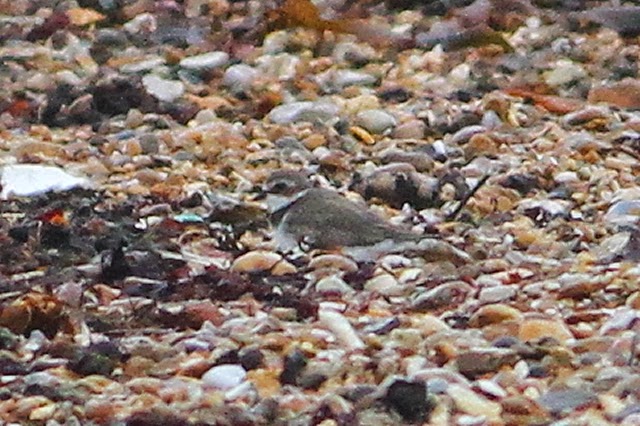
An hour later, as we entered the backstreets of Hayling Island, it came back, conveniently close to a car park we had just passed. After an emergency stop/three point turn/pay & display routine we baled out, one of us shamefully leaving a car door open, can't remember who, and headed up the windy seafront. A small knot of birders were huddled on the shingle a few hundred yards hence looking through scopes, but between us and them were two dog walkers and their mutt, tail all of a wag. Imagine a large flock of Ringed Plover flying away with a lookalike Semipalmated playing 'Where's Wally' among them...
Clouded Yellow on graveyard flowers in a Wareham churchyard - not bad for 20th October.
There have been enough unhappy endings on this blog this year though, and fortunately the dog was on a lead and the Plover stayed put. Despite suboptimal viewing conditions and some imperfect direction-giving - 'it's on the shingle' (on a shingle beach - no s***!), 'below the groyne' (do you mean the groyne below which every single wader in view is sitting?), 'by a piece of litter' (have you seen the state of this beach?) - we all got on it before too long. The Plover wasn't seen after a tornado hit Hayling Island the following day, and I was concerned it may have joined the Needletail (windmill)/Great Snipe (cat)/Short-toed Lark (Merlin) roll call of 2013 tragic rare bird snuffings. I see it's back today though so apparently not. Phew.
Semipalmated Plover. By that bit of shingle.

Monday, 9 September 2013

Summer's last hurrah

The long summer seems finally to be coming to an end, in these parts anyway. Time, then, to celebrate it with a wash up of some Lepidoptera seen on holiday in Cornwall and the Isles of Scilly last month.
Clouded Yellow never perches with the wings open but this pair were attempting to mate near The Lizard (the 2nd individual can just be seen behind the leaf). By focusing in the right area and setting a high shutter speed I was able to catch the open wings as it flapped.
An even luckier shot of a Clouded Yellow in flight
A more typical view of Clouded Yellow
Clouded Yellow
A small proportion of female Clouded Yellows are of the rare white form helice - this one was on Peninnis Head, St Mary's. While superficially similar on the underwing, the difference becomes more obvious in flight - see Nick Hopper's excellent open-winged shot here on the Portland Obs post for 29th August. 
Hummingbird Hawkmoth, Kynance Cove
Small Pearl-bordered Fritillary between The Lizard and Kynance Cove
Wall, The Lizard
Wall, The Lizard
Small Copper was one of the commonest butterflies on Scilly during August
Common Blue were also plentiful
And, to come full circle, another stunning Clouded Yellow, this one of 20+ on St Mary's in the short walk between Porth Hellick and the airfield.


On the subject of the airfield, the landing strip on St Mary's is pretty small: as you can see, barely room to swing an Otter.

Monday, 24 September 2012

Wings, but no birds

Birds eschewed my local gravel pits at Swineham this weekend for the east coast, judging by reports from afar. But I still managed two patch ticks from the world of lepidoptera in the form of a Hummingbird Hawkmoth, feeding manically on honeysuckle in a hedgerow, and a Clouded Yellow butterfly, looking a bit out of place cruising the gardens of suburban Wareham.

Hummingbird Hawkmoth, Swineham 22nd September 2012

A few years ago Hummingbird Hawks seemed to be everywhere - we even had one in our garden in Kent - but I certainly haven't seen as many of them in the last couple of years. Similarly with Clouded Yellows - I usually manage to see one or two most years but seem to have found it a bit harder in the last couple. A good excuse, then, to dig out one of my favourite Clouded Yellow pictures - taken on St Mary's in October 2006.

Clouded Yellow, St Mary's, October 2006

October 2006 was a classic for butterflies on Scilly, with a Monarch, a couple of Long-tailed Blues, a Queen of Spain Fritillary and an invasion of Clouded Yellows including a few of the rare helice form. Although I dipped the Queen of Spain, the highlight for me came on the 9th when I found my own Long-tailed Blue - a near perfect specimen - and an hour or two later caught up with my first Monarch feeding on ivy on the Garrison. Happy days...

Self-found Long-tailed Blue, St Mary's, 9th October 2006