Showing posts with label Small Copper. Show all posts

Wednesday, 23 May 2018

Western woodlands

I grew up in the Forest of Dean but since my folks moved to Devon several years ago, my opportunities to go back have been few and far between. This means that once regular visits to Nagshead to see summer migrants in the oak woodlands have become a thing of the past. I failed to catch up with a Pied Flycatcher or a Wood Warbler on migration this spring in Dorset - it was a pretty poor year for both at our coastal watch-points - and only saw my first Redstart of the year when it was back on territory in Wareham Forest.
Male Pied Flycatcher, Yarner Wood
This male appeared to be bringing a caterpillar back for a female presumably sitting on eggs in a nestbox 
Photographing black and white birds in the dappled light of the wood was challenging to say the least. And when the light was good, the view was obscured!

So when a family camping trip last weekend left me surplus to requirements, I seized the opportunity of a Sunday drive to one of my nearest Pied Flycatcher breeding areas - Yarner Wood in Devon, on the eastern edge of Dartmoor, less than two hours from home. I had visited this area on a summer holiday a few years ago but the Pied Flycatchers had already shipped out. So I knew where to go but not exactly where the best areas for seeing the birds might be. I needn't have worried - the answer was just about everywhere! Every other nestbox seemed to host a pair, many choosing to set up camp right next to the path and chip aggressively at passers by.
Many of the Pied Flycatchers bore leg rings
Flycatcher doing what it says on the tin
A male in full song
In contrast to the apparent abundance of Pied Flycatchers, Wood Warblers seemed to be having a terrible year. I bumped into a chap who said he had seen one going into a nearby nestbox. This didn't sound quite right as Wood Warblers don't use nestboxes, and it would be singing almost constantly at this time of year. I returned to my friend to ask if he was sure about what he'd seen and he showed me a photo he had taken of a female Pied Fly. Okay, they're not the hardest species to separate but let's not be too judgemental, we all have to start somewhere...
Females were more elusive, generally sitting on eggs - but this one came out to stretch her wings
Just the one Spotted Flycatcher seen - but it was certainly making itself heard
This Redstart was one of several singing males
I wandered off again and it transpired that my friend had fallen foul of some numerical as well as avian confusion - he had been advised to look for a Wood Warbler near a numbered nest box ending in '13' but, when I eventually tuned in to the familiar cascade of shimmering notes from a singing Wood Warbler, and looked at the nearest nestbox, I realised he had misheard what must have been described to him as a '30'. One of the reserve staff came by soon after and broke the unhappy news that I had located the only singing Wood Warbler in Yarner Wood.
Wood Warbler
The Wood Warbler stayed high in the canopy
A lovely bird to hear and to watch in song - the whole body shakes with the effort
I could see bling on both of the Wood Warbler's legs which I assumed had been fitted when it was a nestling, but the warden explained that it had in fact only recently been colour-ringed and fitted with a geo-locator. Hopefully this can provide some insight into what might have gone wrong for its congeners on the long migration to tropical Africa to inform future conservation efforts.
Pearl-bordered Fritillary on the path at Yarner Wood - a male I think judging by the slim abdomen
One of our rarer species, getting a helping hand on Dartmoor via Butterfly Conservation's All the Moor Butterflies project
The beautiful underwing of the Pearl-bordered Fritillary
While the Wood Warbler tally was a tad depressing, Redstarts seemed to be doing okay with several singing males, and a Spotted Flycatcher also brightened up a glade which was otherwise full of its Pied cousins. A nearby clearing produced another highlight - a colony of Pearl-bordered Fritillary. Initially very active in the hot and sheltered micro-climate of the clearing, the sun went in just long enough to cause one to snap its wings shut to reveal the diagnostic - and very striking - underwing pattern. An uplifting spring day in western oak woodland - just what the doctor ordered.
Out on the moor proper I could not find a Whinchat, but Meadow Pipits were plentiful
Small Copper on Dartmoor
The first Pied Flycatcher of the day in Yarner Wood

Sunday, 10 September 2017

Ragged royalty

Barra for an American Redstart would have been a bridge too far this weekend: Brighton was a more practical destination to see a new species for me in Britain: a Queen of Spain Fritillary butterfly. It's difficult to believe that almost eleven years have passed since I saw my last new British butterfly. That was a Monarch, one of which was just around the corner from a Long-tailed Blue I found earlier in the day on the Isles of Scilly back in October 2006. A few days after that, a Queen of Spain Fritillary was also seen on the islands near the Trenoweth flower farm but despite much searching I was unable to find it.
Male Queen of Spain Fritillary - it looks like it survived a bird attack judging by the state of hind-wing on the right hand side
A slightly more flattering photograph of the fritillary showing the most intact hind-wing
Details of a sighting of three of these rare migrants at Halcombe Farm near Piddinghoe first emerged two weekends ago and was immediately of interest. Unfortunately, the news broke the day before the gloriously sunny Bank Holiday Monday - not the sort of day you want to be driving along the south coast, and I couldn't get away in any case. Last weekend was equally compromised, as being on call for emergencies meant that I was unable to leave Dorset.
The species is known for spending much of the time basking on the ground: this one was no exception
A brief bout of nectaring provided one of the few opportunities to get a shot of the bold silver spots on the underwing
Discussing the survival chances of the fritillaries with Phil Sterling during the week, he was pretty convinced that unless the weather turned really foul, they would still be present this weekend. So with one eye on the forecast, and the other on Butterfly Conservation's excellent Sussex branch website, I resolved to go on Saturday as full sunshine was promised throughout the morning. Internet updates suggested that two individuals were still present on Thursday, both looking more than a little worn, and that was enough to persuade me to make the effort of an early start to beat the traffic yesterday morning.
This Clouded Yellow was one of 15 butterfly species on view at Halcome Farm
Comma
I arrived at Halcombe Farm around 0900 and began combing the area around a bonfire which was being used as a lek site by the fritillaries - all three having been identified as males. As the morning warmed up, a Clouded Yellow landed nearby but there was no sign of the fritillaries. Other butterflies, and then another butterfly watcher, arrived. We split up and shortly before 1000 he gave me a shout to indicate he had found one.
A female Adonis Blue was lying low in the grass
A male Common Blue was easier to see
Queen of Spain Fritillary is reasonably common on the near continent but still very rare in the UK with just a few hundred records and a small number of unsuccessful attempts at colonising documented. So despite the slightly ragged appearance of the visiting royalty, I was very glad I got to see one of the trio before their inevitable demise, particularly as the famous bonfire is apparently scheduled to go up in smoke within a matter of days.
Small Copper
Small Heath
Well done and thanks to the diligent transect walker, Dave Harris, who first discovered them, to Neil Hulme for getting the news and directions out to the wider world, and to the landowner Colin Appleton for allowing access to the site which has provided a lot of pleasure to many visitors over the last fortnight.
Brown Argus
Painted Lady - another migrant at Halcombe Farm
The bonfire adopted by the Queen of Spain Fritillaries

Tuesday, 2 May 2017

Visitors from afar

Without wishing to give the impression I am an anti-social cuss, I try to encourage friends and family to avoid visiting me during the months of May and October, as these represent two of my favourite months for wildlife photography. I could of course expand this to cover the bird migration seasons of 'spring' (Feb-June) and 'autumn' (July-November) but that would seem unreasonable. In any case, as often as not they ignore this advice, in which case I am forced to fall back on the small print in the visitors contract which states that if they insist on coming (i) I can't promise I will be there and (ii) I can't promise to appear to be enjoying myself if I would rather be somewhere else.

This Bank Holiday weekend friends from Cornwall (Debbie and Alec) retaliated to my frequent visits to their house at convenient times of year for rare bird migration by arriving at mine. They were of course made very welcome, and a bit of birding had to be squeezed in on Friday night before their arrival, and Monday evening after their departure. And on the Saturday, when we took them to Arne. And a bit on Sunday when I dragged Alec to Portland for an early morning shift. Well it's not my fault if they didn't read the small print.

On Friday there was just time between plumping up the pillows in the spare room and rolling out the red carpet to nip up to Longham Lakes to see a Bonaparte's Gull which had spent a few days in the area, one of a number of this wanderer from the Americas to turn up in southern England in recent days. That was easy enough to find on the North Lake, either hawking insects or sitting out on a man-made island near the shore.
With our guests arriving late on Friday, the household succumbed to the temptation of a lie in on Saturday and after lunch at the Arne café, we took the long route around the reserve which took us away from the busiest areas. Highlights were a couple of Sand Lizards, one of which, to our surprise, sat out on the heather next to the path and didn't scarper as we made our way past. This was closely followed by an exquisite Small Copper and an equally exquisite male Siskin by the café.
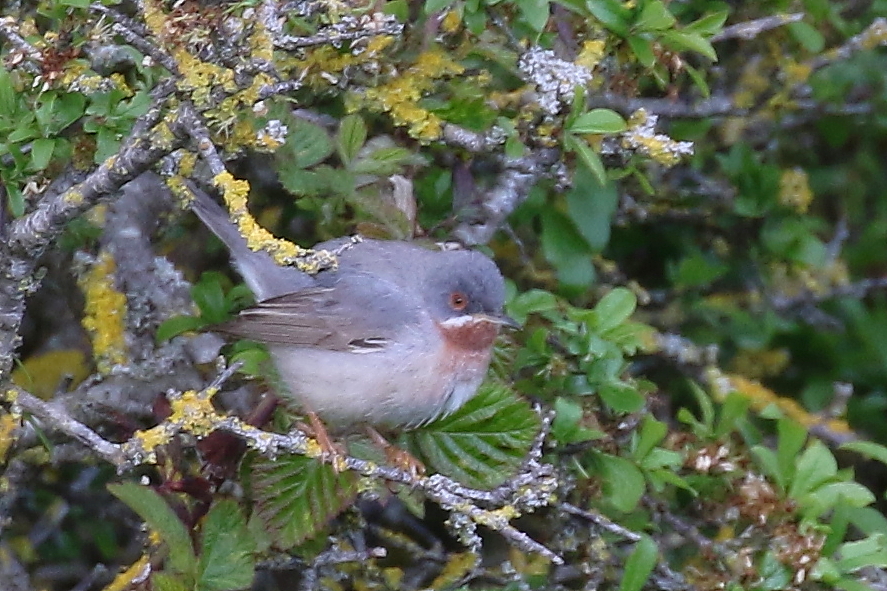
Dragging Alec down to Portland early on Sunday morning proved to be a bit of a disappointment bird-wise - a strong wind was blowing from the south east, migrants were thin on the ground (restricted to a few Yellow Wagtails, a couple of Turtle Doves and an Arctic Skua past the Bill) and we failed to see an Eastern Subalpine Warbler present at Cheyne Weares despite a near two hour vigil. Fortunately in view of the lack of birds, as a former Naval officer, Alex was happy to revisit former haunts around Portland.
Bank Holiday Monday saw us bidding farewell to our guests, and me heading back to Portland shortly afterwards for another crack at the Eastern Subalpine Warbler. In much more clement weather, this was successful, and it showed about as well as any Subalpine Warbler I have seen, feeding actively and singing in the late afternoon. Wheatears and Linnets at the Bill capped a thoroughly enjoyable weekend for visitors - avian and human. With apologies to my guests if my body language ever suggested otherwise!

Sunday, 30 October 2016

Net migration

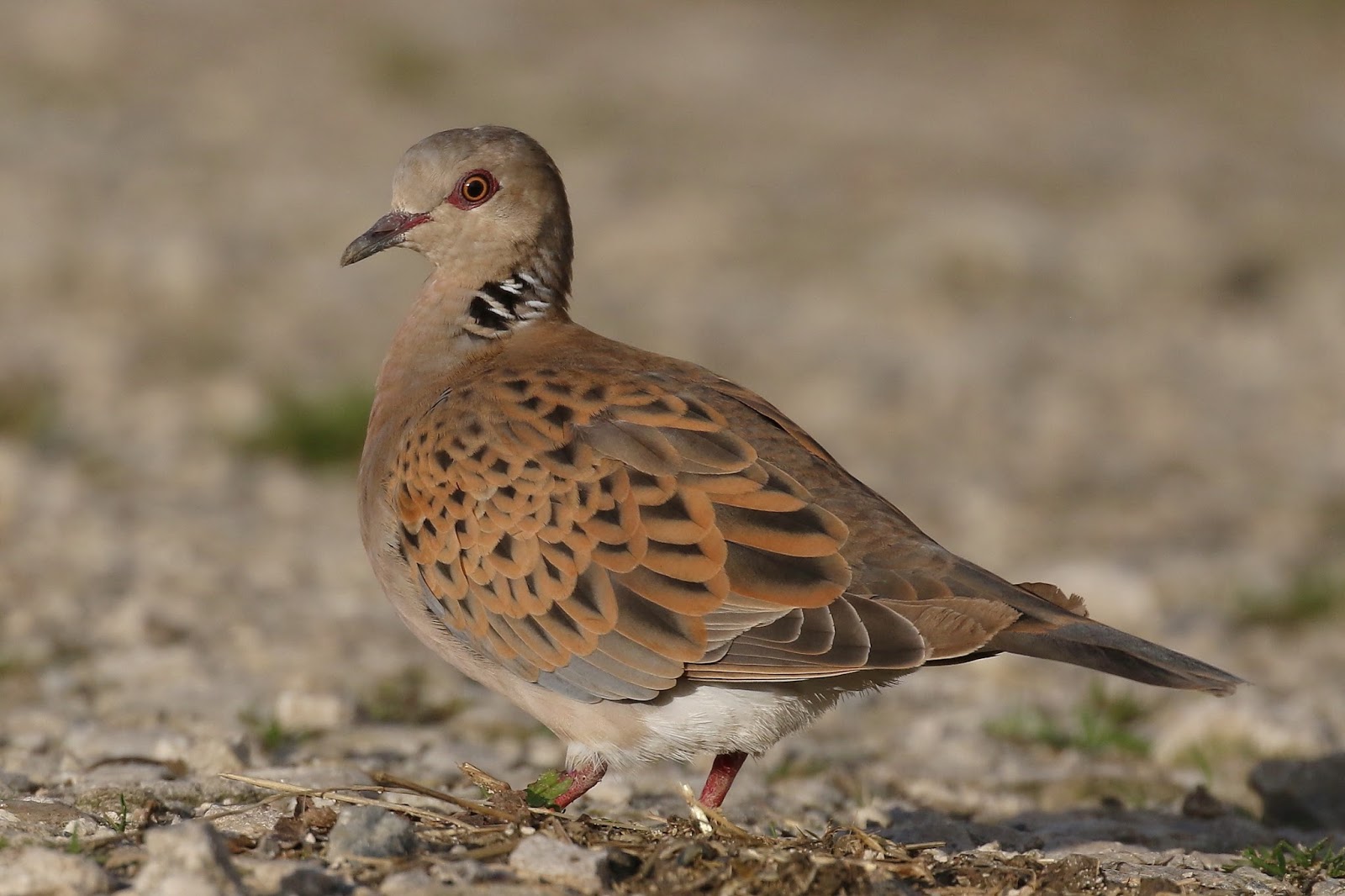
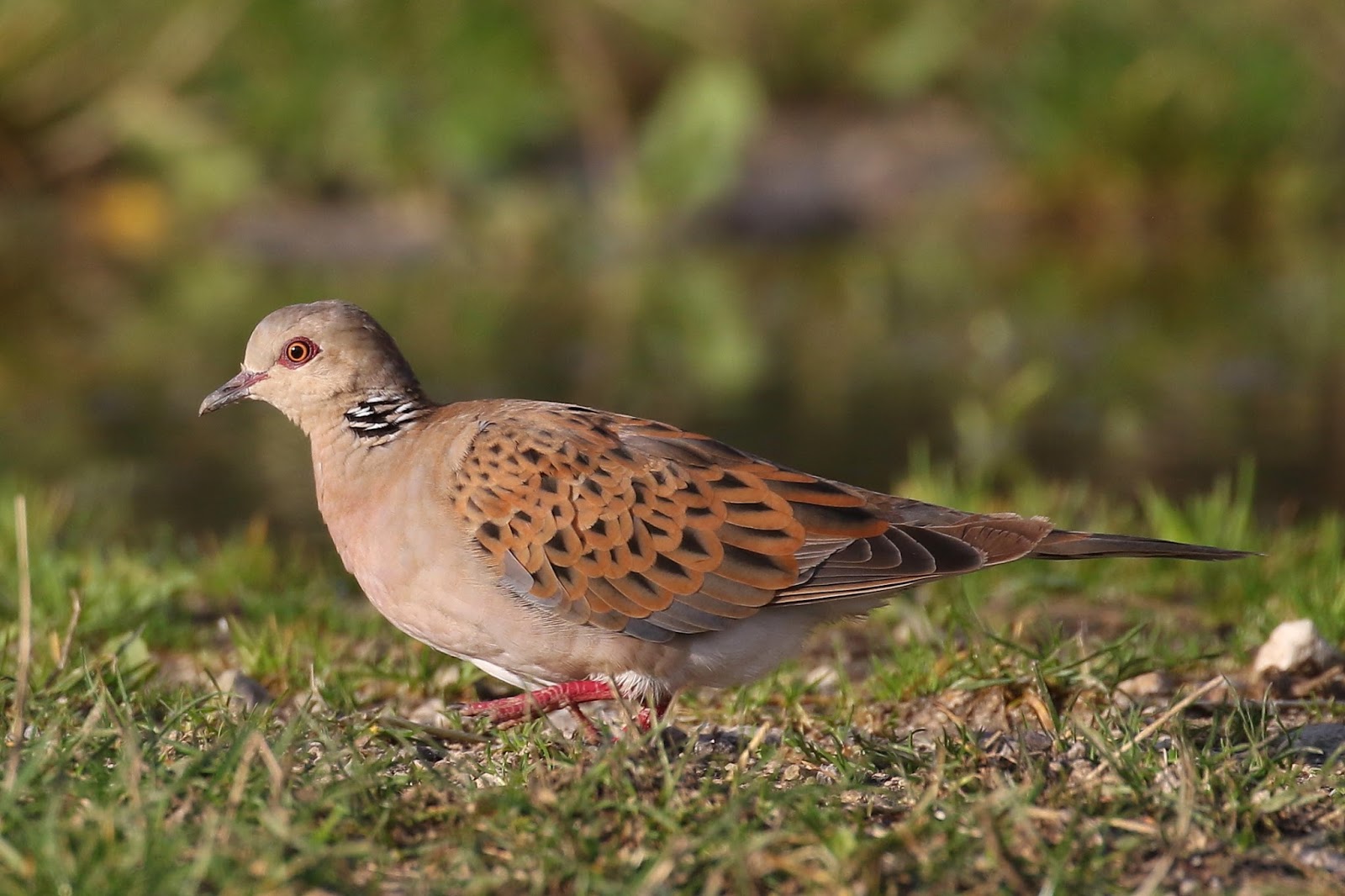
Four visits to Portland this half-term may have failed to deliver the hoped for Dorset mega - several rare migrants being netted and ringed but not seen again after their release - but in addition to the raptors featured in my last post, there were still some other attractive birds to photograph. Perhaps most widely appreciated by birders dipping on the Red-flanked Bluetail and the Pine Bunting was the Reap Lane Turtle Dove. The precipitous reduction in the number of this once commonplace species in Britain is well documented so I won't bang on about it here. Suffice to say if the depressing combination of factors which have contributed to its decline could be reversed we could all look forward to spring, and the sight and sound of this handsome bird, a little more.
Turtle Dove, Reap Lane
This bird seemed unperturbed by people, dogs and even the local cats
A few years since I last saw one in Dorset
I lay down to get these photos, doing well to avoid the obvious hazards of Reap Lane, a favoured area with dog walkers
When not on the ground it was roosting in a small Sycamore yards from the path
Stonechats always seem quite obliging on Portland
This the female of a pair
With the Siberian Accentor invasion still ongoing, Dunnocks have been getting a bit more scrutiny lately
A few Redwings were in evidence on Portland this week
A pair of Ravens on Portland
A small crowd of fellow Bluetail dippers at the Bill
West Cliffs, Portland
I also managed a visit to Durlston this week - Blackcaps were the most conspicuous warbler
This a female Blackcap
Skylarks were on the grasslands...
...and a late Small Copper was in the gully  
Evening mist in the Frome Valley
Turtle Dove
Turtle Dove