Showing posts with label Comma. Show all posts

Sunday, 10 September 2017

Ragged royalty

Barra for an American Redstart would have been a bridge too far this weekend: Brighton was a more practical destination to see a new species for me in Britain: a Queen of Spain Fritillary butterfly. It's difficult to believe that almost eleven years have passed since I saw my last new British butterfly. That was a Monarch, one of which was just around the corner from a Long-tailed Blue I found earlier in the day on the Isles of Scilly back in October 2006. A few days after that, a Queen of Spain Fritillary was also seen on the islands near the Trenoweth flower farm but despite much searching I was unable to find it.
Male Queen of Spain Fritillary - it looks like it survived a bird attack judging by the state of hind-wing on the right hand side
A slightly more flattering photograph of the fritillary showing the most intact hind-wing
Details of a sighting of three of these rare migrants at Halcombe Farm near Piddinghoe first emerged two weekends ago and was immediately of interest. Unfortunately, the news broke the day before the gloriously sunny Bank Holiday Monday - not the sort of day you want to be driving along the south coast, and I couldn't get away in any case. Last weekend was equally compromised, as being on call for emergencies meant that I was unable to leave Dorset.
The species is known for spending much of the time basking on the ground: this one was no exception
A brief bout of nectaring provided one of the few opportunities to get a shot of the bold silver spots on the underwing
Discussing the survival chances of the fritillaries with Phil Sterling during the week, he was pretty convinced that unless the weather turned really foul, they would still be present this weekend. So with one eye on the forecast, and the other on Butterfly Conservation's excellent Sussex branch website, I resolved to go on Saturday as full sunshine was promised throughout the morning. Internet updates suggested that two individuals were still present on Thursday, both looking more than a little worn, and that was enough to persuade me to make the effort of an early start to beat the traffic yesterday morning.
This Clouded Yellow was one of 15 butterfly species on view at Halcome Farm
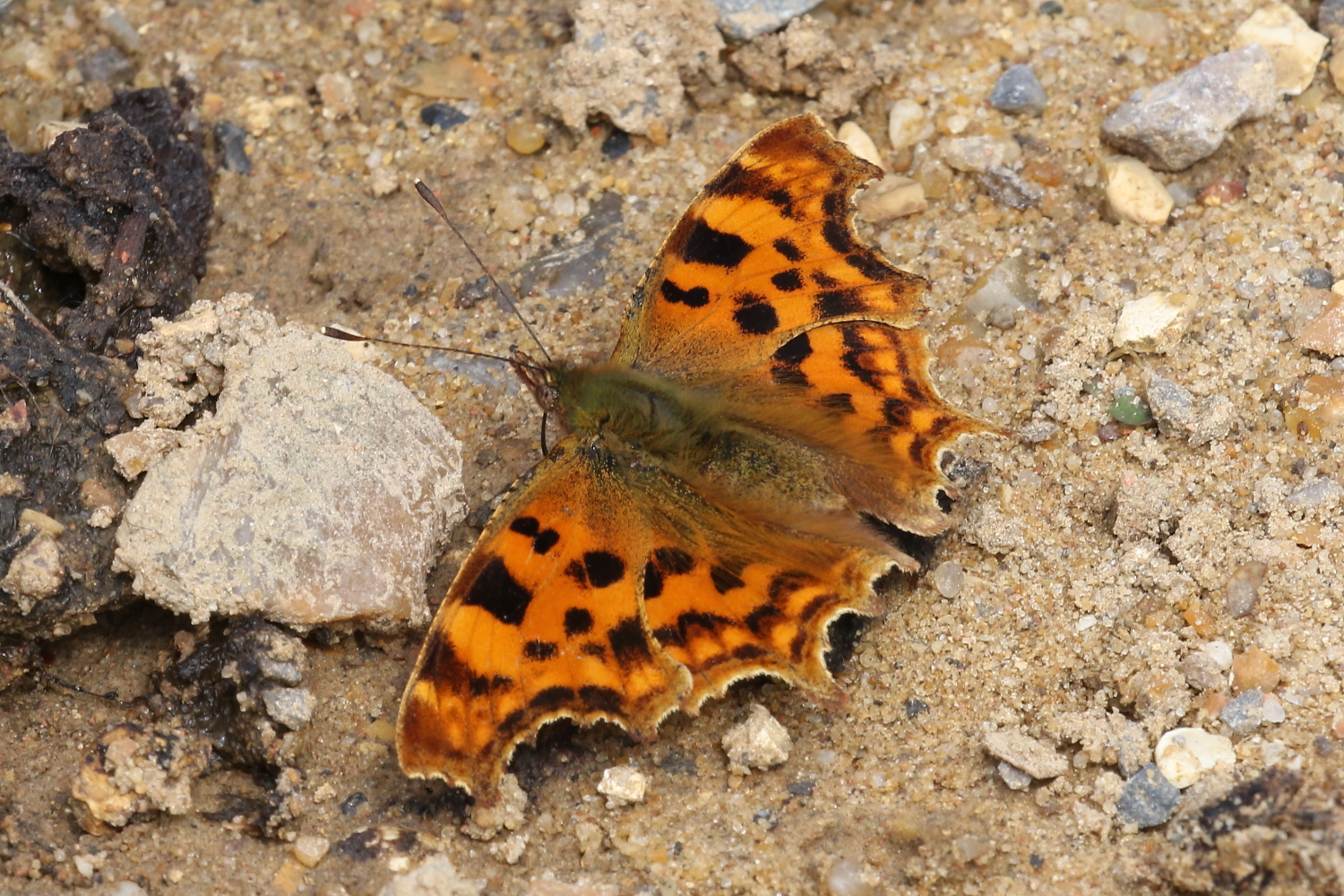
Comma
I arrived at Halcombe Farm around 0900 and began combing the area around a bonfire which was being used as a lek site by the fritillaries - all three having been identified as males. As the morning warmed up, a Clouded Yellow landed nearby but there was no sign of the fritillaries. Other butterflies, and then another butterfly watcher, arrived. We split up and shortly before 1000 he gave me a shout to indicate he had found one.
A female Adonis Blue was lying low in the grass
A male Common Blue was easier to see
Queen of Spain Fritillary is reasonably common on the near continent but still very rare in the UK with just a few hundred records and a small number of unsuccessful attempts at colonising documented. So despite the slightly ragged appearance of the visiting royalty, I was very glad I got to see one of the trio before their inevitable demise, particularly as the famous bonfire is apparently scheduled to go up in smoke within a matter of days.
Small Copper
Small Heath
Well done and thanks to the diligent transect walker, Dave Harris, who first discovered them, to Neil Hulme for getting the news and directions out to the wider world, and to the landowner Colin Appleton for allowing access to the site which has provided a lot of pleasure to many visitors over the last fortnight.
Brown Argus
Painted Lady - another migrant at Halcombe Farm
The bonfire adopted by the Queen of Spain Fritillaries

Sunday, 16 July 2017

Purple reign

Yes I realise the terrible pun in the headline would be more fitting for the Purple Emperor than the humble Purple Hairstreak - but I haven't had the opportunity to look for the former so far this summer, whereas a spare Sunday morning a few weekends ago provided just enough time to look for the latter at Butterfly Conservation's superb reserve at Alners Gorse. Like the majestic Emperor, the Purple Hairstreak reveals its colourful sheen when light refracts from the wings at certain angles. I had never really managed to photograph this feature well so that was one objective of the visit. It was easily achieved as tens of this characterful insect were seen, many down at eye level in the relative cool of the morning. As usual my time was a bit limited but a White-letter Hairstreak feeding low down on brambles as I made to leave was a huge bonus.
Male Purple Hairstreak at Alners Gorse
This is the same individual at a slightly different angle - note how the extent of the purple varies with the angle of the light
Another angle on the same individual
Another male complete with short tails
All the Purple Hairstreaks I saw with wings open appeared to be males
Purple Hairstreak underwing shows an eye-spot near the short tail
Buds of Buckthorn appeared as cat-nip to the Purple Hairstreaks
They were present on one small tree in double figures
An attractive species - compare to....
...White-letter Hairstreak, which never sits with the wings open
Comma also on the wing at Alners Gorse...
...and plenty of Ringlet
A fresh Southern Hawker also present...
...and one of our most impressive British species, the Silver-washed Fritillary
A pristine male Silver-washed Fritillary
A slightly worn female Silver-washed Fritillary...
...and here a mating pair
Purple Hairstreak at Alners Gorse - a superb reserve, hats off to BC for making it so

Monday, 10 April 2017

Basking time

It's several weeks since winter was confidently declared over in this neglected corner of the internet. Sufficiently long ago in fact to make this pronouncement that spring has arrived an overdue statement of the obvious. Nowhere has it been more so than at Swineham, where the Adders and several of the early spring butterflies have been out for a while now thanks to an ongoing warm spell. A visit last weekend also produced my first 'proper' migrant birds of the year there in the form of not just one but four Little Ringed Plover on the floods which are still referred to grippingly as 'the Stilt pools'. While unsympathetic habitat management continues to take the shine out of visiting Swineham of late, some photos to prove that at least the sun hasn't deserted the old place completely:
Adder enjoying the early spring sunshine
Check out those eyes
Brimstone is uncommon at Swineham
Comma is more typical of the site
Of the butterflies that over-winter as adults, the Peacock seems to be doing particularly well this year 
Speckled Wood at Swineham: once known as the Wood Argus, this butterfly may over-winter as either larvae or pupa
Chiffchaffs can be seen all year round at Swineham but they are now singing almost constantly
Little Ringed Plover at Swineham

Sunday, 24 July 2016

Filthy imperialists

My friend Steve thinks that deferential hagiography written by butterfly enthusiasts about Purple Emperors on the internet just shows how Britain is a country still riven by a class divide. A visit to Hampshire for my nephew's 21st birthday recently put me within striking distance of the Alice Holt forest complex, a stronghold for the Purple Emperor. A few pictures below with some quotes attributed (wrongly, in some cases) to Karl Marx, just for Steve.
His Imperial Majesty, the Purple Emperor, may be master of all he surveys, but he's not above grovelling in the dirt with the lumpenproletariat to feast on dog mess. Except on this visit, when he stayed stubbornly in the treetops.
White Russians resisted the communists after the revolution in 1917. Fitting then that the White Admiral - running dog of the Emperor himself - is often found in the same habitat
This White Admiral was doing what I had hoped the Purple Emperor would do - taking salts from the path...
...as was his arch enemy, the altogether more revolutionary Red Admiral
Marx on debt-driven banking crises: 'Owners of capital will stimulate the working class to buy more and more of expensive goods, houses and technology, pushing them to take more and more expensive credits, until their debt becomes unbearable. The unpaid debt will lead to bankruptcy of banks which will have to be nationalized'. Oh Karl, you're so dramatic, like that's going to happen!
A more proletarian species, the Comma, feeding on the dog dirt arraigned for the Emperor - at least this commoner got the crumbs from the imperialists table
Another prole: the Meadow Brown
Ringlets of the world unite: you have nothing to lose but your chains

Small Skipper. Yet another oppressed victim of false consciousness.
Marx on X-boxes: 'The production of too many useful things results in too many useless people.' Mark those words, kids.
Female Silver-washed Fritillary: the gilded bourgeoisie of the butterfly world
Silver-washed Fritillary: female underside
Male Silver-washed Fritillary
'Let us not flatter ourselves overmuch on account of our human victories over nature. For each such victory nature takes its revenge on us. The people who, in Mesopotamia, Greece, Asia Minor, and elsewhere, destroyed the forests to obtain cultivable land, never dreamed that they were laying the basis for the present devastated condition of these countries, by removing along with the forests the collecting centres and reservoirs of moisture. When, on the southern slopes of the mountains, the Italians of the Alps used up the pine forests so carefully cherished on the northern slopes, they had no inkling that by doing so they were cutting at the roots of the dairy industry in their region; they had still less inkling that they were thereby depriving their mountain springs of water for the greater part of the year, with the effect that these would be able to pour still more furious flood torrents on the plains during the rainy seasons...At every step we are reminded that we by no means rule over nature like a conqueror over a foreign people, like someone standing outside nature – but that we, with flesh, blood and brain, belong to nature, and exist in its midst, and that all our mastery of it consists in the fact that we have the advantage over all other creatures of being able to learn its laws and apply them correctly'. This was written by Karl's mate Engels, in fact, not Marx. Apart from the final word, I'd say he wasn't far off being right.