Showing posts with label Brown Argus. Show all posts

Thursday, 19 July 2018

Out for the Count

Well it's Big Butterfly Count time of year again, and unlike in previous years when the obligation on me to promote it via this neglected corner of the internet was purely moral, happily I am now professionally obliged to big it up. Not that it needs much help from me of course: it is already the world's biggest butterfly survey and the data gathered represents one of our finest examples of  'citizen science'.  Spending 15 minutes in a sunny spot - and there have been plenty of those around lately - is all it takes, and it's good for you too, so there's no excuse not to join in really. Even if you don't see much, it's still important to record it. So, off you trot. And if that's not encouragement enough, here are a few pictures to whet your appetite, highlights from many happy moments photographing butterflies over the last few months.
Painted Lady: this pristine migrant brightened up the weekend on the Purbeck coast
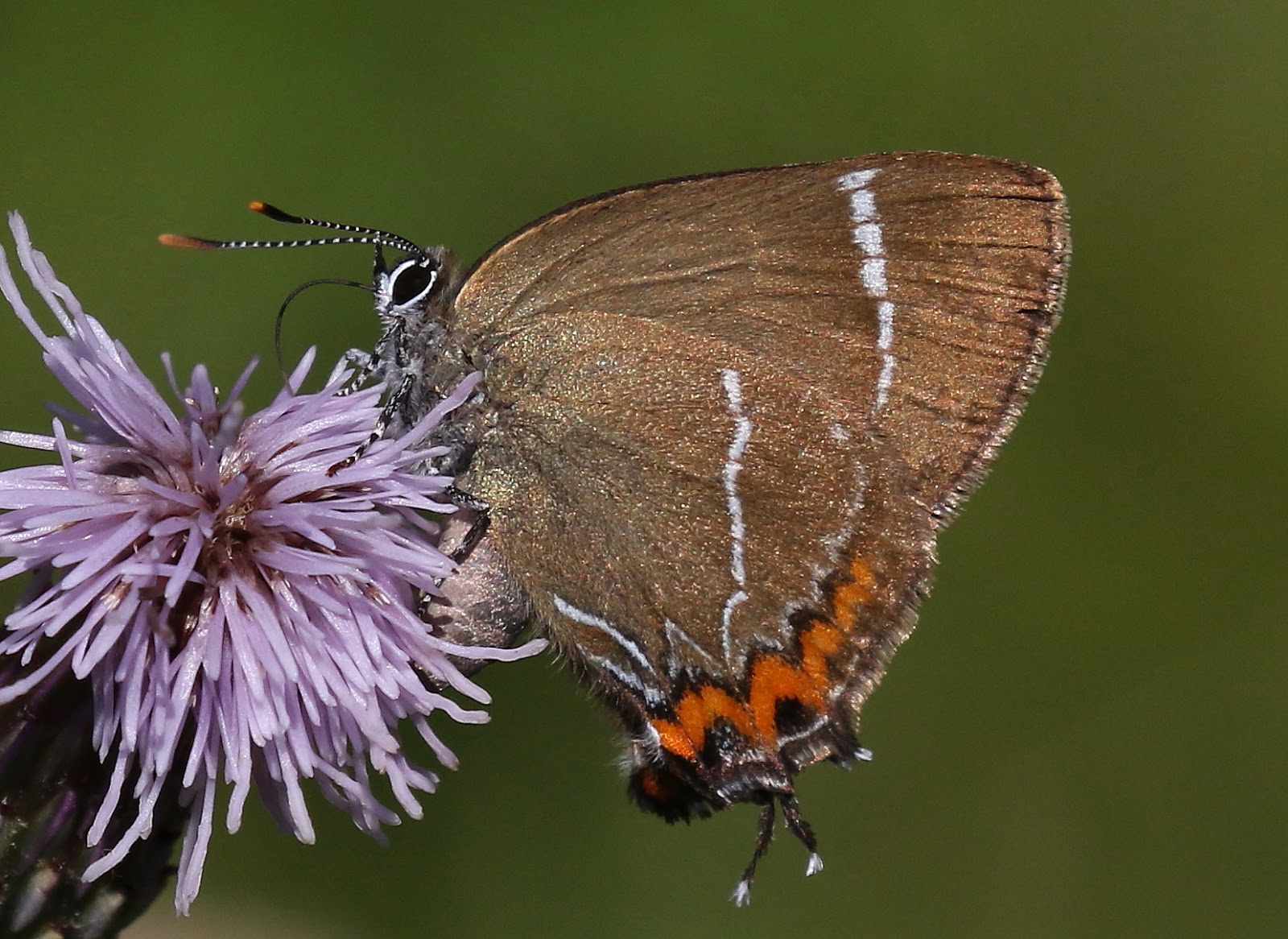
This White-letter Hairstreak was also in good condition - my first in Purbeck (14 July) 
The underwing of this Silver-washed Fritillary reminds me of  the iridescent lining of a mollusc's shell (Purbeck, 14 July)
An Essex Skipper in my tiny town centre garden was a surprise
The antennae tips look dipped in ink with black undersides
Attracted into the garden by our fine display of drought-resistant lavender
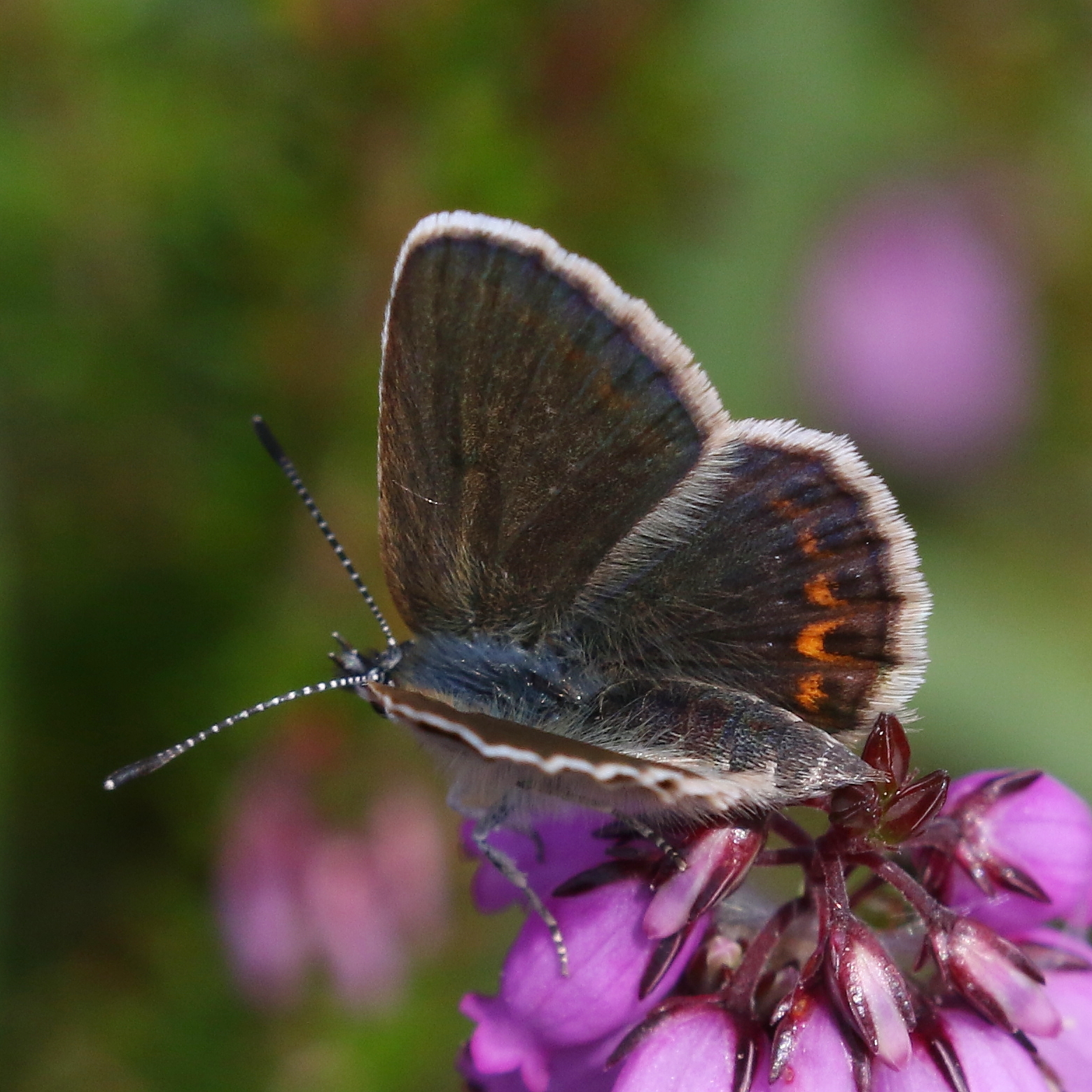
Silver-studded Blues emerged in good numbers on the Dorset heaths this year - this a male...
...and this a female (Studland, 24th June)
Silver-studded Blues have also been dispersing to non-traditional sites, presumably a function of the heatwave
Note the silver studs on the hind-wing of this female
White Admiral also appears to have had a good summer - this one was at Queen's Copse near Wmborne (23 June)
I visited there shortly after the White Admirals had emerged
'Who doesn't love a White Admiral underwing' I asked on Twitter. 114 kind souls agreed!
A business trip to Northern Ireland provided my first opportunity to see the Cryptic Wood White - having seen all the other regularly occurring species in the UK, this was a highlight of the year for me
There was a good colony at Craigavon Lakes, a grassland site well managed for the butterfly by Craigavon Borough Council (8 June)
We even saw a Cryptic Wood White egg-laying - I don't carry a macro lens so this photograph came out surprisingly well
An evening visit to the extraordinarily beautiful Murlough NNR enabled us to catch up with the Irish form of Marsh Fritillary (7 June) - this an iPhone photo
Adonis Blue at Dancing Ledge on 1 June - a species which doesn't cope well with drought conditions
And here's the English form of Marsh Fritillary (Cerne Abbas, 26 May)
Possibly my favourite fritillary underwing - Marsh Fritillary at Cerne Abbas on 26 May
Marsh Fritillary, Cerne Abbas
A fresh Brown Argus at Cerne Abbas (19 May)
Duke of Burgundy, Cerne Abbas (19 May)
The Duke is another species for which there is concern that the foodplant may be suffering in the drought, causing problems for the caterpillars
Small Blue was doing well this spring on the Weymouth Relief Road verges - more good local authority management by my former employer Dorset County Council
The Small Blue colony is thought to be one of the largest in England - and there were none there at all in 2011 (photo taken 18 May)
So the warm weather has certainly been kind to some species - but there are growing concerns about the impact of drought on the next generation: all the more reason to submit your records for the Count.

Sunday, 10 September 2017

Ragged royalty

Barra for an American Redstart would have been a bridge too far this weekend: Brighton was a more practical destination to see a new species for me in Britain: a Queen of Spain Fritillary butterfly. It's difficult to believe that almost eleven years have passed since I saw my last new British butterfly. That was a Monarch, one of which was just around the corner from a Long-tailed Blue I found earlier in the day on the Isles of Scilly back in October 2006. A few days after that, a Queen of Spain Fritillary was also seen on the islands near the Trenoweth flower farm but despite much searching I was unable to find it.
Male Queen of Spain Fritillary - it looks like it survived a bird attack judging by the state of hind-wing on the right hand side
A slightly more flattering photograph of the fritillary showing the most intact hind-wing
Details of a sighting of three of these rare migrants at Halcombe Farm near Piddinghoe first emerged two weekends ago and was immediately of interest. Unfortunately, the news broke the day before the gloriously sunny Bank Holiday Monday - not the sort of day you want to be driving along the south coast, and I couldn't get away in any case. Last weekend was equally compromised, as being on call for emergencies meant that I was unable to leave Dorset.
The species is known for spending much of the time basking on the ground: this one was no exception
A brief bout of nectaring provided one of the few opportunities to get a shot of the bold silver spots on the underwing
Discussing the survival chances of the fritillaries with Phil Sterling during the week, he was pretty convinced that unless the weather turned really foul, they would still be present this weekend. So with one eye on the forecast, and the other on Butterfly Conservation's excellent Sussex branch website, I resolved to go on Saturday as full sunshine was promised throughout the morning. Internet updates suggested that two individuals were still present on Thursday, both looking more than a little worn, and that was enough to persuade me to make the effort of an early start to beat the traffic yesterday morning.
This Clouded Yellow was one of 15 butterfly species on view at Halcome Farm
Comma
I arrived at Halcombe Farm around 0900 and began combing the area around a bonfire which was being used as a lek site by the fritillaries - all three having been identified as males. As the morning warmed up, a Clouded Yellow landed nearby but there was no sign of the fritillaries. Other butterflies, and then another butterfly watcher, arrived. We split up and shortly before 1000 he gave me a shout to indicate he had found one.
A female Adonis Blue was lying low in the grass
A male Common Blue was easier to see
Queen of Spain Fritillary is reasonably common on the near continent but still very rare in the UK with just a few hundred records and a small number of unsuccessful attempts at colonising documented. So despite the slightly ragged appearance of the visiting royalty, I was very glad I got to see one of the trio before their inevitable demise, particularly as the famous bonfire is apparently scheduled to go up in smoke within a matter of days.
Small Copper
Small Heath
Well done and thanks to the diligent transect walker, Dave Harris, who first discovered them, to Neil Hulme for getting the news and directions out to the wider world, and to the landowner Colin Appleton for allowing access to the site which has provided a lot of pleasure to many visitors over the last fortnight.
Brown Argus
Painted Lady - another migrant at Halcombe Farm
The bonfire adopted by the Queen of Spain Fritillaries

Monday, 23 May 2016

Sunday Blues

A late 'winter' cold put paid to any thoughts I may have harboured about wandering further afield this weekend, so I indulged myself on Saturday with Lemsip and a lie-in. Suitably refreshed and a little stir crazy by Sunday, I managed a gentle stroll around Ballard Down to get my quota of fresh air, flora and fauna. Encouraged by the results I have been getting recently with my '1st summer' 100-400mm lens, I also aimed to get some more butterfly photographs. And very rewarding it was too, despite the imperfect weather, with some interesting colour variants of female Adonis Blue among the highlights.
Female Adonis Blue - one of the bluest I have seen, a mesmerising aberration - apparently this is more common in spring broods
Another striking individual - even bluer than the one above, but with orange hindwing spots reduced in brightness - nectaring on Horseshoe Vetch, which is also the larval foodplant
A more conventional female Adonis
The stunning male Adonis Blue
A number of males were quite approachable in the cool conditions of Sunday afternoon
And finally, a pair of Adonis Blues doing their bit for the next generation
A male Common Blue - more lilac in colouration than the Adonis, and note how the white outer fringes to the wings are unbroken by black marks
A Common Blue roosting up in overcast conditions
This is a female Common Blue - like the female Adonis above, this one is at the bluer end of the spectrum

Don't be fooled by the name 'Brown Argus' - this was the third species of blue I saw on the wing at Ballard Down
Brown Argus underside - they were relatively inactive in the overcast conditions

Fortunately, this provided the opportunity for close study of roosting individuals - I love the rich orange spotting on the underside