Success with the
PG Tips, and a full Sunday roast with all the trimmings prepared by yours truly, sent us out into the field with a spring in our step on Monday 2 October. Part of the appeal of Shetland in autumn is that, due to the relatively high proportion of rarities to common birds on the islands at this time of year, and the relative paucity of observers, the visitor has a reasonable chance of finding their own good birds. Even a duffer like me could understand this, and that very morning I found my first Red-breasted Flycatcher in Swinister Burn, a short walk from our accommodation.
 |
| Little Bunting, Grutness |
 |
| An attractive bird with a neat crown stripe |
 |
| The Little Bunting showed during a welcome spell of sunshine... |
 |
| ...and provided brief but excellent opportunities for photographs |
 |
| Red-breasted Flycatcher, Swinister Burn - my best 'find' of the week |
 |
| Twite, Grutness |
Splitting up to cover more ground whilst maintaining contact was an important part of our game plan, and in this we were greatly aided by the loan of a set of CB radios from Jonathan Lethbridge, better known on the interweb as the
Wanstead Birder - thanks Jonathan. These marvellous bits of kit saved a lot of faffing with mobile phones and hedged against the risks of an often intermittent mobile phone signal on Shetland (in saying that, I'm not having a go Shetland, it's still better than my house in Wareham!).
 |
| Only on Shetland - I couldn't work out why the lens wouldn't focus on the RB Fly - it was being photo-bombed by a Yellow-browed Warbler! |
 |
| Spotted Flycatcher, Swinister Burn |
 |
| Several Redstarts were near the Sumburgh Quarries - this a male... |
 |
| ...and this a female |
 |
| Twite at Grutness |
 |
| Twite at Grutness |
Not only did the CBs enable us to stay in constant contact, they proved a useful means of holding a verbal referendum on whether to keep thrashing the adopted patch, or knock it on the head and go look at other people's birds! So it was that when the Red-breasted Flyatcher refused to show for the rest of the team we quickly agreed to move on to pastures new. Specifically, to Grutness near Sumburgh Airport, where a Little Bunting had been seen. This sat out superbly for us in the sunshine on a lichen covered wall - a photographic highlight of the trip.
 |
| Chiffchaff, Grutness - one of several tired migrants which appeared to have just arrived, making them easier to approach |
 |
| A nettle patch at Grutness was bouncing with migrants - including this female Blackcap... |
 |
| ...a male Blackcap... |
 |
| and several Goldcrest |
 |
| Taking the idea of the 'tyred migrant' too literally perhaps? |
 |
| A House Martin was battling in the strong wind at Grutness |
The wind was still whistling past nearby Sumburgh Head: too breezy and explosed for a seawatch but we still managed three Long-tailed Ducks and a pod of dolphin. Howard called them initially as Rissos's but revised the identification to Bottle-nosed as the characteristic body scarring of Risso's was not visible. I grabbed some record shots and while pretty convinced they were not Bottle-nosed, they didn't look like Risso's either - I expected that species to have a flatter front end rather than the stubby snout revealed by the pictures.
 |
| This Common Seal was just off the beach at Pool of Virkie... |
 |
| ...as was this much larger Grey Seal |
 |
| Grey Plover, Pool of Virkie. Compare to... |
 |
| Golden Plover, seen in roadside fields later in the day |
 |
| Ringed Plover, Grutness |
 |
| The spray here illustrates the strength of the wind |
Posting the sighting as Bottle-nosed Dolphin that evening, Howard was contacted by
Hugh Harrop who advised that this species would be a rare sighting in these waters. After an exchange of photos he confirmed they were indeed Risso's, a fact we could now see for ourselves when looking at pictures online of younger Risso's which show a stubby nose and a lack of body scarring, which is acquired by battling adults later in life. I had never seen Risso's Dolphin before, so with a new mammal to add to the new bird of the previous day it felt like we were on a roll.
 |
| Turnstones, Pool of Virkie |
 |
| Dunlin in the seaweed at Pool of Virkie |
 |
| Ringed Plover, Poole of Virkie |
 |
| A couple of Goosander were just offshore at Pool of Virkie |
 |
| Risso's Dolphin, Sumburgh Head |
 |
| The first Risso's Dolphins I have seen |
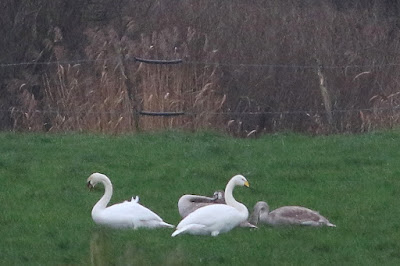
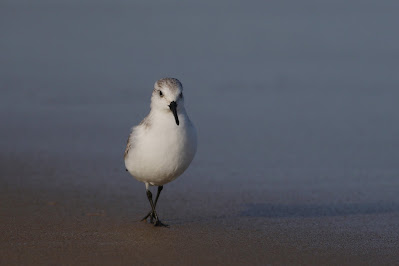
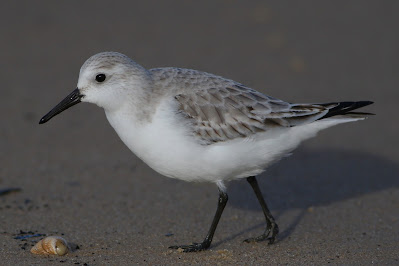
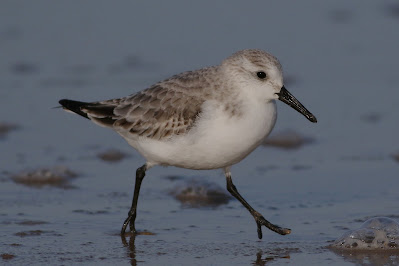
The weather had taken a turn for the worse by this time, so we returned to birding from the car: Loch of Spiggie held a flock of elegant Whooper Swan; Loch of Hillwell an even more elegant and long-staying Common Crane; and a good selection of waders at Pool of Virkie included singles of Curlew Sandpiper, Grey Plover and Sanderling. Best wader of the day though was a Little Stint, discovered in the improbable location of a puddle in a farm entrance at Noss. An eventful day then, with a good find, a new mammal and an excellent supporting cast. The morning would see us chasing another Shetland rarity - come back soon to find out what.
 |
| Whooper Swans, Loch of Spiggie |
 |
| Common Crane, Loch of Hillwell |
 |
| Little Stint, Noss |
 |
| Little Stint, Noss |
 |
| These rusty rods became famous this time last year when Britain's first Siberian Accentor chose to perch on them in a Scousburgh Quarry |
 |
| The runway at Sumburgh Airport - traffic lights stop cars on the main road when the runway is in use |
 |
| A dramatic Shetland landscape |
 |
| One more of the Little Bunting with a halo reflected from a passing plane at Sumburgh Airport |