Showing posts with label Dark-bellied Brent Goose. Show all posts

Tuesday, 16 January 2018

A day out with the buoys

On the Saturday before last I took the boat to Brownsea for a rare winter landing trip. This is usually a great way to get close to waders in front of the hides, and in the days before Christmas, my old friend Hamish Murray, now Dorset Wildlife Trust's Conservation Officer, had been getting great photographs of the long-staying Stilt Sandpiper which had relocated there after extended stays at Lodmoor and Middlebere.
Great Northern Diver, Poole Park. Bonus points for naming the species of crab.
Great Northern Diver, Poole Park 
Unfortunately, on the day of my visit one of the pumps which manages the water levels had broken (pull your finger out, Hamish ;-), and the only waders on the unusually full lagoon were huddled way out on the islands in the middle. Compensation for this slight disappointment came in the form of plenty of good birds, a hunting Peregrine, the resident Red Squirrels and, best of all, the discovery of a Great Northern Diver crabbing the shallows in the unlikely location of Poole Park lake, which I had checked out before boarding the Brownsea boat. I was short of both time and light on that occasion, so I returned this Sunday for another look. It seemed that my luck had run out as park staff were collecting buoys from the Diver's favoured area, pushing it out to the centre of the lake.
Peregrine hunting on Brownsea lagoon, 6th June
Record shot of female Velvet Scoter south of Brownsea, 6th June
After scanning Holes Bay and finding it relatively empty, over a spot of lunch I decided on a change of scene and headed for Ferrybridge, a favourite area for birding at this time of year. I checked out Portland Harbour and photographed some distant Black-necked Grebes before heading for Chesil Cove, where Black Redstarts have proven photogenic in each of the last two winters. On arrival some passers-by suggested I look out for a whale or dolphin in the Cove which they had seen a few minutes earlier, and which they thought might be dragging a buoy from one of the many lobster pots in the area.
Red Squirrel, Brownsea Island
Red Fox, Holes Bay
I scanned the Cove and saw nothing, but looking further out I eventually picked up what looked like an orange buoy creating a bow wave as if being dragged through the water. Then at some considerable distance I saw a cetacean blow, and a small dorsal fin break the surface. It came up a couple more times and, bearing in mind my track record of not being able to identify things off the West Cliffs of Portland, I thought I had better take a photograph in the hope that would help.
Drake Wigeon, Holes Bay
Wigeon, Holes Bay
Within minutes a work colleague who volunteers for British Divers Marine Life Rescue arrived to follow up reports of a whale, suggesting that it had been seen by others before my arrival at the Cove. I checked my photos from which it was clearly a whale of some description while my colleague phoned an update to BDMLR based on what I had seen. We scanned some more but the whale did not resurface. I phoned Martin Cade at the Portland Bird Observatory to encourage him to keep a look out as the whale seemed to be heading broadly away from us and in the direction of the Bill. Sadly I did not see it again, and neither did Martin from a vantage point on the West Cliffs. By now the light was fading and I was still not quite sure what I had seen, but studying the photos through my inverted bins the shape of the dorsal fin started to remind me of the Humpback Whale I saw last February in Devon with Steve Smith. However, I lacked both the expertise and the reference material to be able to eliminate other species on the strength of that. On returning home and emailing the photos to various experts, however, my suspicions were confirmed when they positively identified it as a Humpback Whale.
Black-necked Grebe, Portland Harbour
With the identification confirmed, I posted some record shots on Twitter and, Twitter being Twitter, copped a bit of flack for not putting the news out sooner, based, I trust, on legitimate concern for the welfare of the whale. So for the record, I had the whale in view for just a few minutes, and within minutes of my sighting, BDMLR, who were exactly the people who needed to know about it should some kind of rescue mission be required, were on the scene having already heard the news from elsewhere. Given that the whale appeared to be heading strongly out to sea, and that the light was fading, there was not much more they or anyone else could have done to come to the whale's aid that afternoon.
Dark-bellied Brent Goose, Portland Harbour
I could perhaps, with hindsight, have got news out more quickly of a 'brief sighting of cetacean sp.' which, at that point, I could neither see nor identify - but if it's any comfort, anyone racing down to the Cove on the strength of that would have been disappointed. Anyway, let's hope it has freed itself and comes to no harm. There has been a lot of local media interest (best Q&A thus far - Interviewer: 'How big was it?'; me: 'Err, whale-sized?'.) and I asked the journalists I spoke to to give prominence to the marine conservation organisations like Marine Life and BDMLR who can give the best advice on reporting any future sightings. I am pleased to say most of them have done that thus far.
My distant record shot of the Humpback Whale - described (with some justification) by the breakfast DJ on Radio Solent as 'underwhelming' in photographic terms. A tad ungrateful though as I gave permission for him to use it on his website!
Black-tailed Godwit, Holes Bay

Sunday, 12 March 2017

Winter highlights: the waterbirds

As the early spring migrants start to trickle in, it's time to look back at a few highlights of the winter. First up, some waterbirds and waders from around Dorset over the last few weeks.
Purple Sandpiper, Shell Bay Ferry Terminal
One of two Purple Sandpiper feeding on the ferry slipway at Studland yesterday
An engaging species to watch up close as it dodges the incoming waves
Much earlier in the winter a flock of Goosander spent some time fishing close in to Hamm Beach in Portland Harbour
Nine birds in the flock the day I was there
Red-breasted Merganser, also in Portland Harbour
Male Red-breasted Merganser
Also that day a trio of Pale-bellied Brent Geese were with their Dark-bellied cousins at Ferrybridge
Quite easy to pick out among the Dark-bellied Brents
Closer to home a Black Brant (far right) was at Middlebere with the Dark-bellied Brent flock
Again, easy to pick out when on its own; not so easy in with a flock of several hundred birds

Two of the eleven Barnacle Geese which spent much of the winter at Swineham
This Black-necked Grebe was in Shell Bay earlier in the winter...
...same species, same place, just a few weeks later


Sanderling dwarfed by a wave about to break on Studland beach
Purple Sandpiper

Thursday, 1 December 2016

January....

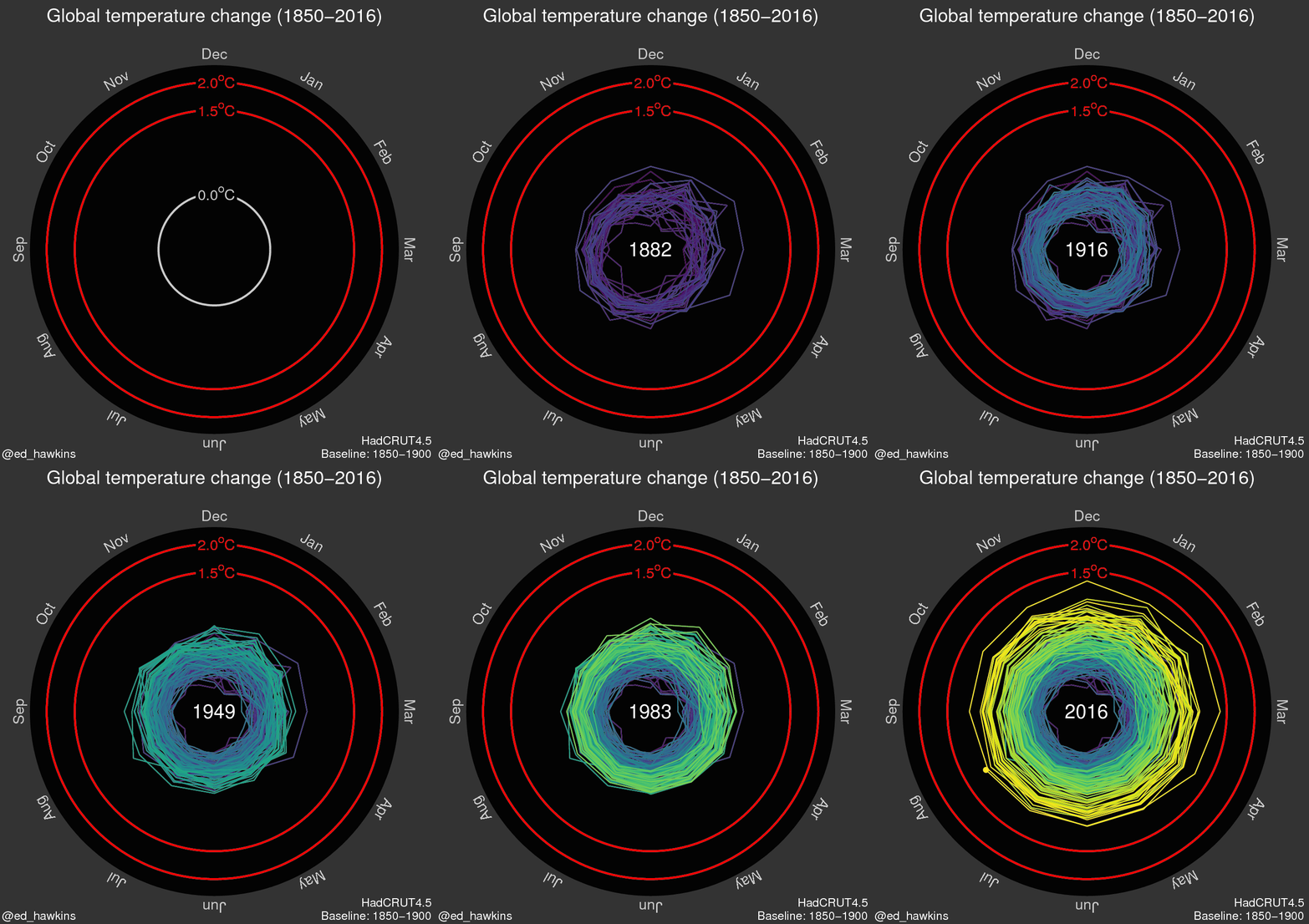
Good news readers, I've decided to spare you the usual epic 'review of the year' post in favour of reflecting on 2016 via twelve month-by-month instalments during December. So a bit like a crappy advent calendar without the chocolates. Starting, then, with January which was warmer than usual - something to do with this, no doubt: one of the scariest info-graphics of 2016. Anyway, enough of sobering but educational scientific diversions - this was the year, after all, that the free world decided it'd had enough of experts, facts and truth in general. As well as mild, January was also, as I recall, unremittingly grey, so wildlife photography was a bit of a challenge. A few willing subjects presented themselves though, most memorably:
Black Redstart - this handsome male brightened up a grey day at Chesil Cove. My January 'photo of the month' - and bird of the month
Female Black Redstart also at Chesil Cove
This Great Northern Diver spent the New Year just yards offshore at Baiter Park in Poole
Russian Dark-bellied Brents were on the playing fields at Baiter
Purple Sandpiper on the stone steps at Sandbanks
Marsh Tits were coming to feeders at Corfe Castle in January
Blackbird in a rare front at Swineham

Tuesday, 13 October 2015

Minimal effort

While the Northern Isles and Scilly have had their share of October rarities already this year, there haven't been many to chase within striking distance of home so far this month, apart from a flurry of goodies on Portland today while I was busy at work. But it was the desire for a change of scene, without much physical effort or lugging my gear too far, rather than desperation, which saw me heading off to Exmouth on Sunday morning where a Ridgway's Cackling Goose, Branta hutchinsii minima, has been present for the last few weeks.
Ridgway's Cackling Canada Goose: a bit of a mouthful, but worth a fortune in Scrabble.
A smart wee bird, whether tickable or not
A similar sized bird to the Dark-bellied Brents with which it was associating - conspicuously not with its much larger cousin...
...the more familiar, larger and lighter feral Canada Goose
Now before all the purists out there start castigating me for twitching untickable dross, let me explain. First, I like the Exe Estuary. Unlike Swineham, it is always full of birds, even if, like Swineham, some of them are escaped from wildfowl collections. Second, while I have seen presumed wild Richardson's Cackling Geese among flocks of Barnacles on Islay and at Caerlaverock, I'd never knowingly seen Ridgway's before, in or out of a pen. And third, I couldn't face trudging around the patch, and just fancied going a bit further afield without having to make much effort. The Exe is good for that: in several places you can just pull up and scope it.
The Ridgway's in context with the Brents
It took off with two Brents and headed out into the Estuary
A few Pale-bellied Brents (which breed in Svalbard, Greenland and Canada) like this one above, and a Black Brant (which breed in Alaska), were also with the Russian Dark-bellied Brent flock on the Exe - indicative of their ability to pick up all sorts of rough trade.

Brents on the Exe
The chances of the Ridgway's being accepted as a wild bird may therefore be slim, but, as finder Matt Knott points out in his blogminima breeds just a short hop across the Bering Sea from Russia, and the Dark-bellied Brent's breeding grounds on the Tamyr peninsular are about the same distance away from minima's breeding grounds in Alaska as their wintering grounds - albeit in the opposite direction. So, with a little imagination, it isn't wholly inconceivable that it hooked up with what is, on the face of it, an unlikely carrier species.
Sika Deer back near home at Arne
A little more bashful in the woods
Not much point in this leucistic Sika trying to hide - taken at Middlebere last weekend
Water Vole at Arne
After Sunday morning's jaunt, I was back home in time to watch number 1 son and the rest of Wareham Rangers U-13s retain their 100% league record this season, and take a walk around Arne with number 2 son and his mum. Sika Deer serenaded us in the woods, Spoonbills gathered by the dozen in the channels, and an array of autumn funghi presented endless opportunities to remind them via the medium of hackneyed puns that, despite going AWOL around this time of year in search of rare birds, I can still be a fun-guy to be with.
Some funghi
Some more funghi
Even more fun guys (groan)
Insert bad deer pun of your choice, I'm done here