Showing posts with label Red-breasted Merganser. Show all posts

Wednesday, 14 June 2017

Some Scottish specialities

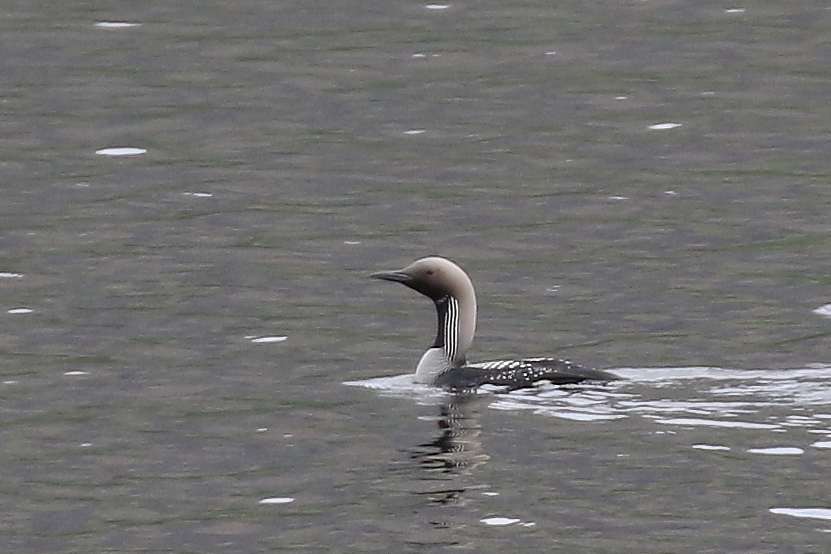
Before I was so rudely interrupted by a flurry of local and national rarities, I was regaling you with tales from our recent Scottish holiday. We'd done the star mammals and the cetaceans, so let's have a look at a few birds. I found a notebook recently from a childhood visit to Gairloch which recorded sightings of three species of diver - Red-throated, Black-throated and Great Northern. By the end of the first day of our recent trip there, I had seen all three species again in a short drive from our cottage on the southern shore of the sea loch to Red Point. Later I counted at least 10 individuals (mostly Red-throats) in one brief scan from the Big Sands campsite where we spent family holidays almost 40 years ago.
This immaculate Red-throated Diver was just off the beach of Red Point
Such a beautiful bird

Another Red-throat was just offshore at Big Sands 
Red-throated Diver flying past us at Red Point
Click to enlarge for a better view of the pinstriped neck pattern
Divers are one of my favourite bird families, combining sleek good looks with haunting calls and an exquisite choice of breeding habitats. It's bad form, not to mention illegal, to bother these protected birds during the breeding season too close to their nesting sites (typically islets on small lochans for Red-throated and on larger lochs for Black-throated), so my plan was to check out plenty of coastal and roadside habitat and hope for close views in areas where there was no risk of disturbance. An early morning visit to the vast shoreline of Loch Maree - the most important breeding site for Black-throated Divers in the country - produced very distant sightings of three birds, which nest on the large islands way out in the middle of the loch. A visit later in the day was equally unsuccessful as the lochshore was busy with kayakers - no chance of a close view in those circumstances.
A reasonably close view of not one...
...or two...
...but three Black-throated Divers on Loch Maree
You have to be a long way north to see Hooded Crow - this one was on the shore near Gairloch harbour
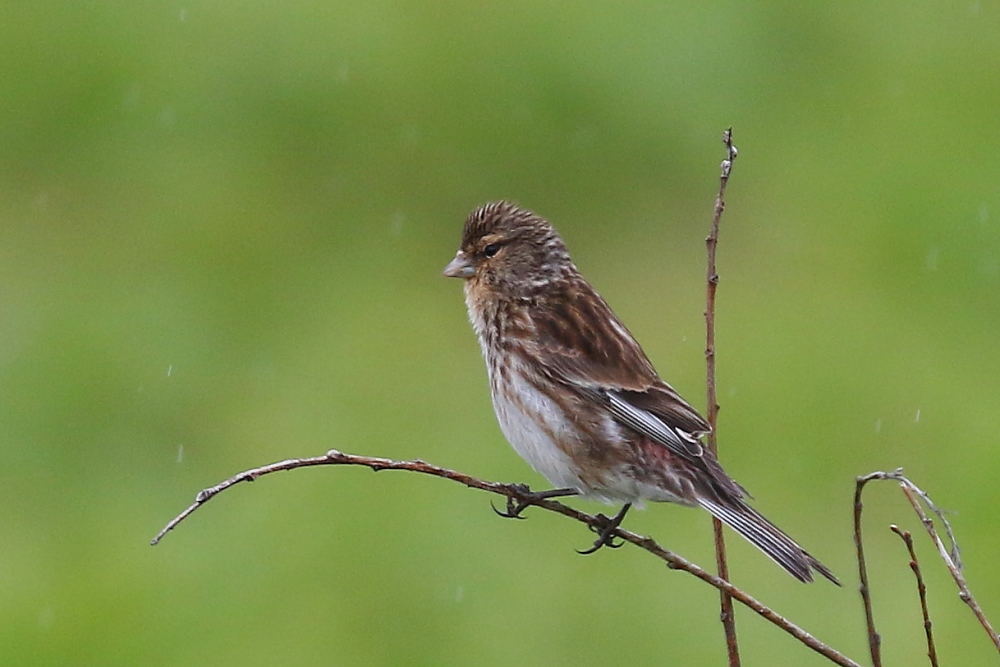
Twite was on my target list for the week - we saw just the one pair, in the rain along the north shore of Gairloch
On another day a couple Black-throats were snoozing close in to an inaccessible stretch of coast near Red Point. So despite good telescope views I was struggling for a photo of a breeding plumaged bird. Then a few days later, when at the south end of Loch Maree looking for dragonflies (more on that in a later post), in an area with few islands and therefore not where one would expect to see divers, not one, or two, but three Black-throated Divers sailed past, apparently too absorbed in each other to pay much attention to me as I fumbled with my camera settings on the shore.

Siskin in the garden of our holiday accommodation
Red-breasted Merganser flying over the sealoch
Skylark at Red Point
Repoll at Red Point - apparently we don't even have to worry about what flavour these days
Northern Wheatear with prey near Red Point
The Beinn Eighe National Nature Reserve, close to where we were staying, is home to another special bird I was hoping to see on our trip - Scottish Crossbill, the UK's only endemic species. A couple of quick visits to suitable habitat had produced nothing more than some distant calls, but a more leisurely stroll with the family around the woodland trail in the NNR was more successful: first a male Crossbill, then a pair. The various site guides I had suggested that Crossbills in this area ought to be Scottish Crossbill, but as I was not carrying sound recording equipment, I guess I can't really prove it. They were fairly chunky, and the calls sounded deeper to my ear than the Common Crossbills near home, so for the sake of argument and the want of a sonogram, let's just call them 'presumed' Scotsbill.
Presumed Scottish Crossbill
Scottish Crossbill has a chunkier more bull-necked appearance than Common
Tree Pipit, Beinn Eighe
I really enjoyed the general 'bumbling around' birding and bumping in to commoner species as well as seeing the local specialities - plenty of breeding Skylark, Siskin, Redpoll, Tree Pipit and Wheatear, all pictured above, were a delight to see. Stand by for one more post on the birds of Wester Ross and then we'll make our way down the food chain to the odonata and lepidoptera before closing the Scottish chapter at the very bottom of the ecological and moral web with an excoriating critique of the West Highland Midge...


Sunday, 12 March 2017

Winter highlights: the waterbirds

As the early spring migrants start to trickle in, it's time to look back at a few highlights of the winter. First up, some waterbirds and waders from around Dorset over the last few weeks.
Purple Sandpiper, Shell Bay Ferry Terminal
One of two Purple Sandpiper feeding on the ferry slipway at Studland yesterday
An engaging species to watch up close as it dodges the incoming waves
Much earlier in the winter a flock of Goosander spent some time fishing close in to Hamm Beach in Portland Harbour
Nine birds in the flock the day I was there
Red-breasted Merganser, also in Portland Harbour
Male Red-breasted Merganser
Also that day a trio of Pale-bellied Brent Geese were with their Dark-bellied cousins at Ferrybridge
Quite easy to pick out among the Dark-bellied Brents
Closer to home a Black Brant (far right) was at Middlebere with the Dark-bellied Brent flock
Again, easy to pick out when on its own; not so easy in with a flock of several hundred birds

Two of the eleven Barnacle Geese which spent much of the winter at Swineham
This Black-necked Grebe was in Shell Bay earlier in the winter...
...same species, same place, just a few weeks later


Sanderling dwarfed by a wave about to break on Studland beach
Purple Sandpiper

Tuesday, 17 January 2017

Birthday treats

It was my birthday recently - a stuttering but undefeated innings of 48, in case you were wondering. To celebrate almost half-a-century of under-achievement I cleared my professional decks, booked the day off work and did some birding around Poole Harbour. The children were at school and Claire was at work, affording me the luxury of neglecting the entire family to go looking for birds without guilt.
Lesser Yellowlegs at Lytchett Bay
Green-winged Teal, just leaving Lytchett Bay
Redhead Smew distantly in Holes Bay
The once fierce competition between Lytchett Bay and Swineham as Poole Harbour birding locations, a fire stoked in these pages on more than one occasion in the past, has tailed off somewhat in recent years. Lytchett has gone from strength to strength under sympathetic management by the RSPB, being diligently scoured by Top 10 Patchwork Challengers (impressive, though I still think Patchwork Challenge sounds like a needlecraft contest). Swineham has gone downhill under a less wildlife-friendly regime, being wilfully neglected by feckless regulars like yours truly. So much so that I felt barely a flicker of shame in shunning the latter for the former to go looking for Lytchett's two long-staying winter rarities from the Americas: a Lesser Yellowlegs and drake Green-winged Teal.
Dark-bellied Brent Geese at Baiter Park
Coot, Poole Park
Drake Goldeneye and Red-breaster Merganser were out in the middle of Poole Park lake
The Yellowlegs was easy enough, sitting out nicely with a Redshank for comparison, the only two medium-sized waders on one of the pools. The Teal required a bit more luck: it flew off just after I arrived, but not before a kindly soul had let me have a quick squint at it through his scope, hence the dodgy record shot above, hurriedly snapped as it pelted away. Around the corner a returning redhead Smew was in Holes Bay for its third winter, while Poole Park held a few photogenic fowl as always. I caught up with a trio of Great White Egrets slightly further afield at Longham Lakes before heading over on the Sandbanks ferry to complete a circuit of the Harbour.
A lone Black-tailed Godwit was on the shore of Poole Park lake
Little Egret, Poole Park lake
Three Great White Egrets at Longham Lakes
The last hour of daylight was spent at Studland, where the raucous calls of a couple of Sandwich Terns were a cruel reminder of just how far away is spring, and the even more raucous calls of the local Ring-necked Parakeets were an equally cruel reminder of just how far away and warm is their native India.
Ring-necked Parakeet, Studland
Sandwich Tern, Studland
I would say watching the sun go down at Studland completed the day, but that wasn't really the end of it as on arriving home there was a birthday present to play with: the US Capitol building from the Lego Architecture range. Quite repetitive assembling the orderly lines of neoclassical columns and other fiddly bits, but ridiculously satisfying, a pure indulgence, and, I am reliably informed by the teenager of the house, substantially more socially acceptable than making an Airfix model. The perfect gift for the middle-aged man-boy in your life.
The US Capitol Building courtesy of the Lego Architecture range - George Washington laid the first brick. If you listen carefully this model makes a strange whirring noise: the sound of a miniature George turning in his grave.

Friday, 4 March 2016

A dash of colour

A striking summer plumaged Bar-tailed Godwit has spent several winters in Poole Harbour, standing out among a flock of its congeners like a colour image superimposed on a monochrome movie. They roost on Brownsea Island and feed along Shore Road, but despite several close encounters with the flock at the latter site I have never seen the brick red individual close enough to photograph until recently. The light was somewhere between 'Joey Essex' and 'Donald Trump' (i.e. not very bright) but with some extreme over-exposure and patience I was able to get some reasonable pictures, despite both photographer and bird being battered by a strong easterly wind. A stunning plumage.
Earlier in the day I had the pleasure of helping out with spotting duties on a Birds of Poole Harbour family birdboat. Most of the families on board had the good sense to stay below decks out of the wind, and I felt I had let down the hardy souls who joined us up top as there wasn't too much to be spotted! That said, we saw some decent birds and got some great close views of species which would generally be seen more distantly from land. Highlights below.
Black-necked Grebe
Great Northern Diver
Male Goldeneye
Red-breasted Merganser (male)
Red-breasted Merganser (female)
Shag