Showing posts with label Red-throated Diver. Show all posts

Wednesday, 14 June 2017

Some Scottish specialities

Before I was so rudely interrupted by a flurry of local and national rarities, I was regaling you with tales from our recent Scottish holiday. We'd done the star mammals and the cetaceans, so let's have a look at a few birds. I found a notebook recently from a childhood visit to Gairloch which recorded sightings of three species of diver - Red-throated, Black-throated and Great Northern. By the end of the first day of our recent trip there, I had seen all three species again in a short drive from our cottage on the southern shore of the sea loch to Red Point. Later I counted at least 10 individuals (mostly Red-throats) in one brief scan from the Big Sands campsite where we spent family holidays almost 40 years ago.
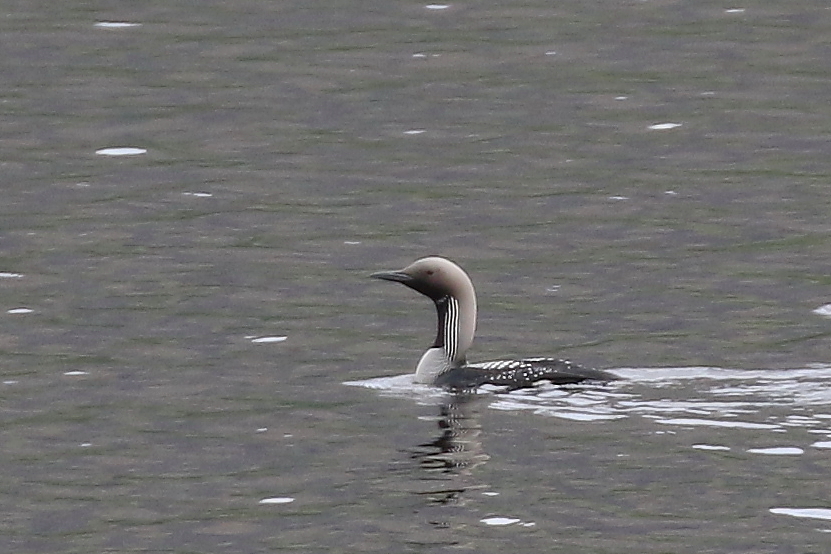
This immaculate Red-throated Diver was just off the beach of Red Point
Such a beautiful bird

Another Red-throat was just offshore at Big Sands 
Red-throated Diver flying past us at Red Point
Click to enlarge for a better view of the pinstriped neck pattern
Divers are one of my favourite bird families, combining sleek good looks with haunting calls and an exquisite choice of breeding habitats. It's bad form, not to mention illegal, to bother these protected birds during the breeding season too close to their nesting sites (typically islets on small lochans for Red-throated and on larger lochs for Black-throated), so my plan was to check out plenty of coastal and roadside habitat and hope for close views in areas where there was no risk of disturbance. An early morning visit to the vast shoreline of Loch Maree - the most important breeding site for Black-throated Divers in the country - produced very distant sightings of three birds, which nest on the large islands way out in the middle of the loch. A visit later in the day was equally unsuccessful as the lochshore was busy with kayakers - no chance of a close view in those circumstances.
A reasonably close view of not one...
...or two...
...but three Black-throated Divers on Loch Maree
You have to be a long way north to see Hooded Crow - this one was on the shore near Gairloch harbour
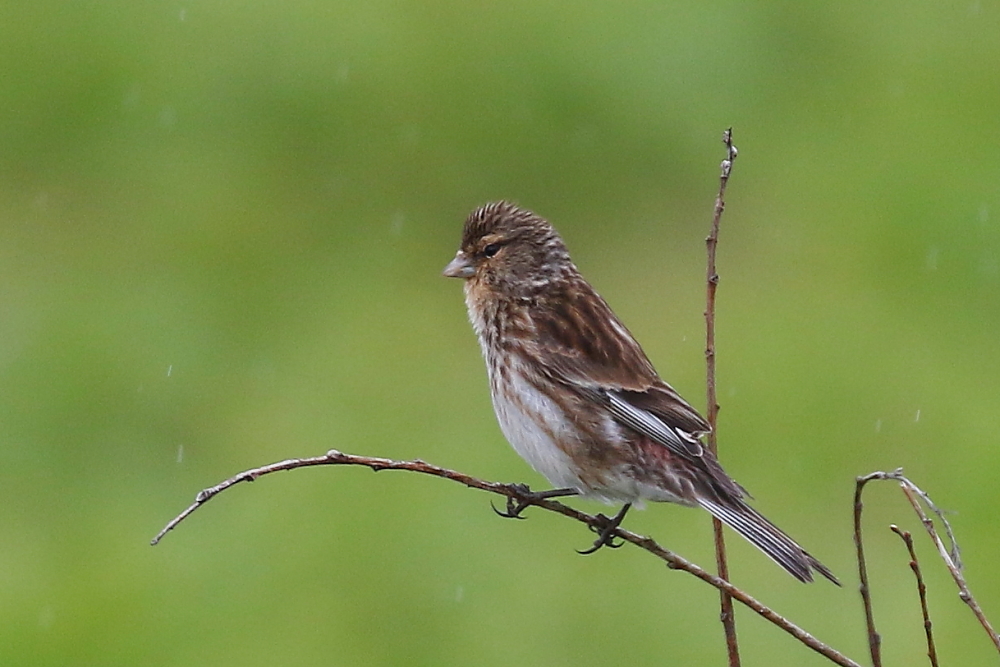
Twite was on my target list for the week - we saw just the one pair, in the rain along the north shore of Gairloch
On another day a couple Black-throats were snoozing close in to an inaccessible stretch of coast near Red Point. So despite good telescope views I was struggling for a photo of a breeding plumaged bird. Then a few days later, when at the south end of Loch Maree looking for dragonflies (more on that in a later post), in an area with few islands and therefore not where one would expect to see divers, not one, or two, but three Black-throated Divers sailed past, apparently too absorbed in each other to pay much attention to me as I fumbled with my camera settings on the shore.

Siskin in the garden of our holiday accommodation
Red-breasted Merganser flying over the sealoch
Skylark at Red Point
Repoll at Red Point - apparently we don't even have to worry about what flavour these days
Northern Wheatear with prey near Red Point
The Beinn Eighe National Nature Reserve, close to where we were staying, is home to another special bird I was hoping to see on our trip - Scottish Crossbill, the UK's only endemic species. A couple of quick visits to suitable habitat had produced nothing more than some distant calls, but a more leisurely stroll with the family around the woodland trail in the NNR was more successful: first a male Crossbill, then a pair. The various site guides I had suggested that Crossbills in this area ought to be Scottish Crossbill, but as I was not carrying sound recording equipment, I guess I can't really prove it. They were fairly chunky, and the calls sounded deeper to my ear than the Common Crossbills near home, so for the sake of argument and the want of a sonogram, let's just call them 'presumed' Scotsbill.
Presumed Scottish Crossbill
Scottish Crossbill has a chunkier more bull-necked appearance than Common
Tree Pipit, Beinn Eighe
I really enjoyed the general 'bumbling around' birding and bumping in to commoner species as well as seeing the local specialities - plenty of breeding Skylark, Siskin, Redpoll, Tree Pipit and Wheatear, all pictured above, were a delight to see. Stand by for one more post on the birds of Wester Ross and then we'll make our way down the food chain to the odonata and lepidoptera before closing the Scottish chapter at the very bottom of the ecological and moral web with an excoriating critique of the West Highland Midge...


Monday, 27 February 2017

Icelandic banker

Our recent half-term whistle stop tour of Cornwall saw me squeeze in some birding between visiting my god-daughter in Bodmin and friends in Falmouth, admiring the excellent National Maritime Museum at the latter among various other sights the county has to offer. One of the highlights was checking out a huge flock of gulls following the tractors of Polgigga as they made busy in the potato fields. Up to four Iceland Gulls had been reported in the area so I thought it would be a banker, but while I only caught up with one, at least it treated me to a close fly-past.
Iceland Gull at Arden-Sawah near Polgigga
I think a 2nd winter bird
Flying right overhead - note pale iris
Here with one of the tractors
It wasn't all as successful though. While at Bodmin, I nipped out to Dozmary Pool to see what I thought would be another banker - the long-staying, oft-returning drake Lesser Scaup. As you can see from the picture below, I couldn't see the pool, let alone the Lesser Scaup. A two hour wait by a hedge in the Nanjizal Valley looking for a Little Bunting was similarly unsuccessful, though at least there was no fog. Passing Choughs, a stunning male Hen Harrier and my first butterfly of 2017 - a Red Admiral - kept me entertained as I waited.
The sweeping vista of, er, fog at Dozmary Pool
Chough - one of a pair over Nanjizal
A male Hen Harrier hammered through Nanjizal
As is often the case it ploughed on without looking back
Red Admiral at Nanjizal
A bit of a rematch with another banker, the Hudsonian Whimbrel at Boat Cove, was successful, though it wasn't as close as on my visit this time last year. A few other waders were on the beach along with the mobile Whimbrel - soon to be downgraded from full species status as a result of changes to the British list.
Hudsonian Whimbrel at Boat Cove
Revealing the diagnostic all dark rump in flight
Grey Plover at Boat Cove
Curlew at Boat Cove
A couple of distant Red-throated Divers off Boat Cove
On the way home, after a bit of luck seeing an American Wigeon at Exminster without too much searching, there was just to time to take a short detour to look for a Little Bunting near Axminster. A couple of locals were looking for the Bunting when I arrived, and although it had been seen not long before, tales of them multiple dipping on this elusive bird did not leave me feeling very hopeful. The light was also fading, but with the rest of the family playing games on a variety of mobile devices in the car, I thought I would give it the last hour of daylight. After just half of this, a flock of previously unseen Reed Buntings flew up from the long grass, and as they alighted in the trees around me, one gave the distinctive ticking call of a Little Bunting. While it didn't exactly pose for a photo, I managed a couple of shots of it partially obscured by vegetation to cap off a good trip.
Little Bunting, Trinity Hill LNR near Axminster
It would not sit out in the open for me in a couple of brief views
This Reed Bunting was more obliging

Monday, 4 April 2016

Some different garden birds

When we left our tiny Wareham town centre garden behind on Friday, a Blackbird was tending to three newly hatched chicks, but apart from that there wasn't much to be seen in it by way of wildlife. Holidays mean a chance to see what turns up in someone else's garden and our lochside cottage on the west coast of Scotland this week is one of the better ones we've visited in that regard. As well as the moths, the birds are pretty good too.

Take this morning for example, when a goose-like call had me reaching for the telescope, through which two tiny dots in the distance materialised into a pair of Red-throated Divers, calling and displaying to each other. Black Guillemot, one of my favourite British birds, is also fairly common, along with Red-breasted Merganser, Eider and Goldeneye. We've stocked up the feeders, so tits and finches have been on the menu too. All very welcome, especially as it hasn't stopped raining since we arrived!
Male Bullfinch through the bedroom window
Female Bullfinch, ditto
Coal Tit in the garden
The Red-throated Divers were too far away to photograph until one was disturbed by a passing boat and gave a flypast
Black Guillemot - a pretty good garden bird
Woodland on the shore of Loch Creran
The view from the back garden

Saturday, 21 February 2015

Minsmere

The RSPB's flagship nature reserve at Minsmere was conveniently close to our temporary home in Suffolk for the last few days so deciding what to do on our first full day was an easy choice. The bird life was plentiful if not spectacular, with the odd scarcity among the expected wildfowl.
A pair of Whooper Swan (#98) were on the flooded Konik pony field
A Redhead Smew was roosting on one of the scrapes...
...it later flew it front of the Island Mere hide
Shoveler (#99) were plentiful on the scrapes
Greylag Goose making it's first appearance on the blog this year (#100)
Ringed Plover ditto (#101)
Chiffchaff - a poor photo included solely for the purposes of grinding the photo year list on another meaningless notch (#102) - and in case I forget to post one later in the year
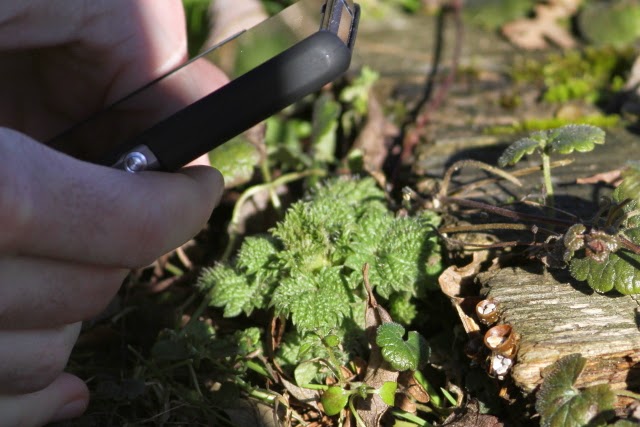
Despite seeing not much out of the ordinary, I did get one tick at Minsmere in the form of Bird's Nest fungus - named for how it looks rather than where it is found. There was a profusion of it on the boardwalk near the visitor centre but it was so small that I think we would have walked straight past it had it not been for someone else on their knees with a macro lens giving its presence away. 
The tiny and exquisite Birds Nest fungus
This picture gives some idea of scale
Marsh Harrier against the slightly incongruous backdrop of the Sizewell nuclear power station
This area is one of the strongholds of Marsh Harrier in the UK
There was precious little going on out at sea but a few Red-throated Divers (#103) were on the move
We stayed until dusk to watch to sun go down, and were rewarded with close views of feeding Common Snipe, a short Bittern flight, a couple of dozen Bewick's Swans coming in to roost and 3 Otter scudding distantly across the Mere.
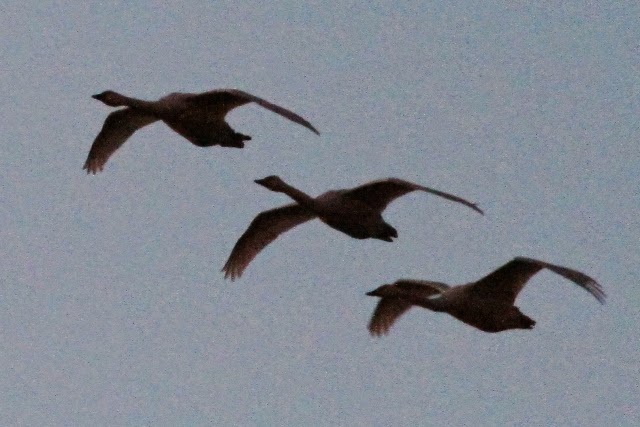
The Whooper Swans dropped in to the Mere as the sun was setting


Common Snipe
24 Bewick's Swans flew in to roost just as we were leaving for home
Dusk is a good time to see Bittern (#104) - this one just caught the last rays of the sun

The extensive reedbeds at Minsmere catching the evening sun
Marsh Harrier
Otters
Sunset at Minsmere