Showing posts with label Blackbird. Show all posts

Tuesday, 13 March 2018

A look back at the beast

In the excitement of blogging about patch Hawfinches, I almost forgot to recount everything else I saw during the cold snap in the Swineham/Wareham area a couple of weekends ago. In truth, there was nothing spectacular, but plenty of common or scarce species were turning up in unusual locations, some surprisingly easy to see as the harsh conditions forced them into gardens or otherwise into the open in the search for sustenance. The highlights were a Firecrest in my postage stamp of a town centre garden, and an icicle-clad Spoonbill on the main gravel pit at Swineham. Sadly, two of this last species were found dead in recent days in Dorset: one had presumably succumbed to the cold, the other, which had two broken legs, was thought possibly to have snapped them trying to free itself from ice. An illustration of the harsh impacts of the freeze which, judging by the death toll chronicled on social media, befell many individual birds over the course of a few days. And a reminder to put some food out for the garden birds if the coming weekend's forecast of snow materialises.
Adult Spoonbill - I have never seen one with icicles on the breast feathers.
Black-tailed Godwit, one of several hundred on the frozen fields at Bestwall.
A few dozen Curlew were also present.
Fieldfares were in the gardens of Wareham.
Redwings were everywhere, including my town centre garden and this one in the town's churchyard.
Blackbirds were among the other thrushes in the churchyard.
Normally shy Song Thrushes seemed unusually bold in the cold.
Not a great view of a Water Rail - but any view is a good view in the thick reeds at Bestwall. This was one of three of this species out in the open.
This was the only reasonably sharp photograph of the Firecrest in my garden I could manage, snatched through foggy glass with shaking hands!
The first time I have seen ice floes coming up the River Frome!
Swineham Point inundated by a very high tide - Redshanks, Skylarks, Meadow and Rock Pipits were attempting to feed on the ice here.

Within hours of the last snowflake, the onset of spring seemed to resume: temperatures were back up to double figures and this Dunnock was belting out song as if to declare it had survived the harsh conditions.

Thursday, 1 December 2016

January....

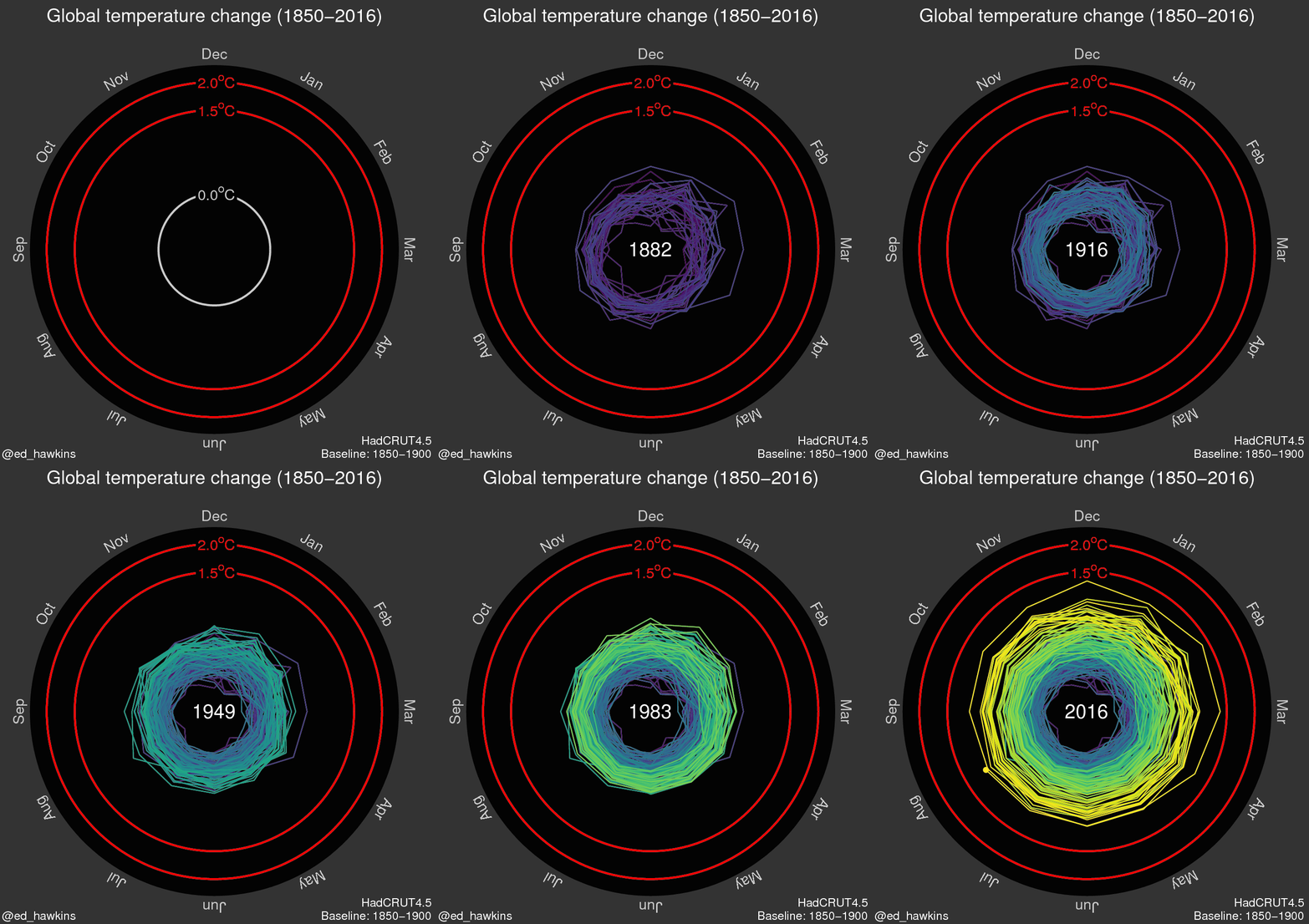
Good news readers, I've decided to spare you the usual epic 'review of the year' post in favour of reflecting on 2016 via twelve month-by-month instalments during December. So a bit like a crappy advent calendar without the chocolates. Starting, then, with January which was warmer than usual - something to do with this, no doubt: one of the scariest info-graphics of 2016. Anyway, enough of sobering but educational scientific diversions - this was the year, after all, that the free world decided it'd had enough of experts, facts and truth in general. As well as mild, January was also, as I recall, unremittingly grey, so wildlife photography was a bit of a challenge. A few willing subjects presented themselves though, most memorably:
Black Redstart - this handsome male brightened up a grey day at Chesil Cove. My January 'photo of the month' - and bird of the month
Female Black Redstart also at Chesil Cove
This Great Northern Diver spent the New Year just yards offshore at Baiter Park in Poole
Russian Dark-bellied Brents were on the playing fields at Baiter
Purple Sandpiper on the stone steps at Sandbanks
Marsh Tits were coming to feeders at Corfe Castle in January
Blackbird in a rare front at Swineham

Saturday, 2 May 2015

A rare sighting on the patch

By which I mean me: I haven't been to Swineham for ages what with important business to attend to, being the perfect husband/father, and a tiny bit of twitching. The long weekend is providing a bit more breathing space than usual though so I headed down this morning. It was pretty quiet, predictably, but a few decent birds and photo ticks for the year were on offer.
Whimbrel at Swineham Point
2 birds were present
After recent events in Somerset, I thought I had better check for the all dark rump of Hudsonian Whimbrel - sadly, it wasn't to be
A single Bearded Tit pinging over the reedbed (#165)
First Blackbird fledgling of the year
Blackcap
Don't often see Sand Martin on the deck at Swineham
A few Swift were over the gravel pits (#166)
Sedge Warbler

Monday, 20 April 2015

Also on Scilly...

The Great Blue Heron eclipsed most other news from Scilly this weekend, and while we missed what looked and sounded like a fantastic day on Sunday, there were still a few scarce species and migrants to catch up with after we left the Heron on Bryher on Saturday lunchtime. Best of these was probably a Jack Snipe which bobbed comically outside the ISBG hide at Lower Moors - on the pool which has had the privilege of playing host to both of Britain's Great Blue Herons.
Jack Snipe, Lower Moors (152nd species photographed in Britain this year)
Jack Snipe
Common Snipe for comparison - bill length and size the most obvious differences
As well as being on the first boat over to Bryher on Saturday morning, we were also on the first boat off at 1330, having spent several hours admiring the Heron. Although tempted by Tresco's Black Duck, it would have complicated the logistics and involved travelling back in an open boat as opposed to the covered luxury of the Falcon, so we headed straight back to St Mary's for a few hours leisurely birding before our return flight. If there were Scilly Shrews on Porthloo Beach they were keeping their heads down, though Wheatear, Whimbrel and White Wagtail provided an alliterative trio of birds to admire.
Wheatear, Porthloo
Whimbrel (#153), Porthloo
White Wagtail, Porthloo
Moving on to Lower Moors I saw my first Sedge Warbler of the year, hopping around the reed stems of Shooters Pool. I heard one on the way to work on Friday but didn't have time to stick around to look for it. A Heron dropped in out of nowhere but sadly it was not the Great Blue returning, just a regular Grey Heron. But it did give some idea of how awesome the views must have been for those fortunate enough to see the GBH from this spot.
Sedge Warbler (#154), Lower Moors
An obliging bird
The sound of the camera caught its attention
I have travelled to the islands many times in autumn, but it was the first time I had been there early enough in the year to see Bluebells. There was a good display of these and wild garlic in several places, the Old Town churchyard, where we failed to find a Wryneck, providing one of the best, along with close views of Song Thrushes, which are famously tame on Scilly, and the local Blackbirds.
Blackbird, Old Town Churchyard
Bluebells
Song Thrush, Old Town Churchyard
All too soon it was time to head back to the airport for our return flight. Sitting in the departure lounge tired, wind-blasted but happy, it was quite a contrast to the emotions of doing the same on the mainland 10 hours earlier. We approached Lands End in glorious sunshine, a fitting end to a successful and very enjoyable day.
Grey Heron, Lower Moors
Compare to the Great Blue Heron in the previous post
Swallows at Porthloo found rich pickings over a smelly bit of seaweed (#155)
Their flight speed dropped as they approached enabling a few shots to be taken

Thursday, 24 January 2013

Challenging behaviour

As if life-listing, year-listing etc weren't enough, birders have been signing up to various web-based challenges for the New Year - the best known being Foot-it and the Patchwork Challenge. Where I work, 'challenge' is a well known euphemism for 'pain in the butt'. This may explain why the former requires you to forsake the comfort of covered transport to trudge around in the cold earning your birds, and the latter to resist the temptation of distant and exotic rarities in pursuit of patch trash. I jest, of course, it's all good stuff to keep folk out of their cars and birding locally, though a bit worrying that some of us have to be goaded into walking by the promise of sticking it to our mates in a competition.

Blackbird in my tiny garden could have been bird #1 on the Foot-it list. If only...
Being disorganised and lacking competitive spirit, I didn't get my scat together to sign up for either. Don't get me wrong, I'm not against them, they just involved more statistical analysis than I was capable of. Foot-it, for instance, requires you to estimate the number of species you would normally expect to see within a given radius of home; then set a target number of species you hope to see on foot in the month of January; divide one by the other and times the result by a hundred to give a percentage; add your mother's age to that; and subtract the number of species other people have seen on your patch while you've been inside doing the maths. Or something like that. The Patchwork Challenge is even more complex, awarding points for relative rarity based on the numberwang scoring system.

One of five Brambling in a finch flock in Wareham. Where were you on the birdrace?

Despite this daunting complexity, lots of birders have signed up for the Patchwork Challenge, only to find themselves outnumbered by senior citizens who mistook it for a needlework competition. Just as well I didn't put my name down really as I note from the website that my birdracing team-mate Marcus Lawson has done so for the Swineham patch, and he always sees more there than me. Also taking part is our birdrace vanquisher Shaun Robson for Lytchett Bay, which I cruelly dissed in a recent post. This has the potential to turn it into something of a Lytchett v Swineham grudge match, in which I'm far too mature to take sides (Go Marcus!).

Dunlin don't often come this close at Swineham
Anyway, having missed the chance to sign up for either, now I feel ever so slightly left out and obliged to bang on about all the good birds I've seen within walking distance from home, if only to prove I didn't need an organised competition to get me out and about on Shanks's pony. Not to mention the opportunity to share with you the poor quality photos I have taken of them in the process. (Official excuse: there was no light).

Avocet: black-and-white patch magic in a grey world
Over the course of last weekend, for instance, around Swineham I was treated to 3 or 4 Marsh Harriers, a Barn Owl, almost 200 Avocet, a small flock of Brambling, oodles of Fieldfare, a couple of dozen Snipe plus an Egyptian Goose with a slightly half-bred looking mate which had relocated from nearby Holmebridge. No hesitation in slapping these on the patch list though on account of an earlier decision to accept diabolically low barriers to entry for waterfowl for this particular list. So, I guess I should wish all Foot-it and Patchwork Challengers the best of luck, and, relying as they must on personal integrity to make it a fair fight, hope that they apply higher ethical standards to their patch listing than yours truly.

Monday, 24 October 2011

A quieter day on St Mary's

After the madness of yesterday, today was a calmer affair spent re-acquainting ourselves with St Mary's. A walk with the family along the beaches of Hugh Town, Porth Mellon and Thomas' Porth produced a Common Seal and a Whinchat. Blackbirds were also very much in evidence - male birds on Scilly show a more reddish-orange bill and orbital ring than the same species on the mainland.
 
Common Seal - Town Beach

Whinchat - Porth Mellon

Blackbird - Thomas' Porth