Thursday, 11 April 2013

Patch neglect: treat it mean, keep it keen

A few weeks ago I suggested in this post that fleeting visits paying fickle homage to a patch were unlikely to be rewarded with good birds. Turns out I was wrong: a brief but fruitful visit to Swineham yesterday produced two coveted patch ticks.

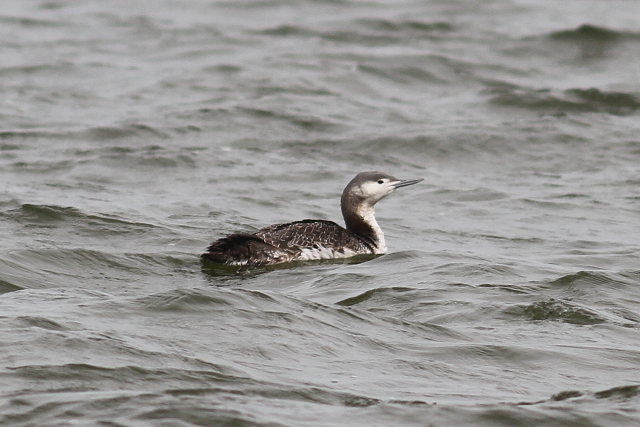
Red-throated Diver
Red-throated Diver
The first was a Red-throated Diver. This had been on the gravel pits last weekend while I was elsewhere, but I caught up with it in the Wareham Channel, just off Swineham Point. One had been seen in the area on and off during the winter, often far out in the Channel, but I had failed to clap eyes on it despite several visits.

Jack Snipe - shorter bill and shorter, more pointed tail than Common Snipe
Jack Snipe coming in to land
I turned to leave and a small wader burst from almost under my feet - it didn't fly far, but was in the air long enough for me to rattle off a few shots. Brutal cropping of these confirmed my suspicions that it was a Jack Snipe - another quality Swineham tick.

Shoveler

Shelduck
After a few unsuccessful attempts at flight shots recently I was beginning to wonder whether my new 7D camera was as strong on this score as my old 40D. Today provided some reassurance as it captured the Jack Snipe as well as could be expected from distance, and a few other subjects which were a bit closer, albeit in poor light.

Nuthatch
Cetti's Warbler taken at ISO 2000
Similarly, the new camera continues to cope better than the old one with lower light situations, such as the dingy corners of bushes preferred by the local Cetti's Warblers, an arch-skulker ever there was one. There has been some vigorous ditch clearance work in the Swineham area which has taken out a few of last year's preferred haunts for this species, but several were still present and vocal today. A couple of Swallows heading purposefully north hinted at the change of season - the last few days have definitely been rubbish spring days rather than rubbish winter ones. So, a pretty good haul for a mad dash, and all on foot from home. Low carbon, low effort birding at its best.

Tuesday, 9 April 2013

A rush of blood

I was out of county on Saturday on family business when two parties of Stone Curlews turned up on the West Dorset coast, and while I expected them to move on overnight, Sunday morning provided a slim chance to get this species on my Dorset list. I went for the pair at West Bexington which had shown well the previous evening, and eventually saw them in a stubble field with the help of the finder Alan Barrett and his fellow patch watcher Mike Morse. The birds were quite distant, but Mike had managed to check a colour ring combination which later revealed that at least one of them bred in neighbouring Wiltshire.

Skylark, Aust Warth
The plan for the rest of the day was to catch up with some other locally rare and scarce birds: Garganey at Radipole, Spoonbill at Lodmoor and Great Grey Shrike at Morden Bog. But then the pager reported a Killdeer in Lancashire. It is one of the iron laws of nature that a good bird will turn up just after my holiday comes to an end, but I thought I might have the jump on this one: it was just before 1100, and I reckoned I could be at the Killdeer site by 1530. Maps and crisp packets, along with reason and judgement, were swept off the dashboard and replaced with a satnav, which I set for Longridge and headed north.

Distant Stone Curlews at West Bexington, Dorset

A while later the pager reported that the bird had flown, but I ploughed on, and half an hour later it was back. I found myself uttering an involuntary 'Come on!'. Another half an hour and it was gone again, so it was clearly not a settled individual. At times like this, decisive action is required, so I pulled into the services on the M5 to procrastinate.

Short-eared Owl, Aust Warth
This second negative report saw my adrenaline levels plummet, the rush slowed and after a reflective cup of coffee I concluded that I might as well dip on Twite at nearby Aust Warth and save a tank of fuel as dip on Killdeer in Lancashire. So dip on Twite I did, and for a couple of hours. It was still a good decision as the Killdeer was not seen again all day, and at least there were Short-eared Owls to enjoy at Aust.
Shoveler, Ham Wall RSPB, Somerset
So with two sets of plans for the day not quite coming off, it was time for plan C: return home via the Somerset levels and try to photograph the long-staying Pied-billed Grebe. This was a bit more successful - the bird came quite close, albeit in poor light.

Pied-billed Grebe, Ham Wall RSPB, Somerset
More impressively, it repeatedly gave its distinctive call, a resonant yodel, puffing out a throat sac which seemed to double the thickness of its neck in the process.

The Pied-billed Grebe puffing its throat out and giving a haunting call
If the Little Bitterns return to breed on neighbouring Loxton Marsh this spring, you might be able to hear their distant dog-like booming at the same time as a Pied-billed Grebe calling - a collectors item for the sound recordists out there.

When wary, the Grebe would lie low in the water and not dive but submerge like a submarine with the body held horizontal - an interesting bit of behaviour
The penalty for all this tarting around was to miss a Red-throated Diver, one of my favourite birds, at home on Swineham Gravel Pits. While still present yesterday afternoon, it had gone by the time I got there at dusk, though a Barn Owl, a Marsh Harrier and a ringtail Hen Harrier were some consolation.

Me and the 'Peat Moor' centre on the Somerset Levels: made for each other
And so it was back to work today, secure in the knowledge that a full diary and an even fuller in-tray will prevent any further rushes of blood to the head, at least until the weekend.
Saturday, 6 April 2013

Pastures new

My parents moved to North Devon last year, a place that must have potential for good birds but from where not much seems to get reported. Being where it is there is always a chance of something good, as the Trumpeter Finch which relocated from Lundy to this stretch of coast in 2011 suggests. Yesterday's was a family visit rather than a birding trip but we managed to get out to Baggy Point and see a few birds between tea shops, beaches and car parks.

This Rock Pipit on Croyde beach looks a bit littoralis - very grey above, pretty white below, prominent supercilium with a hint of pinky wash about the face (but not so much on the breast) - but the more I read the more confused I get. Any help?
Same bird from a wider angle.
Different bird, even greyer and a bit more pink on the underparts
A smart male Wheatear near the Baggy Point car park
House Sparrow
White Wagtail in the same field as the Wheatear

Thursday, 4 April 2013

You wait for ages...

I've been back and forth to Portland this week like a quarry lorry. Blame the triple helping of Bluethroats. I did go specifically for the first one, but on my last two visits the damned things just kept turning up, each one more brightly marked than the last.

Wheatear, Chesil Beach
Wheatear, Portland Bill
First stop yesterday was at Ferrybridge, where a Kentish Plover present the day before could not be relocated. Then to an unpromising looking grassy patch at the south end of Chesil Beach which held at least 5 photogenic Wheatears. Onwards to Avalanche Road, where a pair of Ring Ouzels showed even better than at the weekend, though I had to lie down amid the horse dung on the edge of their chosen paddock to get the light behind me. Fortunately, like my fingers, most of it was frozen solid so didn't stick.

Ring Ouzel, Avalanche Road
A not very thorough twirl around a windswept Portland Bill added nothing of note to the day's sightings, and the third male Bluethroat of recent weeks had by then been relocated so I headed back to Chesil Cove for a look. As I approached a small group of waiting birders the Bluethroat flew past me and into cover. So I'd seen it, but not a great view.

Sandwich Tern, Chesil Cove
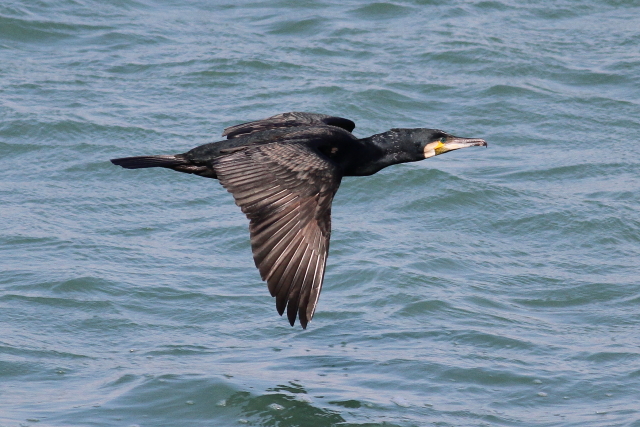
Cormorant, Chesil Cove
Sandwich Terns fishing in the Cove provided a welcome distraction while we waited and eventually the Bluethroat reappeared to feed on the shoreline rocks. Chesil Cove was sheltered from the worst of the cold winds, so it was good to thaw out in the presence of such a photogenic bird.

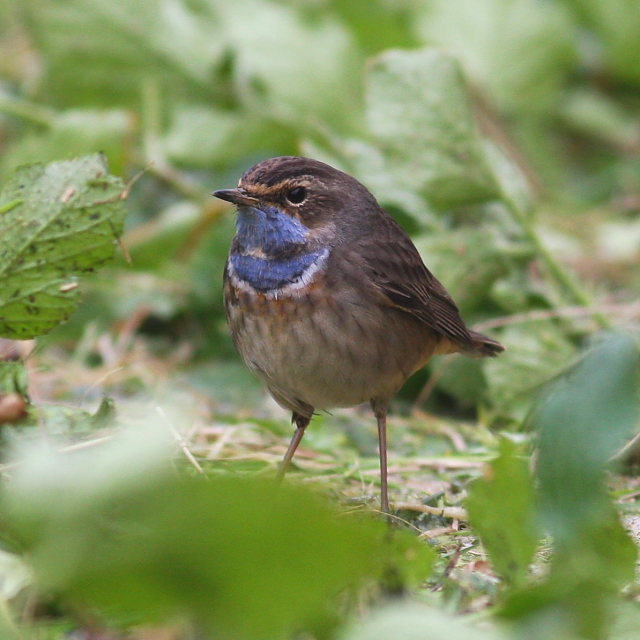
Bluethroat, Chesil Cove
This was a very flighty individual, and while it came briefly onto the path at our level it was soon flushed by some dog walkers back down to the beach below. When it comes to lying down in excrement for a photo, horse is one thing, but I draw the line at dog, and there was plenty of it to avoid it along this stretch of the West Weares footpath.
This bird showed a broader red breast band than the two previous males on Portland.
The white spot on the throat was also more obvious than the other two males
Nick Hopper and I were just leaving the main crowd behind and heading for our cars when the Bluethroat sat up in front of us on a rock. Portland stone has been used to builds citadels, castles and cathedrals, so it's good for many things, but making exposures easy for the photographer is not one of them, especially if the subject is a small brown bird on its sun-bleached surface. Churlish to complain though given how many opportunities the famous rock has presented to see this species lately.

Struggled a bit with the exposure on this one
A flash of yellow gape, as if red, white and blue weren't enough.

Monday, 1 April 2013

Footy and birds

The Bank Holiday weekend has been mostly footy and birds. Naturally, birds came first with a stunning male Bluethroat on Portland yesterday morning, the second in as many weeks. I think Portland now leads the rest of the country 4-3 on appearances of this species in the last fortnight.

Male White-spotted Bluethroat, Suckthumb Quarry, Portland

Portland v Rest of England on Bluethroats has certainly been a more closely fought battle than the lesson in passing football served up by a purring Wareham Rangers under-10s team to local rivals Lytchett yesterday afternoon. This bottom of the table six-pointer was held at a bitterly cold Turlin Moor, scene of a drive-by shooting in January. Son George had a good game, as did they all, in a 4-0 away win. For many of us long-suffering parents, as well as George himself, it was the first time we had been on the winning side.

Chiffchaff, Suckthumb Quarry, Portland

'What did it feel like to win'? I asked. 'Amazing', he said. In perhaps not the best parental sporting pep talk ever, I said 'so now you know what it feels like to nail a shot of a White-spotted Bluethroat'. It was certainly a more exciting scoreline, and a better game, than the dross on offer at Dean Court today in the Bournemouth (1) v Scunthorpe (0) fixture. The Bluethroat was pretty shy, and it could have found worse places to hide than the Bournemouth goal line which didn't see much action all afternoon.

Male Black Redstart, Suckthumb Quarry, Portland

As the home side were fighting for promotion, and the visitors trying to avoid relegation, a bit more passion might have been in order. George and I attended to keep Uncle Andy (a Scunny boy) and cousin Jack company. After a brief debate about which stand to go in, we settled on the away end partly out of family loyalty, but mainly because it provided better shelter from the relentless easterly winds. These have been getting a bit tiresome, but in their defence they have played their part in turning up more than the usual number of Bluethroats.

Male Ring Ouzel, Avalanche Road, Portland

Even Uncle Andy had to agree that the Rangers game was far better value for money - an average cost per goal of 50p compared to £31 at Bournemouth. At £2.20 for a cup of hot chocolate which half-breached the Trades Descriptions Act (hot, but precious little chocolate), the catering also compared very unfavourably to 50p for the perfect cuppa from Mr and Mrs Mitchell's Touchline Bistro at Wareham home games.

Female Ring Ouzel, Avalanche Road, Portland

Eddie Howe's self-proclaimed 'Barmy Army' (enthusiastic if unoriginal) sang 'Bournemouth 'til I die'. Given the average age in the seaside town, that can't be far off for some. Speaking of death, a tideline Red-legged Partridge corpse at Arne RSPB was the most noteworthy bird in a bracing walk this morning. Not wishing to remind the Scunthrope or Lytchett boys of their league prospects, I resisted the temptation to post photos of the rapidly decomposing corpse, and have included a selection of live subjects from yesterday on Portland instead.

Drake Red-breasted Merganser, Portland Harbour

Saturday, 30 March 2013

Get thee to a Nunnery

So said Hamlet to Ophelia, and if Ophelia wants to see a Black-bellied Dipper, it's still good advice. The Nunnery in question is in Thetford, home of the British Trust for Ornithology, and the bird has spent the winter nearby, next to Three Nuns' Bridges, off Nuns' Bridges Road, in case you hadn't got the nun-based influences on the area. I was guessing that one of the BTO staffers stumbled across the bird in their lunch hour and so it seems.

Black-bellied Dipper, Thetford
I was itching to road test my new Canon 7D, and what better way to put a camera through its paces than taking photos of a small dark bird in a small dark place? Taking photos of a small dark bird with a white breast in a small dark place full of shimmering water, that's how - a scenario guaranteed to test the exposure skills of even the best camera and photographer. The forecast was cloudy with sunny spells, which also boded well for trying out the new gear in a variety of light conditions.

For those who give a toot about such things, this shot taken in slightly better light at 1/200th sec, f5.6, ISO 400, tripod and shutter release cable. Same settings for the shot above except 1/125th sec.
After an early start from Dorset I was on site just after 0800.The Dipper took a little while to locate but the telltale sign of a man in camouflage gear lying in mud on the river bank gave it away.

1/160th sec, f5.6, ISO 400

Another dozen or so photographers then appeared from downstream - good to see a friendly face in the form of James Lowen among them - I thought they might be following the second Black-bellied Dipper which turned up at the same site recently, but it soon became clear they were in pursuit of the local Otters.

Otter. Shame about the twig. Life's too short for Photoshop. 1/640th sec, f5.6, ISO 1600
 
I joined them as a very compliant Otter swam around at close range and climbed out of the water amongst slightly less compliant vegetation. The light was still pretty poor so James and I returned to the Dipper to comfort it with the now familiar sound of whirring motordrives. It gave a few bursts of song in return, so clearly a male. After a couple more hours I had managed a variety of shots in degrees of light and shade, and used up all my memory cards, so decided to call it a day.
 
Otter. Aperture Priority (f5.6) 1/400th, ISO 3200)
So the wildlife performed, but what about the camera? This is not the place, and I'm not the man, for a full technical review, so let's just say I was very pleased with the results - sharp, good colour rendition in the circumstances, and capable of a very fast burst of 8 frames per second. It's also reasonably idiot proof, a bonus for the idiots among us.

The Dipper used this large stump mid-stream as a songpost.
I took a few test shots with the 40D just to convince myself I hadn't wasted my money on the upgrade, and they were reassuringly trashy. I shan't be pensioning it off yet though - as well as a treasured item, it'll make a pretty good spare body when I get the shutter button fixed.

Catching a rare bit of sunshine, allowing a dizzyingly fast shutter speed of 1/250th sec.
 The 7D was a bit grainier at higher ISO ratings than I was hoping for, but these were pretty extreme conditions, and I think my expectations were probably unrealistically high. I suspect I'll still be grateful at some point for the maximum ISO rating of 6400 compared to 1600 on my 40D. Any more criticisms? At this stage, I have to say Nun. See what I did there?

Just time to tick and run Stone Curlew in the Brecks on the way home, an early spring migrant overlapping with the not yet departed wintering Fieldfare (out of focus top right).

Sunday, 24 March 2013

Coming, ready or not

Hundreds of migrant birds seemed to decide yesterday that enough was enough, and, whether the weather in Britain was ready or not, they were coming anyway. After yet another week marred by illness, today I resolved to join them.
Wheatear: one of over 50 at Portland Bill today
On Saturday, Dorset's migration hotspots of Portland Bill, Hengistbury Head and, er, the drain behind PC World in Poole, were apparently buzzing with Chiffchaffs and Wheatears. Star of the show though was a White-spotted Bluethroat at Portland Bill, so I headed there first thing this morning.
This Black Redstart showed while the Bluethroat didn't
Portland this morning was as it should be: heaving with Wheatears. But after couple of hours standing around by the Obs quarry, where the Bluethroat had been the previous night, these and a Black Redstart were about all I had seen. A walk to the Top Fields produced a few Ring Ouzel and another came in off the sea as I headed back down to the Bill.
Goldcrest at the Bill
As I reached the car and was thinking of heading off, the pager reported that the Bluethroat was back, and after an undignified trot on my part and a short wait, it revealed itself in the quarry. It stayed hunkered down as a bloke with a strimmer, oblivious to the telescopes and lenses trained on him, stripped the vegetation from just above its head. Almost a red-spotted Bluethroat.
Male White-spotted Bluethroat
The strimming man eventually got camera shy and packed up, allowing the Bluethroat to return to feed on the path in full view. It was a tonic to be back out with my lens freshly back from the menders. Unfortunately, it turned out that the lens was fine, and it was the camera shutter button that was faulty all along. A shutter release cable circumvented the problem in the short-term, and an impulse purchase of a new Canon 7D online last night will do so in the medium-term.
The Bluethroat flashed its rufous tail sides aggressively at a Robin at one point
I made the mistake of discussing this purchase with several photographers present today, who told me what a crap camera it was, or that I'd paid too much, you know, just the stuff you want to hear when you've just sold a child to purchase consumer electronics...
Showing the leg ring fitted at the Bill yesterday
This was a Dorset tick for me and quite a few others present by the sound of it, and I headed home full of the joys of spring. Not even dipping on a Kentish Plover at Ferrybridge on the way back could wipe the smile off.